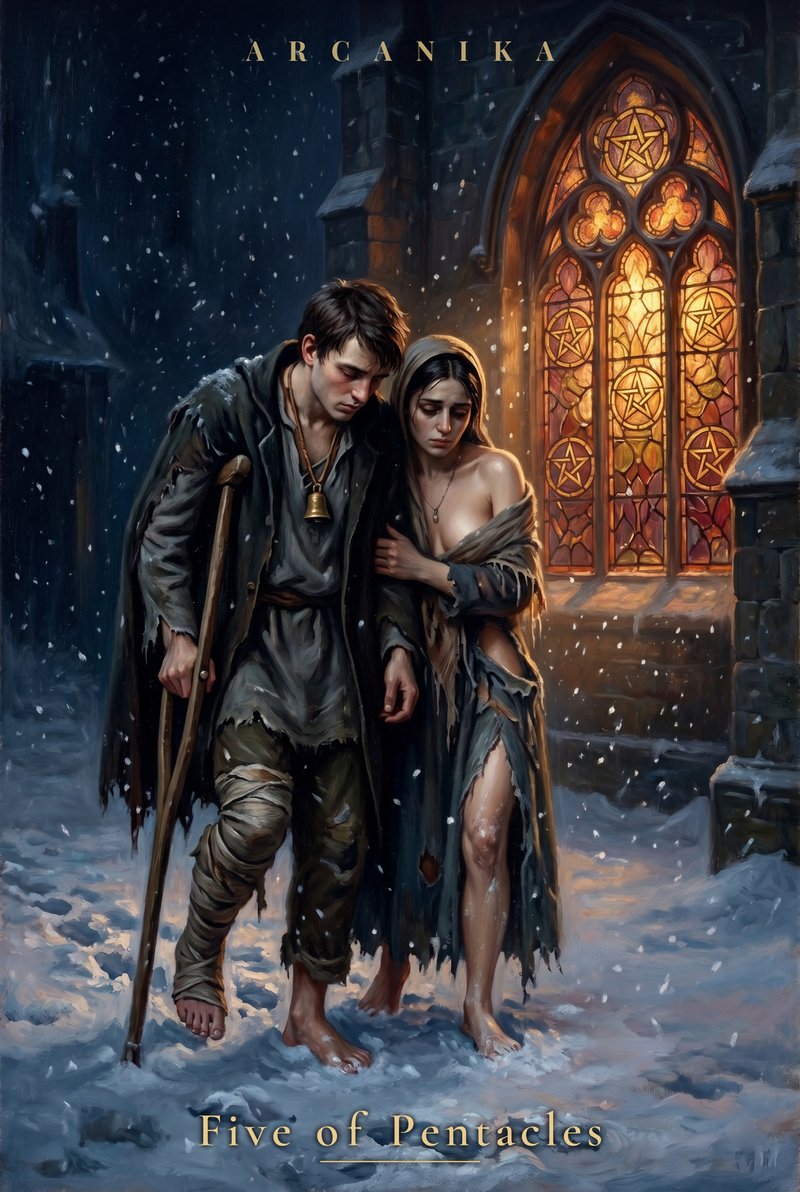
Through the snow, past the lit stained-glass window of a church, trudge two — a man and a woman, pressed together against the cold, half-dressed, in want; inside there is warmth and light, but the door seems not meant for them. Their bodies huddle closer in their shared misfortune. The Five of Pentacles is about deprivation, isolation, a hard stretch; about poverty not only of the body but of the soul — the feeling that you are left out, cast off, forgotten. This is the card of cold and lack: of money, health, warmth, acceptance. But in the way the two press together beneath the snow there is also the other side: in hardship people draw closer, and a shared trial binds tighter than a well-fed contentment. The lit window nearby speaks of help that is nearer than it seems, if you dare to ask or to step inside. The card says: you are cold and alone right now, and that is truly hard — but you are not alone, and warmth is close. Don't refuse the outstretched hand out of pride; hold to the one beside you. The warmest thing in the frost is someone's shoulder, when everything else has been taken away.
🪟Stained-glass window — Spiritual and material help that already exists and is freely given — but cannot be received by those who do not look up
🩼Crutches and bandaged foot — Physical suffering and vulnerability; the body's pain as a metaphor for any crippling lack — financial, emotional, social
🔔Bell at the neck — The traditional mark of a leper, signaling social exclusion; the internalized shame of poverty that makes one feel contagious or unworthy of aid
❄️Snow and cold — The stripping away of comfort and warmth; the season of exposure when everything hidden becomes visible, and survival demands more than pride allows
⛪Church threshold — The boundary between scarcity and sanctuary; the moment of choice — to enter or to pass by — that the card holds frozen in time
👥Two figures walking together — Shared hardship; the quiet solidarity of those who suffer alongside each other, and the paradox that even mutual blindness to help can be survived when it is endured in company
Interpretation
The Five of Pentacles sits at the intersection of real-world hardship and inner blindness. It is one of the tarot's most honest cards about suffering: it does not promise that misfortune is an illusion or a lesson in disguise. The cold is real. The injury is real. The hunger is real. And yet the card's genius lies in that blazing window — the help that was always there, that the sufferer could not see because their eyes were fixed on the ground. This is not a card of weakness; it is a card about how suffering itself creates a tunnel vision that makes recovery harder.
Within the Pentacles suit, the Five arrives after the stability of the Four of Pentacles — that figure who grips his coins so tightly he cannot move — and before the Six of Pentacles, the generous weighing of gifts and the first act of redistribution. The Four's hoarding creates the very brittleness that the Five shatters. The suit is telling a story: what happens when security becomes rigidity, and then breaks. The Five is the moment of fracture and exposure. Only after this passage can the reciprocity of the Six begin.
In a reading, this card appearing in the present position is a prompt to take inventory: what resources, relationships, or forms of support have you been walking past? It can signal financial difficulty, job loss, health challenges, or the loneliness of feeling cast out from a community. It may also point to an emotional pattern — the belief that help does not exist, or that one is unworthy of it — that is older and deeper than the present crisis.
When this card appears alongside The Tower, the collapse is sudden and total; the Five of Pentacles is often what follows — the aftermath, the figure standing in the rubble. Paired with The Hermit, the isolation is chosen and inward rather than imposed; the light the Hermit carries may be the very lantern the Five's wanderers cannot see. And next to Six of Pentacles, the narrative completes itself: the moment of receiving, the hand extended, the turning of a tide.
✦ Full InterpretationUnlock the card's full readingFree registration reveals the final paragraphs of the interpretation and gifts you ⭐ for your first spreadyour first spread is on us
Advice & forecast
✦ The card's advice
When this card speaks, the first counsel is physical: look up. Not metaphorically, but as a practice — scan your actual environment for what you have been overlooking. Is there a person whose offer you deflected? A resource you assumed was closed to you without checking? An institution or community that would welcome you? The Five of Pentacles often surfaces when pride, shame, or the sheer exhaustion of long struggle has made asking for help feel impossible. The card does not ask you to be grateful for hardship or to find the silver lining. It asks only this: the window is lit, and the door is closer than your feet have brought you so far.
🔮 What the forecast holds
In the future position, the Five of Pentacles warns of an approaching season of difficulty — financial, physical, or social. The forecast is not a sentence; it is a preparation. Knowing the cold is coming, you can take stock of your resources now, identify who in your life might stand beside you, and practice the discipline of asking for support before the crisis demands it. The card also implies that during this coming trial, the deciding factor will not be the severity of the hardship but whether you notice the help available to you. The wanderers who pass the church could walk in — the story is still open.
↓ Five of Pentacles reversed
When the Five of Pentacles falls reversed, the most common reading is one of emerging relief: the tide is turning, the hardship breaking. You may find yourself finally able to accept assistance you previously refused — a loan, an apology, a hand extended in reconciliation — and this acceptance marks the real beginning of recovery. But reversal here carries a shadow: the release of pressure can flip into recklessness, the relief of survival converting into spending, chaos, or burning what was carefully preserved during the lean season. There is also a subtler reversed reading: you have seen the window at last, but you are still standing outside. The card reversed asks whether you will actually walk through the door, or whether the habit of hardship has become its own strange comfort. Sometimes the reversed Five names a person who identifies so completely with their suffering that healing feels like a loss of self.
The card in spreads
The same card reads differently depending on the spread and the question — compare real spreads:
Spread "The Window and the Snow"
Locating hidden help during hardship
«What help am I walking past, and how do I turn toward it?»
The Work — what you have already built or done
Three of Pentacles
The Threshold — the current state of hardship and what keeps you from the door
Five of Pentacles
The Gift — what becomes available when you turn around
Six of Pentacles
This spread follows the narrative arc the Pentacles suit traces across the middle numbers. Three of Pentacles in the first position reveals the work and community already present in your life — the foundations laid, the collaborations begun — even if they feel distant in this cold season. The Five of Pentacles in the center is the honest mirror: it shows both the reality of what you are enduring and the specific blindspot keeping you from relief. Is it shame? Exhaustion? A belief that help will not come? Six of Pentacles as the outcome does not promise effortless rescue but it does promise reciprocity — a weighing and a giving that becomes possible the moment you allow yourself to receive. Read the three cards as a single motion: the ground was laid, the storm arrived, and the turn toward warmth is closer than it seems.
Spread "Two in the Snow"
Understanding shared hardship in a relationship
«How is this difficulty testing us, and what are we missing together?»
The Bond — what the relationship is truly built on
Two of Cups
The Trial — the hardship being endured and the shared blindspot
Five of Pentacles
The Hearth — the fulfillment available if you face the door together
Ten of Cups
The Five of Pentacles in the center of this spread names the specific strain — financial pressure, illness, grief, the loneliness of being together but unreachable to each other. Two of Cups opening the spread asks about the original resonance: was this relationship built on genuine recognition, or on a need for company in the cold? The answer shapes everything. When the hardship the Five describes hits a partnership, it either reveals the depth of mutual care or exposes that the two figures were walking parallel paths rather than a shared one. Ten of Cups as the destination reminds us that emotional fulfillment — the warm interior behind the stained glass — is genuinely achievable, but only if both people are willing to stop walking away from the light and instead reach for the door together.
✦ PremiumUnlock the Full ReadingSpread "Two in the Snow": position-by-position reading, card combinations, and guidanceOpen with subscription →first spread is free
Spread "The Leper's Bell"
Releasing shame around asking for help
«What shame am I carrying, and what would it mean to set it down?»
The Bind — what belief or experience is keeping you isolated
Eight of Swords
The Exile — the form your isolation is currently taking
Five of Pentacles
The Path — how to move from shame toward integration
Temperance
The bell at the wanderer's neck in the Five of Pentacles is one of the card's most telling details: it announces the presence of someone deemed untouchable. In this spread, the Five in the center names your current experience of that exile — the way hardship has shaded into shame, the sense that your struggle marks you as unworthy of warmth. Eight of Swords in the first position often reveals that the bind is not external at all — the ropes that hold the blindfolded figure are loosely tied, the sword-cage of one's own making. The isolation of the Five was born in the mind before it was imposed by the world. Temperance as the final card offers a remarkably gentle resolution: not triumph, not sudden rescue, but the slow and patient work of integration — mixing what has been separated, restoring flow between the cold outside and the warmth within, one considered step at a time.
✦ PremiumUnlock the Full ReadingSpread "The Leper's Bell": position-by-position reading, card combinations, and guidanceOpen with subscription →first spread is free
How it differs from Manara
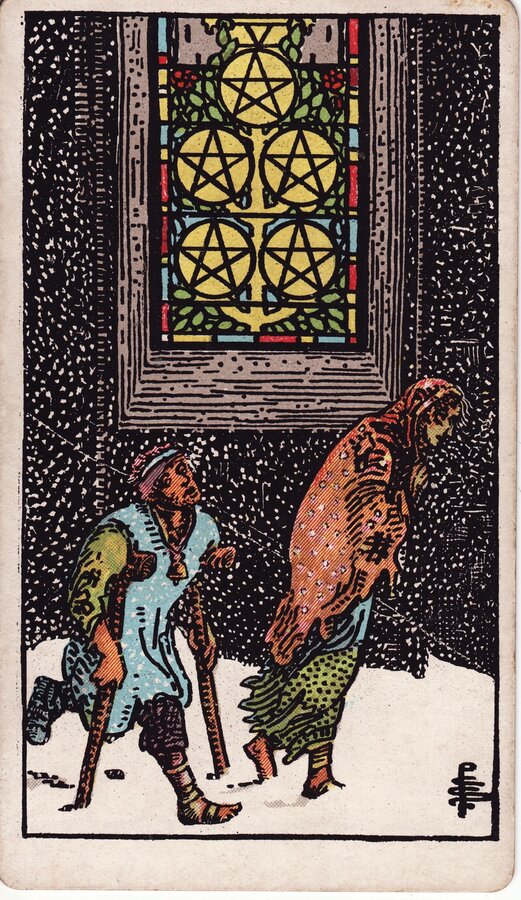
Rider-Waite-SmithFive of Pentacles
vs
Soblazn — Sensual TarotFive of Pentacles
In the Rider-Waite-Smith image, the Five of Pentacles is a study in spiritual and material destitution: the scene is cold, clothed, and public, its anguish rooted in exclusion from shelter and community. The church window — symbol of available grace — dominates the background while the figures below fail to register it. Milo Manara's version, true to his sensual Italian line, reframes deprivation through the body and desire. Where Waite shows figures hobbled by injury and want, Manara renders vulnerability as an erotic and emotional nakedness — the exposed self as the site of loss, longing, and potential rescue. The Waite card asks: what help are you too proud or too numb to accept? The Manara version asks: what part of yourself have you abandoned to survive, and at what cost to your vitality and pleasure? Waite grounds the card in social and economic reality; Manara translates it into the interior landscape of longing and self-denial.
ManaraSoblazn — Sensual Tarot
SceneSensual figures in a state of exposure or deprivation — vulnerability rendered through the body, nakedness, and longingTwo clothed wanderers in snow, passing an illuminated church window they do not notice — cold, public, archetypal
FocusEmotional and erotic privation — the hunger of the body for closeness, warmth, and desire withheld or lostMaterial, social, and spiritual hardship — poverty, illness, and the psychology of refusing available help
QuestionWhat have I starved myself of in the name of survival — and is that deprivation still necessary?What light am I walking past without seeing, and what would it cost me to simply turn around?
Symbolism & correspondences
The Five of Pentacles carries the energy of Mercury in Taurus — quicksilver intelligence dragged into earth's gravity, the mind overwhelmed by the weight of material reality. Mercury wants to move, to communicate, to find solutions; in Taurus, those capacities are slowed and burdened by physical needs, stubborn circumstances, and the body's insistent demands. This combination produces the card's characteristic fixity: the figures know something is wrong, but cannot think their way out because thinking itself has been colonized by the cold. The earth element of Pentacles deepens this — this is not abstract worry but embodied, grounded hardship, felt in the bones.
Element
Earth
◆
Arcana
Minor
Suit
Pentacles
Frequently asked: Five of Pentacles
What does the Five of Pentacles card mean?
The Five of Pentacles speaks of a difficult passage through material or emotional poverty. Two figures walk through bitter cold, oblivious to the warm light of the church window above them — help exists, but hardship has narrowed their gaze to the ground beneath their feet.
What does the Five of Pentacles card mean reversed?
Reversed, the Five of Pentacles signals that the worst of the storm has passed, or is about to. The stained-glass window finally catches your eye; you reach for the door handle.
What does Five of Pentacles mean in love and relationships?
A relationship may be passing through a lean season — financial pressure, illness, or the exhaustion of shared struggle can create distance. Yet the card carries a quiet tenderness: the two figures walk together, and even in hardship there is companionship.
What does Five of Pentacles mean for work and money?
This card often marks a period of unemployment, financial setback, or professional rejection. The wound here is not only economic — it touches self-worth and belonging.
What advice does the Five of Pentacles card give?
Lift your eyes. The light you need is closer than you think — whether a person, an institution, or an inner resource you have overlooked.
Ready to see how this card unfolds in your own reading?