sudden upheavalrevelationcollapse of illusionsliberation through destruction
The Tower is the moment divine clarity arrives uninvited — not as punishment, but as the only force strong enough to free what false certainty had imprisoned. It is the veil torn open, the lie that held a world together suddenly unable to hold.
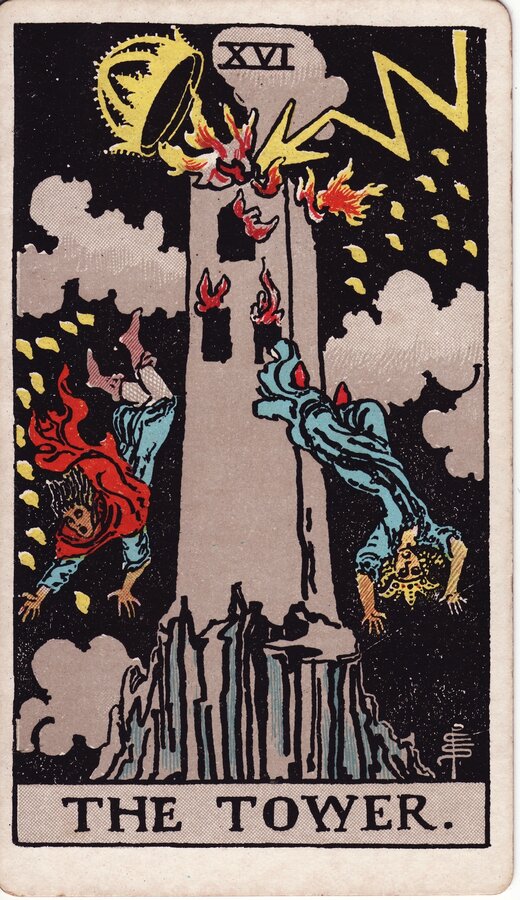
A tall stone tower stands on the peak of a bare black rock, no garden, no water, no softness around it — only raw matter. A crown sits atop the tower, and in this moment lightning strikes it directly, blasting the crown into the air and setting the structure ablaze. Flames pour from the two narrow windows like eyes opening in shock. Two figures fall headfirst from the tower — one draped in fine cloth, one simpler — their arms wide, unable to catch themselves. All around them the air is filled with small tongues of flame, twenty-two in number, each shaped like the Hebrew letter Yod. The sky behind it all is absolute black.
⚡Lightning bolt — The divine force that cannot be negotiated with or deflected — it arrives whole or not at all. Not wrath, but the only light strong enough to pierce the walls humans build around their certainties.
👑Falling crown — The crown of the tower represents false authority — the belief that human constructs can house the divine. When the lightning strikes, the first thing to go is the claim to sovereignty.
🔥Yod flames — Twenty-two drops of fire shaped like the Hebrew letter Yod — the first letter of the divine name. The destruction scatters the sacred rather than destroying it; what rains down is presence, not absence.
🧗Two falling figures — The word once spoken and the word as it has been distorted — both fall together. Neither survives when the structure of self-deception collapses. They fall equally, regardless of rank or crown.
🪨Bare rock — The tower stands on naked stone — no soil, no roots, nothing organic. A structure built purely on will and material ambition, with no ground capable of sustaining growth.
🌑Black sky — Night without stars — the moment before the Star appears. This is the darkness at the turning point, neither the old light nor the new, only the breath between them.
Interpretation
Of all the cards in the Major Arcana, the Tower is the one most people fear — and the fear is not irrational. This card describes the experience of having a world-view shattered, the sudden collapse of something you had organized your life around. The fall is real. The disorientation is real. The Tower does not minimize any of that. What it adds is the understanding that the structure was never as real as it appeared: it was a 'House of God' built by human hands, which is another way of saying a house built on pride.
The Tower follows The Devil in the sequence of the Major Arcana, and the relationship between them is one of the most important in the deck. The chains that bind in The Devil are not broken by the prisoner's will — they are blasted open from outside. What willpower could not accomplish, lightning does in an instant. The Tower is also the resolution of the promise whispered by The High Priestess at the very beginning of the journey: she sat before a veil, hinting at a mystery behind it. Here, in card sixteen, the veil is not parted — it is torn. And what Temperance approached with such careful, patient gradation, the Tower accomplishes in a single strike.
In a real reading, the Tower usually signals an event that cannot be undone: a revelation, an ending, a rupture that reorganizes everything around it. In matters of relationship, it often surfaces when something long concealed is finally named. In work, it can mean the sudden loss of a position or the collapse of a plan. In inner life, it marks moments of involuntary awakening — when a belief system you lived inside simply stops being credible. The common thread is always the same: something that seemed permanent reveals itself as temporary.
When the Tower falls near The Star, this is one of the most hopeful sequences in the entire deck — catastrophe followed by healing, the open wound followed by the water that cleanses it. Near Death, it signals a transformation so complete that the person who emerges will barely recognize the one who entered. And when it appears beside The Fool, there is something almost merciful about it: the Tower returns the Fool to the beginning, with nothing carried forward except the lesson.
✦ Full InterpretationUnlock the card's full readingFree registration reveals the final paragraphs of the interpretation and gifts you ⭐ for your first spreadyour first spread is on us
Advice & forecast
✦ The card's advice
When the Tower appears as guidance, the message is both simple and difficult: do not spend your energy trying to prevent what is already in motion. The lightning has already left the sky — the only question is whether you meet it with your arms open or your hands up to shield a structure that cannot be saved. This does not mean passivity. It means directing your energy toward what comes after, rather than toward what is falling. Notice what remains when the smoke clears — those are your real foundations. And be honest, quietly, about what part of you feels relief alongside the fear.
🔮 What the forecast holds
What is coming is a shift you will not be able to prepare for in the ordinary sense — not because preparation is useless, but because the change will arrive in a form you did not anticipate. The structure that falls may be external: a plan, a role, a relationship. Or it may be internal: a belief about yourself or the world that has been quietly losing its credibility for some time. Either way, there will be a distinct before and after. The invitation is not to soften the impact, but to trust that the ground which remains when the tower is gone is more solid than the tower ever was. What opens on the other side of this is real.
↓ The Tower reversed
When the Tower appears reversed, the lightning is not absent — it is stuck. The charge has built to the point of crisis, but the strike keeps not arriving: the relationship continues in suspended tension, the job goes on past the point of meaning, the belief system creaks and groans but is propped up with increasing effort. This is the card's most exhausting expression, because it takes enormous energy to maintain a structure your deeper self already knows is hollow. The fear driving this is often fear of the unknown — the fall seems worse than the discomfort of staying, so staying becomes the default. But the Tower reversed is not a reprieve. It is a prolonged version of the same reckoning, distributed across time rather than concentrated in a single moment. The longer the storm is held back, the more total the eventual clearing tends to be. There is also a particular quality of isolation in this position: the person living it often cannot name what is wrong, only that something feels perpetually on the verge of breaking. Recognizing this state for what it is — delayed transformation rather than stable unhappiness — is the first real step. The reversed Tower asks: what are you protecting by keeping this standing, and is that thing worth the cost of maintaining the walls?
The card in spreads
The same card reads differently depending on the spread and the question — compare real spreads:
Spread "Before · The Strike · After"
Understanding a sudden change or shock
«What was the situation, what is happening now, and what does it open toward?»
Before — what was being held in suspension
The Hanged Man
The Strike — the nature of the rupture
The Tower
After — what this opens toward
The Star
This three-card arc moves through the full Tower experience: the frozen moment before, the rupture itself, and the first light that follows. The Hanged Man in the first position describes what had been suspended — what you were waiting through, what was held in a kind of willing or unwilling pause. The Tower in the center is the event itself: read it for the nature of the break, whether it was primarily internal (a realization) or external (a collapse of circumstance). The Star in the final position names what the Tower was making space for — not as consolation, but as honest direction. If a difficult card appears in the After position, it does not mean the clearing is false; it means the next phase requires its own navigation. Read all three as one continuous breath: suspension, rupture, opening.
Spread "The False Structure"
Naming what needs to fall
«What am I holding together that no longer deserves to stand?»
What holds you bound — the chain beneath the tower
The Devil
The Tower — the structure itself
The Tower
What was hidden behind the veil
The High Priestess
This spread works particularly well when someone senses that change is necessary but cannot bring themselves to act. The Devil in the first position illuminates the binding — the attachment, fear, or false comfort that has been maintaining the structure. It asks: what are you getting from keeping this standing? The Tower in the center is the structure itself — read it for how precarious it actually is, and what kind of force would be needed to bring it down (or what force is already approaching). The High Priestess in the final position names what has been hidden behind the tower's walls: the truth, the resource, the self that could not be accessed while the false structure stood. This is often the most quietly powerful position in the spread — what the veil was concealing is rarely as frightening as maintaining the wall had made it seem.
✦ PremiumUnlock the Full ReadingSpread "The False Structure": position-by-position reading, card combinations, and guidanceOpen with subscription →first spread is free
Spread "The Morning After"
Finding footing after a shock has already occurred
«The tower has fallen — what do I do now?»
The Tower — what has fallen, what ended
The Tower
The Work — how to integrate and find balance
Temperance
The Light — what becomes possible now
The Sun
This spread is for the morning after — when the event has already happened and the question is not whether to prevent it, but how to move through the aftermath with clarity. The Tower in the first position is not a prediction here but a reflection: what exactly fell, and what was its nature? Reading it carefully tells you what kind of loss this was — of certainty, of relationship, of identity, of material security — and therefore what kind of recovery is called for. Temperance in the second position describes the work of integration: the patient, day-by-day process of finding a new equilibrium. Temperance does not rush; it asks you to hold opposites simultaneously and trust the process of their slow merging. The Sun in the final position offers genuine clarity about what becomes available once the tower is no longer blocking the light. This card rarely lies in this position — it names something real that was waiting behind the structure that fell.
✦ PremiumUnlock the Full ReadingSpread "The Morning After": position-by-position reading, card combinations, and guidanceOpen with subscription →first spread is free
How it differs from Manara
Manara Erotic TarotThe Tower
vs
Rider-Waite-SmithThe Tower
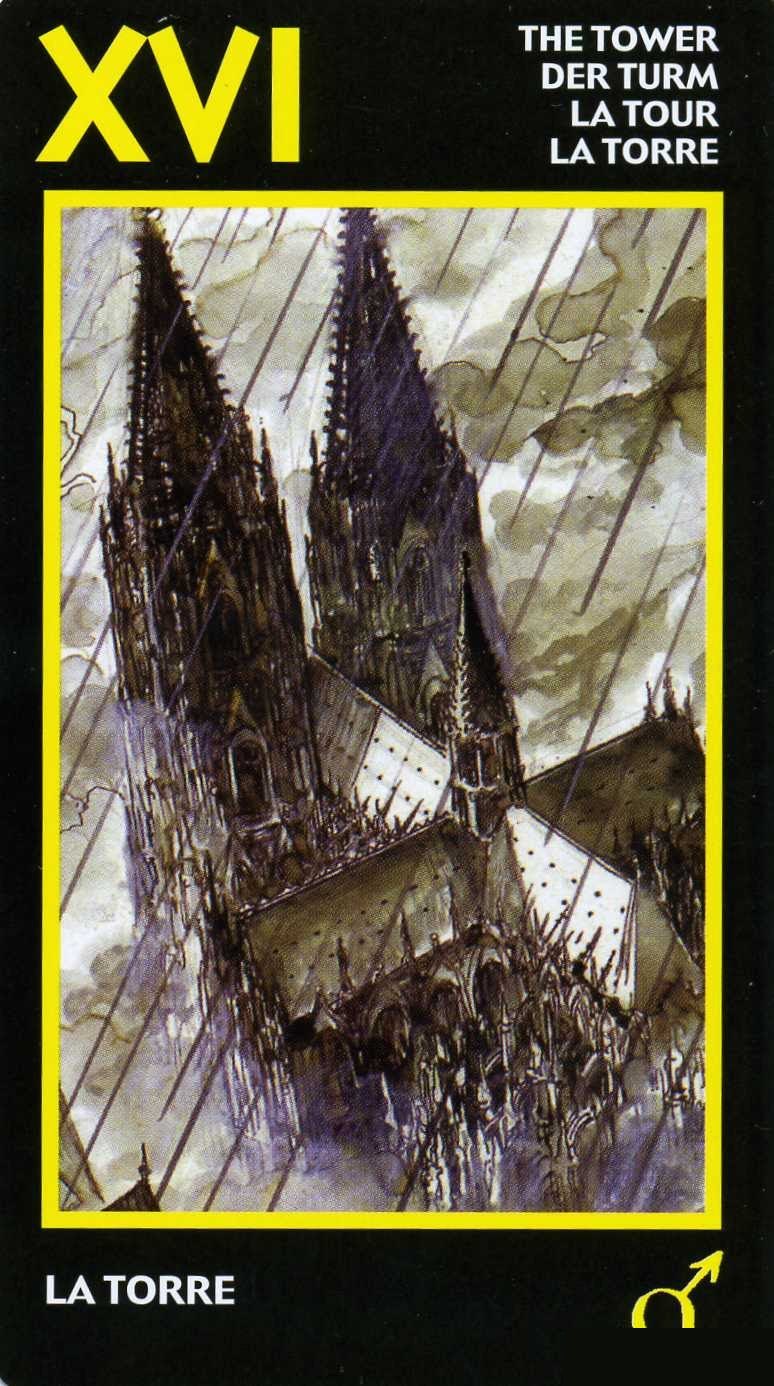
In the Rider-Waite-Smith image, the Tower is pure archetype: stone, lightning, falling bodies, divine fire — nothing softened, nothing personal, a symbol of cosmic correction that speaks to any life question. The scene exists outside time and gender. In the Milo Manara Erotic Tarot, the same card is brought entirely into the body and the intimate: the collapse is experienced as loss of control over desire, a moment when the choreography of seduction gives way to something ungovernable. Where Waite shows two figures falling from a tower, Manara shows a figure undone by their own longing. The question shifts from 'what structure is being destroyed' to 'what are you willing to surrender when your body overrides your plans.' Both versions agree that something irreversible is happening — they differ only in whether it is the tower of the mind or the tower of restraint that falls.
ManaraRider-Waite-Smith
SceneA figure overwhelmed by uncontrollable desire — the body becomes the site of the upheaval, not the architectureA stone tower on a rock struck by lightning; a crown blasted away; two figures falling through fire and Yod flames
FocusErotic surrender, the loss of composed self-control, desire as an elemental force beyond managementThe collapse of false certainty, divine revelation breaking through human-built structures of pride and self-deception
QuestionWhat are you willing to lose when real desire arrives — and what does that loss reveal about you?What false structure have you been maintaining, and what becomes possible the moment it falls?
Symbolism & correspondences
The Tower is assigned to Mars, the planet of force, rupture, and direct action — the energy that cuts through rather than negotiates. Mars does not plan; it acts, and it does not stop to assess the damage until the act is complete. In the Kabbalistic system, the Tower corresponds to the path between the sphere of Glory and the sphere of Splendor on the Tree of Life, a channel associated with the active principle crashing into the reflective. The Hebrew letter Peh, meaning 'mouth,' is linked to this card — the spoken word, the divine utterance that cannot be recalled once given. Fire is the Tower's element, but specifically the fire of revelation rather than warmth: the fire that illuminates by consuming, the fire in which nothing false can persist.
Element
Fire
♂
Astrology
Mars — the planet of force, sudden action, and the will that breaks through walls
✦
Arcana
Major
Ready to see how this card unfolds in your own reading?