The Four of Swords is the one act of mercy in the suit of the mind: the knight who lays down his sword and lets the silence do what thinking cannot. It is the knowledge that withdrawal is not surrender but the deepest form of readiness.
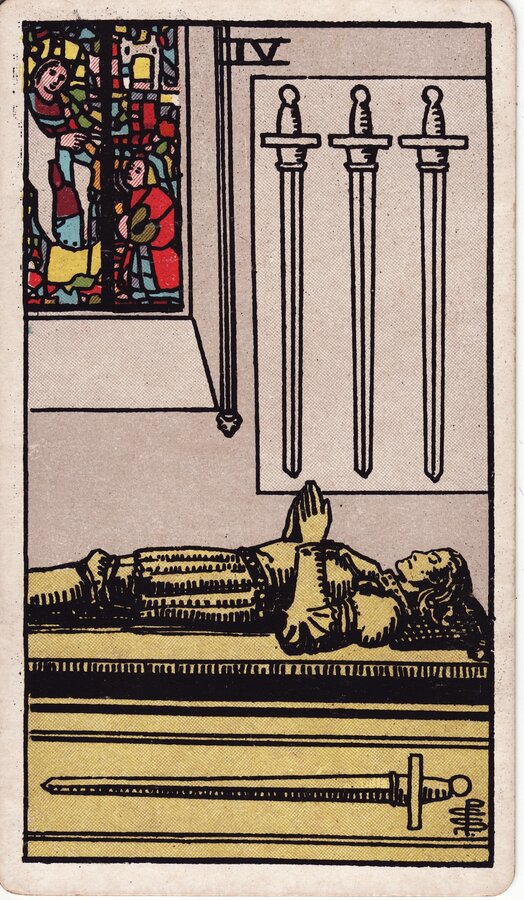
A stone effigy of a knight lies upon a tomb slab in a chapel, his hands folded in prayer across his chest, his face composed and upturned. One sword runs along the length of the slab beneath him, flat and parallel to his body. Three swords hang point-down from the wall above him, suspended but not falling. A stained-glass window to the left bathes the alcove in soft colored light, depicting a figure of grace — a mother and child, an emblem of shelter and mercy. The chapel is quiet; nothing moves. This is not a battlefield but a sanctuary, and the stillness here is chosen, not suffered.
⚔️Three suspended swords — The mind's threats remain present but inert — thought exists without force, hovering without harm
🗡️One sword beneath the knight — Personal will and capacity are not abandoned, merely set aside; the ability to act is preserved for when the time comes
🪨The stone effigy — Symbolic rather than literal death — a ritual stillness that makes transformation possible without actual end
🌈Stained-glass window — Sacred, consecrated space; the maternal and divine watching over the sleeping warrior, blessing the rest
🙏Folded hands — The gesture turns inward rather than outward — the battle is surrendered to prayer, surrender, and inner listening
⛪The chapel itself — Structure that contains and honors the retreat; rest here has form, intention, and sacred boundary
Interpretation
Every suit in the tarot has at least one card that steps outside its own current — and in the Swords, the most relentless and painful of the four, that card is this one. The Four of Swords is the eye of the storm. All around it, the suit cuts, divides, and wounds: betrayal, grief, defeat, sleeplessness, ruin. But here, in the four, the knight has done something radical. He has stopped. He has put down the sword. He has chosen the chapel over the battlefield, not because he lost, but because he understood that continuing would be a form of self-destruction.
The Swords tell a story of the mind under pressure — from the clean clarity of the Ace of Swords to the brutal finality of the Ten of Swords. The Four sits midway, offering the only exit that is not defeat. It echoes the stillness of The Hermit, who also withdraws with his lamp, and the suspended wisdom of The Hanged Man, who teaches through inversion. But where those cards carry a sense of extended time, of a long passage, the Four of Swords has the feeling of a deliberate, finite pause — a convalescence with a known end. It knows that the Five of Swords waits on the other side, and it chooses not to rush toward it.
In a reading, this card almost always means: not yet. Not yet act, not yet decide, not yet push through. Whatever the question, the Four of Swords introduces a necessary interval. It may point to a literal need for physical rest — illness, recovery, hospitalization, a retreat. It may indicate that a situation needs to be left alone to resolve itself, that intervention will only tangle the threads further. In positions of advice, it is perhaps the clearest card in the deck: stop, wait, rest, let the silence work.
When this card appears alongside The Hermit, the withdrawal is likely long and spiritually significant — a period of genuine inner work rather than temporary recovery. Paired with Ace of Cups, it may suggest that emotional healing is what the rest is for. Next to Knight of Swords, it may be a direct warning: slow down before recklessness costs you everything.
✦ Full InterpretationUnlock the card's full readingFree registration reveals the final paragraphs of the interpretation and gifts you ⭐ for your first spreadyour first spread is on us
Advice & forecast
✦ The card's advice
When the Four of Swords appears as guidance, it is asking you to treat rest as a discipline rather than a luxury. This is not permission to avoid what must eventually be faced — it is recognition that you cannot face it well from where you currently stand. Find the smallest version of sanctuary available to you: a day off, an hour of silence, a walk without your phone, a night of real sleep. Let the three swords hang where they are. They will still be there when you return, but you will meet them differently. The most courageous thing available to you right now may simply be to stop.
🔮 What the forecast holds
The near future asks you to prepare for a pause, willingly or otherwise. Something is drawing you toward stillness — a needed rest, a change of pace, a situation that removes you from the usual current of activity. Do not resist this. What looks like delay from the outside is incubation from the inside. Use this interval with intention: reflect on what the previous movement has cost you, and what you want to carry forward when you emerge. The rest is temporary; what you learn inside it may not be.
↓ Four of Swords reversed
When the Four of Swords reverses, the healing circuit is broken — either rest is being denied when it is desperately needed, or the retreat has overstayed its welcome and become a comfortable hiding place. There is a difference between protecting a wound and refusing to let it close. If you recognize the first pattern, the card is an urgent warning: the cost of continuing without rest is compounding daily, and the body or mind will eventually enforce the pause whether you choose it or not. If the second pattern is closer to truth, the card is a gentle push: the chapel doors are open, the world outside is not as hostile as you remember, and there is life waiting on the other side of the threshold. Either way, the reversal points to a disruption of the natural rhythm between action and recovery — the knight half-risen from the slab, not yet standing, not yet lying down. Find your ground again.
The card in spreads
The same card reads differently depending on the spread and the question — compare real spreads:
Spread "The Chapel Spread"
Mapping the nature and timing of a needed rest
«What does this pause need from me, and what will it give back?»
The wound — what drove you here
Three of Swords
The sanctuary — what this rest is for
Four of Swords
The threshold — what awaits when you emerge
Five of Swords
This three-card spread follows the Swords' own narrative logic: the Three of Swords in the first position names the grief or conflict that made withdrawal necessary — look at it honestly, without softening. The Four of Swords at center is the sanctuary itself, and when it appears here it asks: what quality of rest is actually available to you right now, and are you truly allowing it? The Five of Swords in the third position does not have to be a bad outcome — it may simply name what you will need to navigate when the rest is complete. Reading these three together, ask whether the wound in the first card has been genuinely tended by the rest in the second, or whether you are emerging too soon into the conflict waiting in the third.
Spread "The Knight's Return Spread"
Deciding when to move from rest back into action
«Am I ready to return, or do I need more time?»
Current state — where you actually are in the recovery
Four of Swords
What still needs inner work before re-emerging
The Hermit
The path forward when readiness arrives
Six of Swords
When the Four of Swords anchors the first position, it confirms that a period of withdrawal is current or very recent — the question is no longer whether to rest but how to gauge readiness. The Hermit in the second position is a remarkable companion: whatever it shows is the unfinished inner work, the lamp not yet held high enough. Do not rush past what the Hermit reveals. The Six of Swords in the final position is one of the kindest cards in the suit for a future position — it names a quiet passage, a transition that is not triumphant but genuinely healing. Together, this spread often reveals that the person is closer to ready than they think, but that one more honest conversation with themselves is needed first.
✦ PremiumUnlock the Full ReadingSpread "The Knight's Return Spread": position-by-position reading, card combinations, and guidanceOpen with subscription →first spread is free
Spread "The Stained Glass Spread"
Understanding what is being protected during a period of withdrawal
«What is this stillness holding safe for me?»
The sanctuary — what the withdrawal is actively protecting
Four of Swords
The suspended tension — what is not yet resolved but not yet pressing
Two of Swords
The emerging balance — what will be restored when the rest is complete
Temperance
The Four of Swords in the first position asks you to name what precious thing is being held inside the quiet — a relationship, a creative project, a fragile new sense of self, a decision that needs more time to ripen. Two of Swords in the second position names the tension that is paused but not resolved: the swords are still there, hanging on the wall. This is not a problem — it is information, showing you what you will need to face with fresh eyes when you emerge. Temperance in the third position offers one of the most reassuring forecast cards in this spread: what is coming is not explosion or collapse, but the slow return of proportion, the gradual blending of what was separate. Read this spread as the arc of a healing: what is sheltered now will, in time, be integrated.
✦ PremiumUnlock the Full ReadingSpread "The Stained Glass Spread": position-by-position reading, card combinations, and guidanceOpen with subscription →first spread is free
How it differs from Manara
Manara Erotic TarotFour of Air
vs
Rider-Waite-SmithFour of Swords
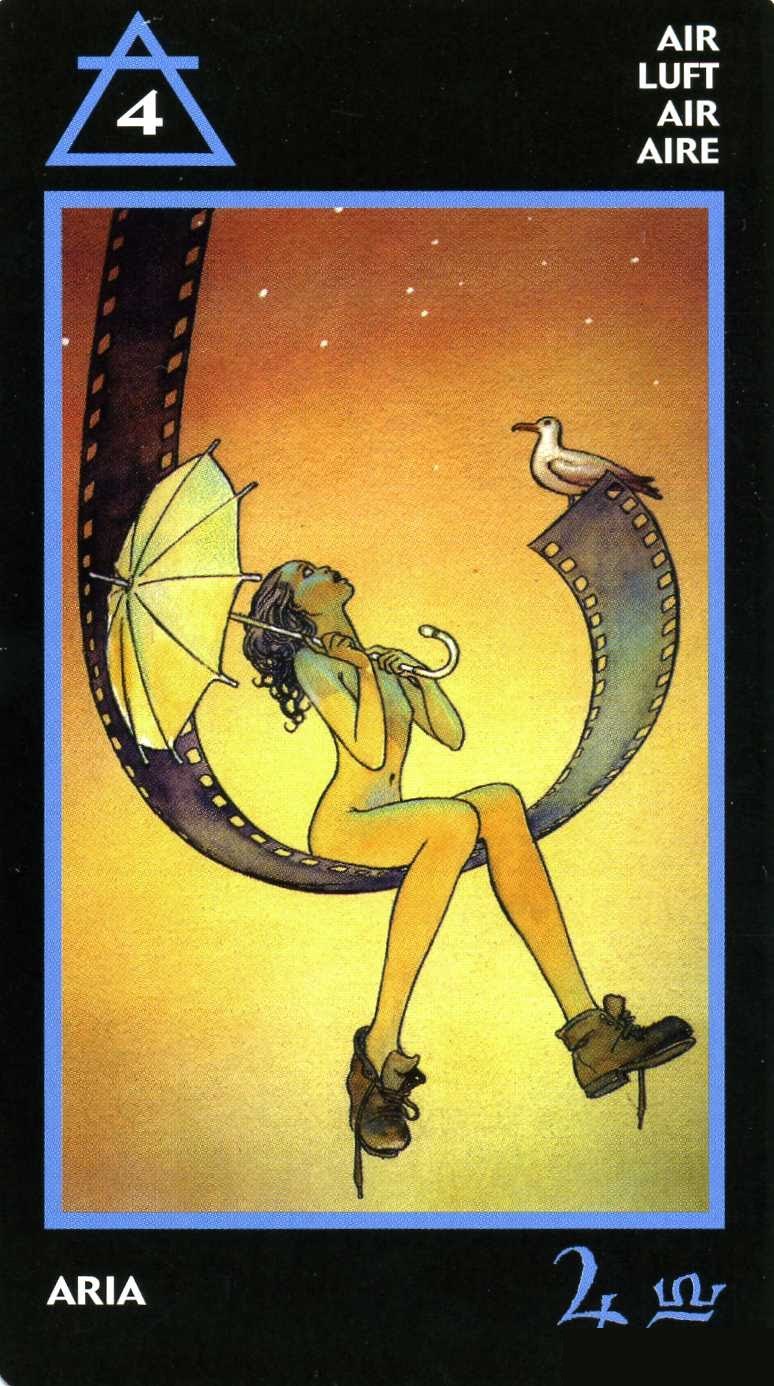
In the Rider-Waite-Smith image, the Four of Swords is an archetype of protected stillness — a knight removed from the world, sealed in stone and prayer, watched over by sacred light. The card asks about the mind and its mercy toward itself. Milo Manara's version transforms this into a scene of sensual surrender: the body at rest is soft, warm, and alive, and the retreat from the world is colored by pleasure and the intimacy of being cared for. Where Waite's knight lies in solemn stone, Manara's figure reclines in an almost erotic repose — the pause is not heroic but deeply physical. Waite poses the question of whether you can stop fighting; Manara asks whether you can allow yourself to be held.
ManaraRider-Waite-Smith
SceneA figure in languid, sensual repose — the body surrendered to rest in a warm, intimate setting; vulnerability rendered as beautyA stone effigy of an armored knight on a tomb slab, chapel-lit by stained glass, hands folded in prayer
FocusThe pleasure and safety of physical surrender; being tended to, held, released from effort through touch and closenessThe deliberate, disciplined withdrawal of the mind from its own conflict; strategic stillness as the highest form of readiness
QuestionCan you let someone else carry the weight? Can desire itself be a form of rest?Can you stop thinking long enough to heal? Is stillness something you can choose before collapse forces it?
Symbolism & correspondences
The Four of Swords carries the signature of Jupiter in Libra — the expansive planet slowed and balanced by the sign of equilibrium, finding growth through harmony rather than force. In the element of Air, this is the mind choosing stillness over its own restlessness, intellect that has learned the value of not-thinking. Jupiter here does not abandon ambition; it understands that the most effective preparation is recovery. Libra's scales are not passive — they seek balance actively, and the Four of Swords is that active seeking made still.
Element
Air
◆
Arcana
Minor
Suit
Swords
Ready to see how this card unfolds in your own reading?