overwhelmburden of successovercommitmentresponsibilitynearing the goal
Fire carried past its natural limit becomes its own kind of prison. The Ten of Wands is the moment when ambition's harvest weighs more than the harvest was worth — and the only wisdom is knowing what to put down.
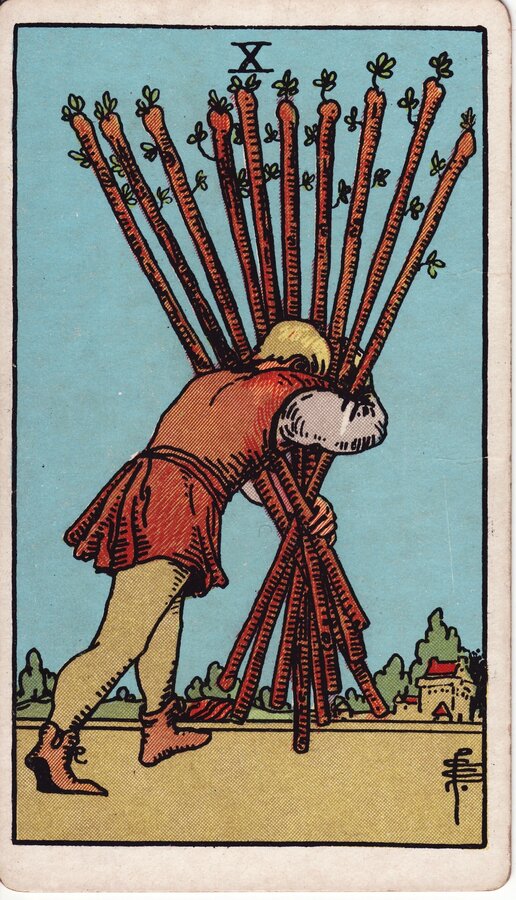
A figure bent almost double makes his way across a flat, worked field toward a small town in the middle distance. He grips ten long wands bundled awkwardly against his chest and shoulder, their weight pulling him forward and down. His face is hidden entirely behind the load he carries — he cannot see where he is going, only that he must keep moving. The earth beneath him is dark and furrowed, evidence of labor already spent. The sky above is a pale, warm yellow, offering no shadow and no sign of evening rest.
🪵Ten bundled wands — The full harvest of the suit — every ambition, project, and obligation gathered into one unwieldy armful
🙈Hidden face — The bearer cannot see ahead; success has become its own blindfold
🏘️Town in the distance — The goal that is almost in reach — but still not here, and the weight does not lessen until arrival
🌾Plowed field — Labor already completed; this is not the beginning of the work, it is the consequence of it
☀️Yellow sky at full daylight — No promise of relief or rest — the day is at its peak, the burden unchanged
⚖️Stooped posture — The body mirrors the psyche: when we take on more than is sustainable, even triumph becomes a kind of collapse
Interpretation
The Ten of Wands occupies a peculiar place in the human story: it is not failure, and it is not triumph. It is the precise moment when success reveals its hidden price. The figure has done everything right — he pursued, he achieved, he gathered — and now the fruit of all that effort is pressing down on his back until his face disappears. This is the card of the person who cannot stop saying yes, who has built something so substantial that maintaining it consumes them entirely. The wands do not feel like prizes anymore. They feel like stones.
As the final numbered card of the Wands suit, the Ten closes the arc that began with the single, blazing spark of Ace of Wands. Every card between them — the early boldness of Two of Wands, the tested resilience of Nine of Wands — has been building to this moment of absolute fullness. In the numerology of the Minor Arcana, tens represent completion, the point at which a cycle exhausts itself and must transform. But unlike Ten of Cups (fulfilled joy) or Ten of Pentacles (dynastic abundance), the Ten of Wands is the only ten whose completion feels like a trap. Fire at its limit does not glow — it smothers.
In a real spread, this card almost always speaks to a concrete situation: a workload that has quietly doubled, a home that requires more than one person can give, a project that devoured a sabbatical and is still hungry. It appears for people who wear busyness as a kind of identity — who are proud of how much they carry and afraid of what it would mean to carry less. The card is not unkind. It does not say the effort was wrong. It simply says: you are allowed to put some of this down.
When Ten of Wands appears alongside Nine of Swords, the situation is urgent — the weight is not just physical or practical but psychological, spilling into sleepless nights and anxious loops. With Hanged Man nearby, a fascinating contrast emerges: the Hanged Man has accepted suspension, surrendered control, and found a strange peace in it. The Ten of Wands is still marching, still clenching the bundle. Both cards invite stillness — but the Wands figure has not yet chosen it.
✦ Full InterpretationUnlock the card's full readingFree registration reveals the final paragraphs of the interpretation and gifts you ⭐ for your first spreadyour first spread is on us
Advice & forecast
✦ The card's advice
The card is asking you to count what you are actually carrying. Not what you agreed to in a moment of enthusiasm, not what feels too important to relinquish — but what is genuinely yours to hold. Some of these bundles belong to other people. Some were never necessary. Some made sense at an earlier stage and simply were never put down when the stage changed. Choose one thing this week to hand off, delay, or release entirely. The town you are heading toward will still be there when you arrive lighter.
🔮 What the forecast holds
The immediate future holds a threshold moment — not a crisis, but a reckoning with capacity. Something you have been managing through sheer effort is about to demand a structural change rather than more endurance. The good news is that relief is genuinely available: the resources to lighten the load exist, whether that means a person to share the work, a decision to step back, or simply the permission to stop. What comes after this card, if you act on its wisdom, is rest that is actually earned — not the guilty rest of someone who has collapsed, but the clear rest of someone who made a choice.
↓ Ten of Wands reversed
When the Ten of Wands falls reversed, the overload does not disappear — it changes shape. The energy that was spent carrying the burden outward now turns inward, often as resentment toward those who appear unburdened, or as subtle maneuvering designed to shift responsibility without openly acknowledging the need. There can be a kind of martyrdom at work here: the reversed bearer knows they are carrying too much, but derives something — identity, control, moral authority — from being the one who carries everything. The card may also signal the genuine beginning of release: a moment when the pile finally scatters, when something collapses under its own weight and a lighter structure becomes possible. The shadow of the reversal is the temptation to call that collapse a betrayal rather than a necessary ending. What is being asked is simple and difficult in equal measure: own your part in the accumulation, and start choosing differently.
The card in spreads
The same card reads differently depending on the spread and the question — compare real spreads:
Spread "The Threshold Spread"
Identifying what to release and what to keep
«What am I carrying that I need to set down, and what is truly mine to hold?»
What I have already endured — the weight's history
Nine of Wands
The burden itself — what is pressing down right now
Ten of Wands
What becomes possible when I set something down
Ace of Wands
The Nine of Wands in the first position shows the accumulated vigilance and exhaustion that preceded this moment — the cost of defending what you built. When the Ten of Wands sits in the center, it confirms that the current overload is not new; it is the logical consequence of a long stretch of pushing through. The Ace of Wands in the release position is quietly thrilling: it suggests that what waits on the other side of letting go is not emptiness but spark — a genuine return of creative energy and desire. The spread is asking you to trust that releasing the heavy bundle is not abandonment. It is the precondition for the next beginning.
Spread "The Delegation Spread"
Navigating an overwhelmed work or life situation
«How do I carry less without letting the important things fall?»
The current load — what is it really?
Ten of Wands
The structure or guidance available to help
The Hierophant
The middle path — sustainable balance
Temperance
With the Ten of Wands anchoring the first position, the reading begins with honest accounting: what is the load, and where did each piece of it come from? The Hierophant in the guidance position points toward institution, mentorship, or established process as a resource — this is not a moment for reinventing the wheel but for leaning into systems that already exist and people who have carried similar things. Temperance in the balance position offers the image of careful, patient blending: not dramatic release but thoughtful redistribution. The spread as a whole counsels against both martyrdom and abrupt abandonment — instead, it points toward a slow, deliberate restructuring, one bundle at a time.
✦ PremiumUnlock the Full ReadingSpread "The Delegation Spread": position-by-position reading, card combinations, and guidanceOpen with subscription →first spread is free
Spread "The Harvest and the Cost Spread"
Understanding the relationship between ambition and exhaustion
«What has my effort built, and what has it cost me?»
The king energy — your ambition at its clearest
King of Wands
The price — what the ambition has extracted
Ten of Wands
The wisdom available — what the solitude of exhaustion is teaching
The Hermit
The King of Wands in the first position names the fire that set everything in motion: vision, drive, the refusal to accept limits. He is the best of what you have been reaching toward. When the Ten of Wands falls in the center, it asks plainly: what did becoming that cost? Not rhetorically — specifically. What relationships, what rest, what simple pleasures were quietly sacrificed? The Hermit in the wisdom position is not a retreat into failure but a deliberate step inward: the lantern he carries illuminates only the next step, and that is exactly the right scale for this moment. The spread suggests that the exhaustion itself is the teacher, if you are willing to stop marching long enough to listen to what it is saying.
✦ PremiumUnlock the Full ReadingSpread "The Harvest and the Cost Spread": position-by-position reading, card combinations, and guidanceOpen with subscription →first spread is free
How it differs from Manara
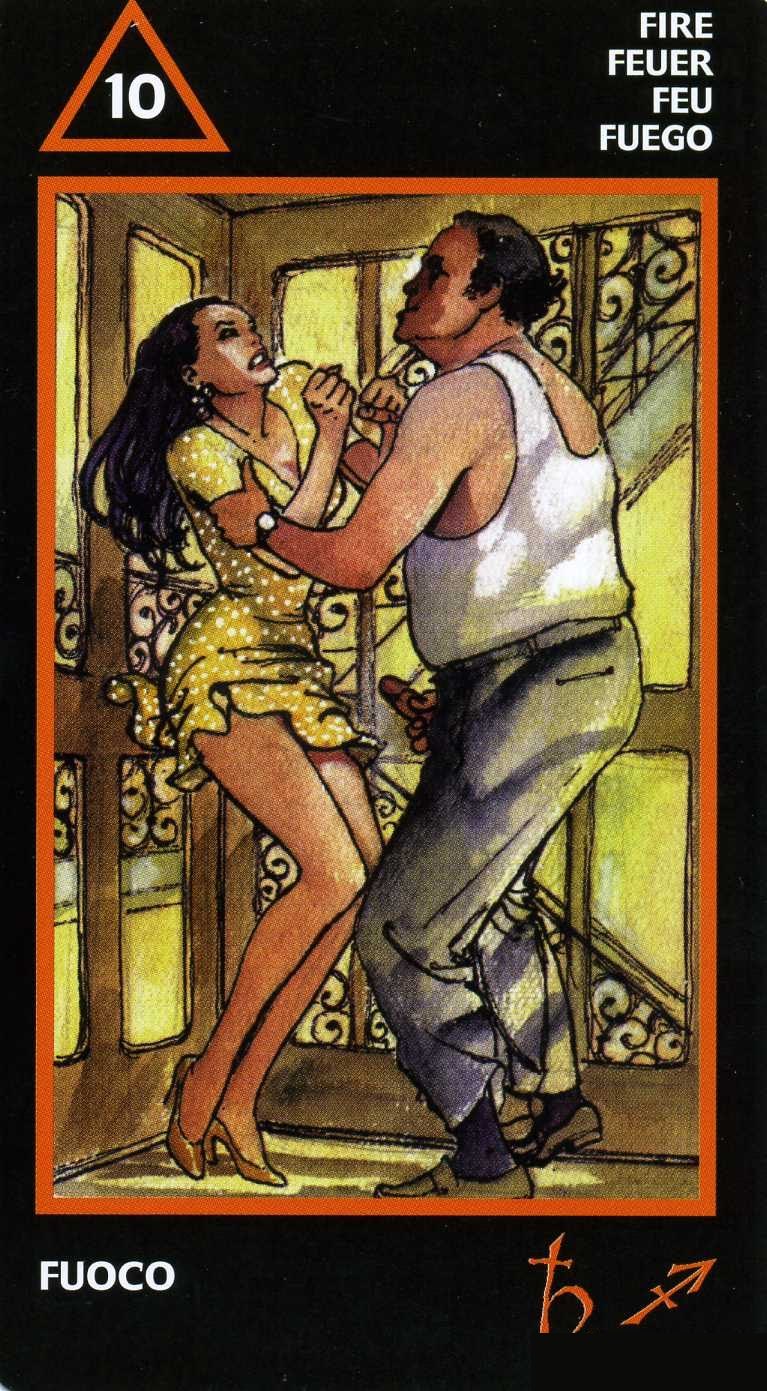
Manara Erotic TarotTen of Fire
vs
Rider-Waite-SmithTen of Wands
In the Rider-Waite-Smith image, the Ten of Wands is a study in impersonal, archetypal labor: a solitary figure obscured by his own burden, his identity swallowed by obligation. The card is deliberately universal — the faceless bearer could be anyone carrying too much. Milo Manara's Erotic Tarot translates the same principle into the language of desire and the body: here the weight is erotic tension, accumulated longing, or the exhaustion of a love that has become a performance. Where Waite asks 'what have you taken on that you cannot set down?', Manara's version asks 'what desire have you been carrying in secret, and at what cost to your body and your pleasure?' The Waite card focuses on will and its limits; Manara's on flesh and the price of sustained wanting. Both arrive at the same threshold — the moment before something must be surrendered.
ManaraRider-Waite-Smith
SceneA figure laden with erotic tension or unfulfilled desire, the body itself expressing the weight of accumulated longingA solitary worker bent under ten bundled wands, face hidden, trudging toward a distant town across a plowed field
FocusThe body as the site of burden — desire carried past its natural expression becomes its own kind of oppressionThe will as the site of burden — ambition and obligation accumulated beyond what one person can sustainably hold
QuestionWhat have you been carrying in your body that was never meant to be carried alone?What have you taken on in your life that you could — and should — set down?
Symbolism & correspondences
Saturn in Sagittarius governs this card, and the combination is exact in its symbolism. Sagittarius is the sign of expansion, aspiration, and the long shot — it always wants more horizon. Saturn is the force that says: here is what expansion costs, here is the structure you must build to hold it. Together they produce the archetypal overreacher who has achieved the grand ambition and now must live inside the weight of it. The element is Fire — but Fire in Saturn's grip is disciplined, compressed, burning low rather than leaping. This is not the fire of inspiration; it is the fire that keeps a forge running hour after hour, grinding.
Element
Fire
◆
Arcana
Minor
Suit
Wands
Ready to see how this card unfolds in your own reading?