The Chariot is the human will at its most sovereign — not brute force, but focused intention that holds contradiction in harness and turns it into motion. It is the self assembled into a single moving point, aimed at the world.
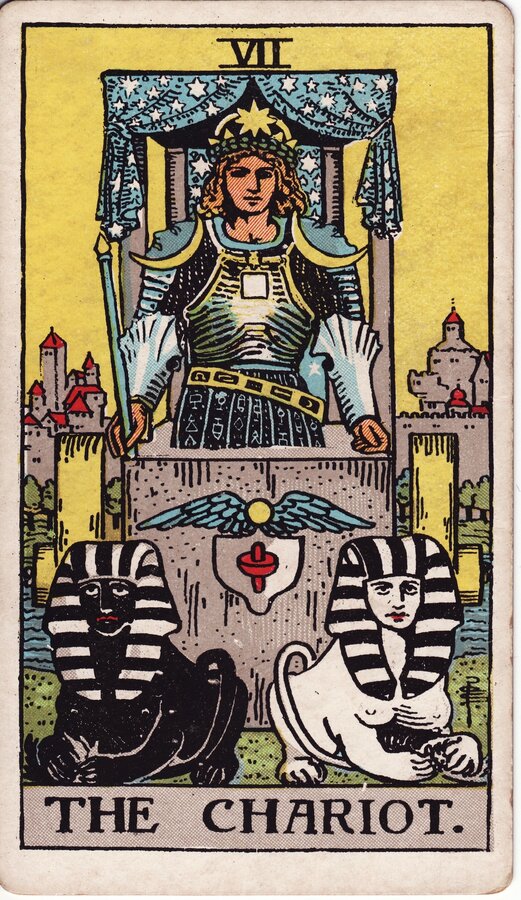
A warrior stands upright in a stone chariot, armored, crowned with an eight-pointed star, holding a wand loosely in one hand. Two sphinxes — one white, one black — are yoked before the chariot but lie still, held not by reins but by the charioteer's presence. Behind him the walled city recedes; before him, open road. A canopy of stars stretches over his head, and on his shoulders he wears crescent moon symbols like epaulettes. His expression is neither triumphant nor anxious — it is simply resolved.
⚫⚪Black and white sphinxes — The two contradictory forces in any situation — light and shadow, yes and no, desire and restraint. The charioteer does not make them agree; he makes them move together. The riddle of the sphinx is the riddle of the self.
👑Eight-pointed star crown — The eight-pointed star connects the wearer to cosmic order, suggesting that personal will and universal law are not in conflict here. The crown is earned, not inherited.
🌙Moon epaulettes (Urim and Thummim) — These ancient oracular symbols on his shoulders are a reminder that the charioteer carries more than he understands. He answers questions whose depths he cannot fathom — a burden worn as armor.
🗡️Wand or sword — Directed intention — the mind sharpened to a point. It is held loosely, not brandished. The weapon is readiness, not aggression.
🪨Stone chariot — The chariot itself is carved from a single cube of stone — a foundation of absolute stability beneath the motion. The self that moves is grounded, not reckless.
🏙️The city behind — What the charioteer left to become who he is now. The city represents origin, society, the lessons of the earlier cards — all of it absorbed and now carried forward.
Interpretation
The Chariot arrives at a precise moment in the soul's journey: after the choice has been made (The Lovers), before the deeper surrender begins. It is the card of the self at maximum coherence — every previous lesson absorbed, every contradiction harnessed, the whole assembled personality moving forward as one thing. It does not promise ease. It promises momentum.
Within the Major Arcana, the Chariot stands as the culmination of the first row — it carries within it the tools of The Magician, the mystery of The High Priestess, the abundance of The Empress, the structure of The Emperor, and the tradition of The Hierophant. All of these form the charioteer's armor. This also means the Chariot marks a turning point: the next card, Strength, introduces a wholly different kind of power — not will-over-the-world but intimacy-with-the-wild. The Chariot is the last word of the ego; Strength is the first word of something older.
In a reading, the Chariot tends to appear when focused effort is both needed and possible. It is a card of competitive environments, career breakthroughs, travel with purpose, and the will to push through obstacles that would stop someone less determined. It is also a card for any moment when the different parts of your life are pulling in different directions — the Chariot says: you do not need to resolve this, you need to drive it.
When it falls near Death or The Hanged Man, the Chariot's triumph carries a warning: the mask you've built so successfully may be the very thing that must eventually come apart. And alongside Wheel of Fortune, it creates a striking tension — the charioteer who believes he steers, meeting the wheel that turns beneath all steering.
✦ Full InterpretationUnlock the card's full readingFree registration reveals the final paragraphs of the interpretation and gifts you ⭐ for your first spreadyour first spread is on us
Advice & forecast
✦ The card's advice
When the Chariot appears, you are being called to stop waiting for things to align on their own. The opposing forces in your situation are not going to resolve themselves into harmony — but they can be harnessed. Set a clear destination. Commit to it. Gather your will, your discipline, your history of small victories, and let them all push in the same direction. You do not need perfect conditions. You need forward motion, sustained long enough to matter.
🔮 What the forecast holds
The Chariot in the future position promises movement — and movement that comes through your own effort rather than chance. Something that has been stuck begins to shift. A goal that seemed distant draws closer precisely because you have stopped hesitating. There may be a test of will involved — a moment when you feel the sphinxes pulling in opposite directions and must choose to hold them steady rather than let them scatter. If you do, what lies ahead is a genuine breakthrough: a win that is entirely yours because you built it from the inside out.
↓ The Chariot reversed
The Chariot reversed is one of the more uncomfortable reversals in the deck, because it turns willpower against itself. The same force that could carry you forward becomes the force keeping you stuck. You may recognize it as stubbornness dressed up as determination, or as control disguised as care. In relationships, it can look like one person steering for both — never asking where the other wants to go. In work, it shows up as the inability to change course even when the evidence is clear. Psychologically, there is sometimes a deeper trap here: a person who has become so identified with being the charioteer — the capable, focused, self-directed one — that any softening or pause feels like annihilation. The reversal asks: what would happen if you put down the reins for a moment? Would everything really fall apart, or have you just been afraid to find out? The path through is not more effort — it is the radical act of letting something be unresolved without immediately trying to drive past it.
The card in spreads
The same card reads differently depending on the spread and the question — compare real spreads:
Spread "The Two Sphinxes"
Clarifying a conflict between two pulls
«I feel torn between two directions. Which force do I harness, and which do I hold?»
The black sphinx — the force of resistance or the unknown
Ace of Swords
The charioteer — what you bring to hold them together
The Chariot
The white sphinx — the force of desire or the known path
Six of Wands
This spread works with the Chariot's central image: two forces you cannot fully reconcile, and the question of how to move forward anyway. Ace of Swords in the position of the black sphinx names what is resisting you or pulling against your stated desire — something hidden, uncomfortable, or simply opposite to where you think you want to go. The Chariot in the center is not a neutral observer: it is you, as you are right now, with everything you have gathered so far. What are you actually capable of holding? And Five of Wands in the white sphinx position names the energy you are consciously chasing — the goal, the desire, the pull forward. Reading all three: the Chariot does not favor either sphinx. It asks whether you can sustain enough inner coherence to let both forces move in the same direction, even if they are not pointing the same way.
Spread "The City and the Road"
Understanding what you are leaving behind and what lies ahead
«What chapter am I closing, and what am I driving toward?»
The city behind — what shaped you, what you carry
The Lovers
The chariot — where you are now, the state of your will
The Chariot
The road ahead — what this momentum is moving you toward
Temperance
The Chariot's image holds a clear before and after: the walled city in the background is the past that made the charioteer; the open road ahead is what the momentum will meet. The Lovers in the first position names the formative choice or relationship that built who you are now — the union or the fork in the road that shaped your current self. Sitting in the chariot position, your current card (The Chariot) describes what kind of will you are bringing to this moment: fierce, doubting, clear, or conflicted. And Temperance in the road-ahead position shows what this momentum is flowing toward — whether it will be met with easy alignment or with a demand to slow and blend. These three cards together form a narrative arc: the love or choice that made you, the will you carry now, and the quality of what you are moving into.
✦ PremiumUnlock the Full ReadingSpread "The City and the Road": position-by-position reading, card combinations, and guidanceOpen with subscription →first spread is free
Spread "The Armor Check"
Assessing whether you are ready for a specific challenge
«Am I ready to move forward, or is something in my armor still missing?»
Your current readiness — the charioteer as you are
The Chariot
What the challenge actually requires of you
The Hermit
The hidden resource — what you have that you have not yet used
Strength
This is a pragmatic, pre-action spread — useful before a launch, a difficult conversation, a significant move. The Chariot in the first position tells you honestly what your will looks like right now: fully assembled, or still a little scattered? The Hermit in the second position names what the challenge actually demands — not what you imagine it demands, but what it is truly asking of you. Often this is a quieter, more internal quality than sheer drive. Strength in the hidden resource position points to something you carry that you may not be counting on: not armor and wand, but something softer and more tenacious. The reading as a whole often reveals that readiness is not about having everything in order — it is about knowing what you have, naming what you lack, and moving anyway.
✦ PremiumUnlock the Full ReadingSpread "The Armor Check": position-by-position reading, card combinations, and guidanceOpen with subscription →first spread is free
How it differs from Manara
Manara Erotic TarotThe Chariot
vs
Rider-Waite-SmithThe Chariot
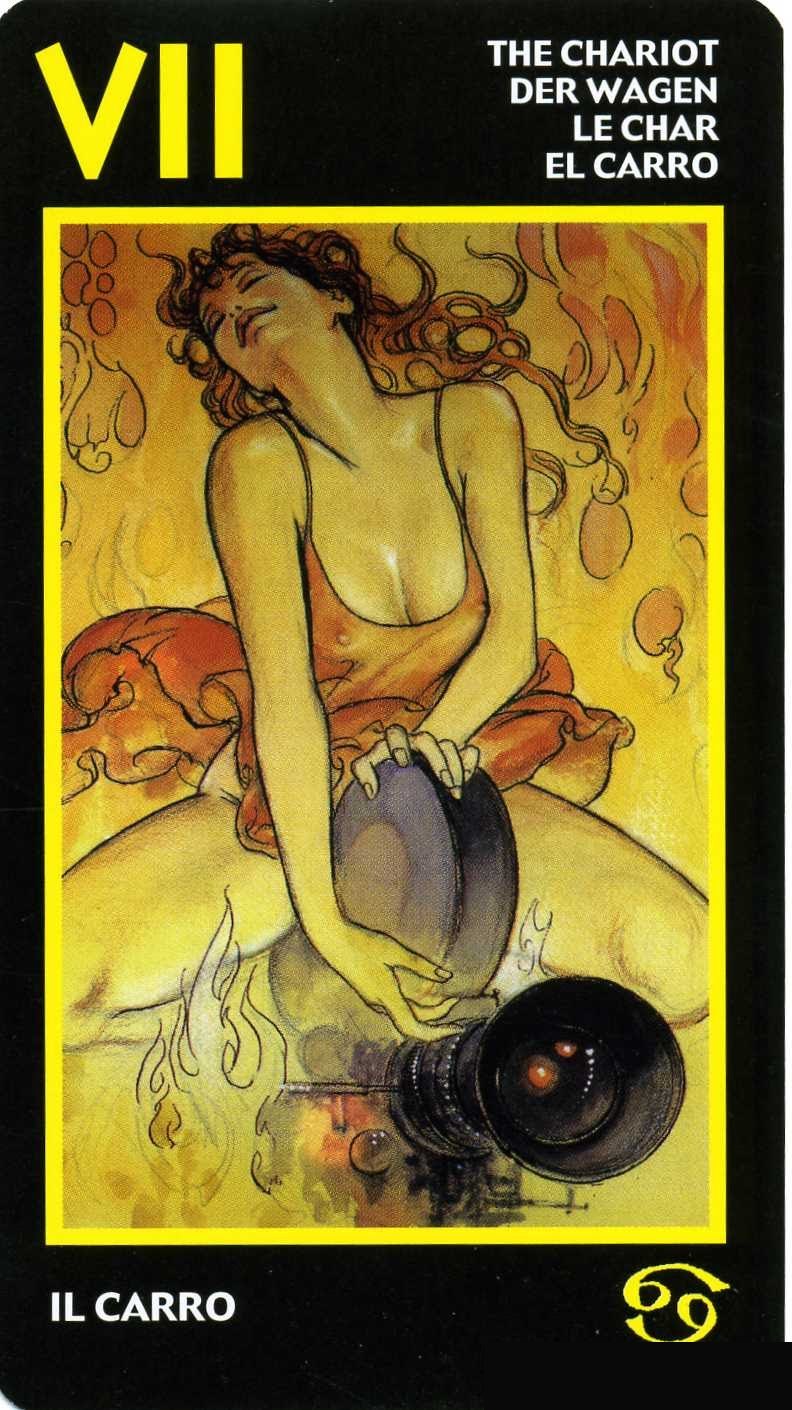
In Milo Manara's erotic tarot, the Chariot becomes a scene of sensual mastery — the power dynamic is embodied, physical, charged with desire. Where the Rider-Waite charioteer commands through pure presence and symbolic authority, Manara's version roots that same will in the body and in intimate tension. Both versions ask the same question at heart — who holds the reins? — but Manara frames it as an erotic charge, a contest of surrender and control between two people, while the Rider-Waite frames it as the inner architecture of a disciplined self moving through the world. The Rider-Waite Chariot speaks to any area of life; Manara's version speaks most directly to desire, dominance, and the power that moves between people in intimate space.
ManaraRider-Waite-Smith
SceneA figure in a charged, sensual scene of physical mastery and intimate tension — the body as the site of will and surrenderAn armored warrior in a stone chariot, held by two sphinxes, moving away from a walled city — will made architectural
FocusErotic power, the interplay of control and desire, physical sovereigntyInner discipline, the mastery of contradiction, forward momentum through focused intention
QuestionWho holds desire in check, and what happens when that control is offered or taken?What do you become when you gather every part of yourself and aim it at a single point?
Symbolism & correspondences
The Chariot is traditionally linked to Cancer — a pairing that surprises until you look closely. Cancer's outer shell is exactly the armor of the charioteer: protective, self-contained, built to move through the world without being unmade by it. The crab moves sideways, crabwise, but it moves with tremendous purposefulness. In Kabbalistic terms, the Chariot sits on the path of the letter Cheth, meaning fence or enclosure — the boundary that defines the self and makes directed movement possible. The number seven, the card's position, carries associations of completion and initiation: the sixth step was the choice, the seventh is the consequence of choosing — motion.
Element
Water
♋
Astrology
Cancer (Cardinal Water) — the sign of the protective shell and forward momentum beneath a soft exterior
✦
Arcana
Major
Ready to see how this card unfolds in your own reading?