Justice is the card of cosmic accounting: you are the sum of your actions, and the present moment is where past and future are weighed against each other. Freedom begins here, when that reckoning is finally met with open eyes.
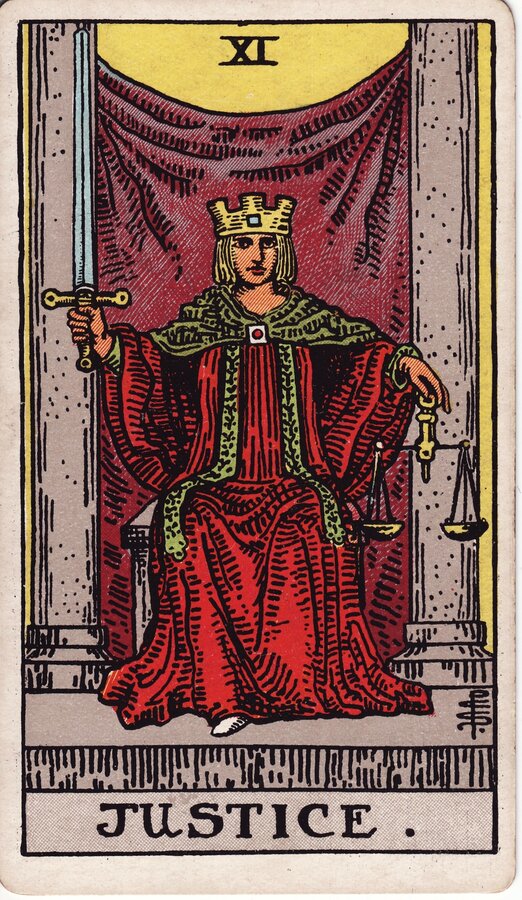
A robed figure sits squarely between two grey stone pillars, facing the viewer without deflection. In her raised right hand, a double-edged sword points straight up — the decision has already been made, the blade drawn with precision rather than anger. In her left hand, scales hang in perfect horizontal balance. A gold crown with a small square at its center rests on her head, and beneath a red cloak a green clasp gleams at the collar. From beneath the robe, the tip of a white shoe is just visible — a quiet signal that even strict judgment carries a thread of mercy. Behind her, a grey curtain closes off the background entirely: no landscape, no distraction, nothing personal.
⚖️The scales — Perfect equilibrium between past and future, action and consequence. Neither plate dips — this is not a verdict already delivered but the moment just before, when everything is still alive and honest.
🗡️The double-edged sword — Raised vertically, not mid-swing: the cut is precise and final, not wrathful. The double edge reminds us that every decision cuts in two directions — toward clarity, and away from illusion.
👑The crown with a square — The small square at the crown's center is the mark of ordered, methodical thought — not intuition or inspiration, but reason applied consistently. Justice wears structure on her head.
🏛️The two pillars — Like the columns flanking the High Priestess, these mark a threshold — but here there is no veil and no secret. The law that governs this space is knowable, visible, and equally applied.
👟The white shoe — A barely visible detail beneath the robe: the white of purity and compassion peeks through even the strictest judgment. The law is not cold — it holds room for mercy, even when it cannot be swayed.
🪟The grey curtain — Nothing behind the figure but a closed backdrop — no nature, no horizon, no sentiment. Justice operates in a space cleared of everything irrelevant. What counts here is only what is measurable.
Interpretation
Justice sits at the exact midpoint of the Major Arcana — the eleventh of twenty-two cards — and this placement is not accidental. It is the hinge of the whole sequence, the moment when the first arc of experience (the outer world, fortune, power) gives way to the inner arc (transformation, dissolution, rebirth). To reach Justice is to arrive at the moment of reckoning, when the sum of every choice you have made is laid on the table and counted. The card does not threaten or console — it simply presents the account.
Justice is closely bound to two neighbors in the Arcana. Wheel of Fortune raises the great question of fate — why did this happen to me? Justice answers: because of what came before. Fate is not arbitrary; it is the shape made by accumulated action. And the Hanged Man who follows is what becomes possible once you accept that answer honestly — the willingness to hang suspended, to let go of your own narrative about who wronged you. Meanwhile, Justice echoes the High Priestess: both sit between twin pillars, both guard a threshold. But where the Priestess holds a secret, Justice holds a verdict. What the Priestess knows silently, Justice says aloud.
In a real reading, this card carries weight in legal and contractual situations — its arrival is generally favorable for anyone whose case rests on solid ground and honest dealing. But its application is far broader than courts: it speaks to any moment where an honest accounting is needed, whether that is a workplace review, a long-deferred conversation in a relationship, or a private reckoning with one's own past choices. The card consistently backs the person willing to weigh themselves by the same standard they apply to others.
When Justice appears alongside The Emperor, the combination speaks to institutional power — structures of authority, law, and hierarchy coming into play. With Judgement, it signals a deeper summing-up: not merely a single situation but a larger life cycle completing itself, with the full weight of the past being lifted and released.
✦ Full InterpretationUnlock the card's full readingFree registration reveals the final paragraphs of the interpretation and gifts you ⭐ for your first spreadyour first spread is on us
Advice & forecast
✦ The card's advice
When Justice appears, the most useful thing you can do is stop arguing your case — at least for a moment — and genuinely put your own actions on the scale. Not to condemn yourself, but to see clearly. The card rewards honesty above strategy: the person who accurately names their role in what has happened, including the uncomfortable parts, is the one who moves through this card's energy and out the other side. Take the practical steps that are yours to take. Sign what needs signing, say what needs saying, complete what you left undone. The sword is already raised; what matters now is that your hands are steady.
🔮 What the forecast holds
What is coming is proportional to what has been. This is not a threat — it is actually a relief, because it means the outcome is knowable and, to a real degree, already shaped by what you have put in. If your efforts have been genuine and your dealings fair, Justice in the future position is one of the more reassuring cards in the deck. If you know there is something unresolved — a debt unpaid, a truth unspoken, a responsibility ducked — this card signals that the moment of settling is approaching. The longer that reckoning has been postponed, the more sharply it arrives. Act from integrity now, while you still have the chance to shape the ledger before it closes.
↓ Justice reversed
When Justice reverses, the scales are still present but no longer level. Something — usually fear, usually pride — has put a finger on one side. The most common expression of this energy is the posture of the perpetual victim: someone who has arranged their inner narrative so that they are always acted upon and never acting, always wronged and never responsible. This is not cynicism to say so; it is simply what the reversed card is pointing at. The freedom that upright Justice offers — the liberation of accepting that you are the sum of your choices — becomes, in reversal, a freedom actively refused. Sometimes the reversal describes external injustice rather than internal: a situation where the rules are being applied selectively, where the powerful escape consequences the powerless cannot, where the letter of the law is weaponized against its spirit. In either case, the shadow of this card is a judgment divorced from genuine discernment — rigid, biased, or hollow. The path back to upright runs through one question asked seriously: what would I see if I looked at my own part in this without flinching?
The card in spreads
The same card reads differently depending on the spread and the question — compare real spreads:
Spread "Past · Present · Future"
Understanding how past choices are shaping a current situation
«Why is this happening to me, and where does it lead?»
What the Wheel has turned
Wheel of Fortune
The reckoning at the center
Justice
What awaits after acceptance
The Hanged Man
This three-card axis is one of the most resonant positions for Justice, because it places her exactly where she belongs: as the pivot between what was and what comes next. Wheel of Fortune in the past position names the forces that set things in motion — the turn of fortune, the cycle that could not be controlled. Justice at the center is the moment of accounting: the Wheel asked 'what happened?', and Justice answers 'because of this.' She does not say it cruelly; she says it clearly. Whatever the Wheel brought in — loss, gain, disruption, opportunity — Justice now weighs against the choices made in response to it. The Hanged Man in the future position is deeply significant: it is the card that follows directly from an honest reckoning, the willingness to stop struggling and let the new understanding hang in you until it has done its work. If Justice is reversed in the center, the path to the Hanged Man's quiet transformation is blocked — the person is still arguing with the scale rather than reading it.
Spread "The Two Sides"
Examining a conflict or decision with genuine fairness
«Am I seeing this situation honestly, or only from my own side?»
What I am not seeing — the other blade
Two of Swords
The honest weight of the situation
Justice
What inner clarity has to offer
The Hermit
Justice in the center position here functions as a literal scales: one plate holds what you already know and feel about the situation, the other holds what you have been unable or unwilling to see. Two of Swords in the first position is telling — that card speaks to deliberate not-looking, the blindfold worn not from ignorance but from choice. Something is being blocked from view. Justice asks you to lower the blindfold and place both blades — your truth and the other — on the scale together. The Hermit in the final position offers the resolution: not external vindication but an inward light, the kind of clarity that can only arrive after honest examination. This spread is at its most useful when you are in conflict with another person or facing a decision where you suspect your own bias. Read the Two of Swords as the specific thing you are avoiding, and the Hermit as what becomes possible once you stop.
✦ PremiumUnlock the Full ReadingSpread "The Two Sides": position-by-position reading, card combinations, and guidanceOpen with subscription →first spread is free
Spread "Where Do I Stand?"
A check on accountability and personal integrity in a situation
«What is my actual role in this, and what do I owe?»
The honest account — what is actually true
Justice
What external authority or structure is in play
The Emperor
What the path forward requires of you
Temperance
This spread asks a direct and sometimes uncomfortable question: not what should happen to me, but what is actually happening, and what is my responsibility in it. Justice in the opening position is the foundation — read this card as the true state of affairs, stripped of the story you have been telling yourself. Whatever it shows, that is the honest ledger. The Emperor in the second position brings in the structural layer: institutions, rules, authority figures, contracts, hierarchies — whatever external framework is making its claims on the situation. Is that structure working fairly, or is it part of the problem? Finally, Temperance as the forward position offers not a prediction but a requirement: the path out runs through patient, deliberate recalibration. Not a dramatic reversal but a careful re-pouring — adjusting, integrating, restoring flow. This spread is particularly suited to situations involving legal matters, workplace disputes, or any moment where you need to know where you actually stand before deciding how to move.
✦ PremiumUnlock the Full ReadingSpread "Where Do I Stand?": position-by-position reading, card combinations, and guidanceOpen with subscription →first spread is free
How it differs from Manara
Manara Erotic TarotJustice
vs
Rider-Waite-SmithJustice
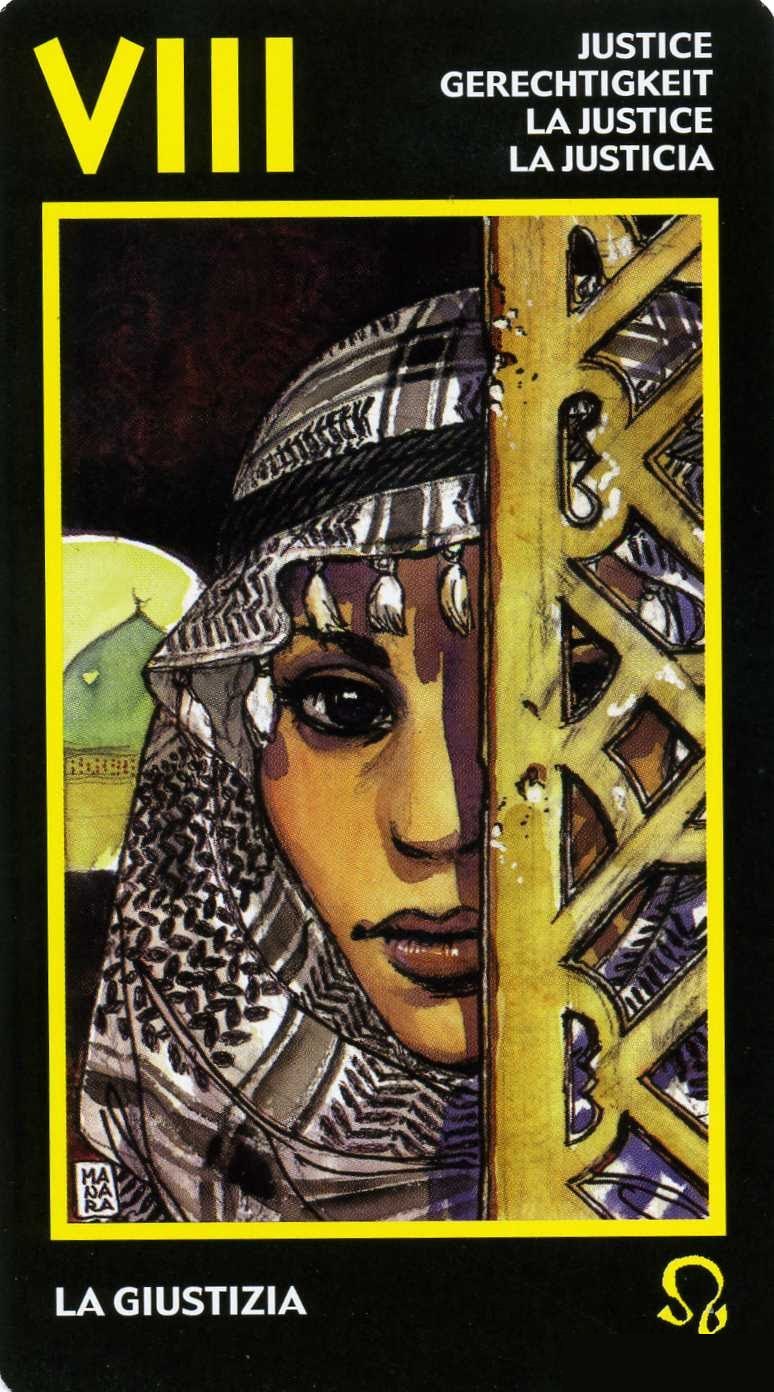
In the Milo Manara Erotic Tarot, Justice becomes a scene of intimate power and physical exposure: a figure whose authority is written on the body, whose judgment is charged with desire and vulnerability rather than detachment. The question Manara's version asks is personal and sensory — who holds power over you, and do you submit to it freely? The Rider-Waite image, by contrast, strips the scene of all heat and personality. Its Justice is institutional: robed, still, and wholly impersonal. The sword and scales address not your longing but your ledger. Where Manara's card pulses with body memory and the sting of consequence felt in flesh, the Waite-Smith version is closer to a courtroom — impartial, procedural, and demanding the same standard of everyone.
ManaraRider-Waite-Smith
SceneAn erotically charged figure whose authority is expressed through the body — exposure, posture, and tension between control and surrenderA robed, enthroned figure flanked by stone pillars, holding raised sword and balanced scales — institutional, still, impersonal
FocusIntimate justice: the power dynamics of desire, the sting of consequence felt in the body, surrender to what is trueCosmic accounting: cause and effect made visible, the impartial weighing of past against future
QuestionWho holds power in this bond, and are you honest about what you want from it?Have you accounted for everything — including your own part in what has happened?
Symbolism & correspondences
Justice corresponds to Libra, the cardinal Air sign ruled by Venus — the one zodiacal figure that is an object rather than a person or animal, a tool of measurement rather than a living being. Libra's energy is oriented entirely toward balance, relationship, and the weighing of competing truths. The Air element places Justice in the domain of the mind and language: this is not an emotional or physical reckoning but a rational one, conducted in the clear light of reason. In the Kabbalistic Tree of Life, Justice is linked to the path of Lamed — the path of correction and adjustment, the movement that restores equilibrium when the system has drifted. Together, these correspondences frame Justice as the card of active, conscious alignment: not the balance that simply happens, but the balance that is chosen.
Element
Air
♎
Astrology
Libra — cardinal Air; the sign of the scales, partnership, and deliberate choice
✦
Arcana
Major
Ready to see how this card unfolds in your own reading?