The Five of Swords is the card of the pyrrhic victory — the moment you realize that winning at any cost means losing the things that made winning meaningful. It holds the uncomfortable mirror of conquest without honor.
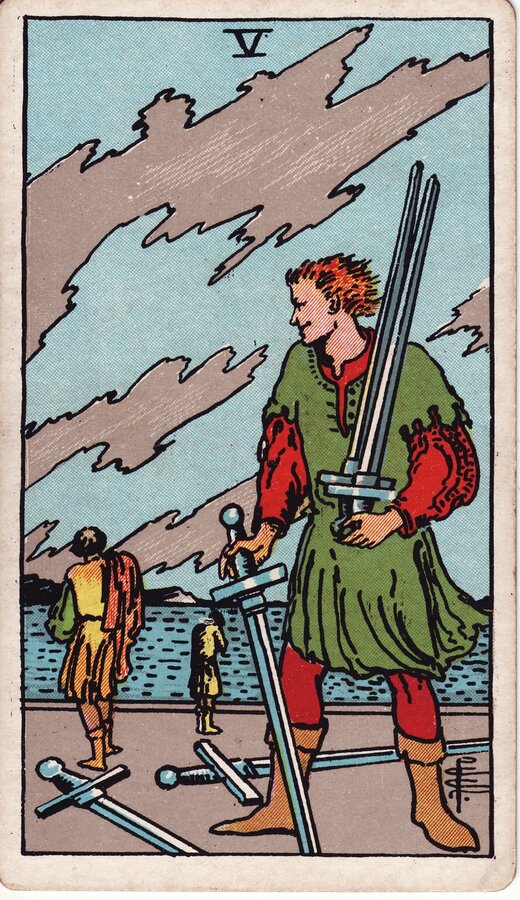
A young man stands in the foreground, facing us with a half-smile that carries more contempt than joy. He holds three swords, two propped against his shoulder and one pointing toward the earth. Two more swords lie at his feet, abandoned by the two figures now retreating across the field. One of those figures covers his face; the other walks with bowed head toward the churning grey water. Above everything, the sky is torn with ragged, turbulent clouds — the air itself in disarray.
😏The smirk — Not triumph but contempt — this victory brings satisfaction only in the other's defeat, not in any genuine achievement
⚔️Three seized swords — Accumulation of power through taking rather than earning; the victor carries more than he can use and still it feels empty
🗡️Two swords on the ground — The abandoned weapons of the defeated — surrender made visible, but also a weight dragging down the victor who must now account for them
🙈The figure covering his face — Shame as a response to defeat — the inward collapse that mirrors the outward loss
🌊The retreating figure moving toward water — The need to cleanse and leave — water as the element of healing after the arid wound of this conflict
☁️The torn sky — Swords rule the mental realm and the air; these violent clouds show the mind — and the world — in genuine upheaval after the confrontation
Interpretation
The Five of Swords arrives when the pursuit of winning has outpaced any memory of why we wanted to win. It names a very human trap: the escalation of conflict past its original cause until the fight itself becomes the goal. The figure with his half-smile has not conquered an enemy — he has conquered his own capacity for meaningful connection. This is the card of the hollow crown, the battlefield where the trophy turns to dust as soon as it is lifted.
Within the arc of the Swords suit, this card sits at a difficult midpoint. After the Four of Swords — rest, withdrawal, recuperation — the Five brings a violent return to action, but without the clarity or purpose that might make that action worthwhile. The adjacent Six of Swords shows what can follow: a quiet departure by water, moving away from turbulence toward calmer shores. The Five must be lived through before that passage becomes possible. It echoes the Five of Wands in its love of conflict, but where the Wands five is energetic and almost playful — a scuffle among rivals who respect each other — the Swords five is cold, deliberate, and unkind.
In a spread, this card often points to a specific recent conflict or ongoing power struggle. It can signal that someone around the querent is acting in bad faith, playing to win rather than to resolve. It can also reflect the querent's own shadow: the part that keeps score, that cannot back down, that would rather be right than be in relationship. In position of outcome, it is a warning: the path you are on leads to a victory you will not want.
When paired with The Devil, the Five of Swords takes on a deeper shadow — both cards speak to the logic of domination and the chains it builds around the one who wields it. Alongside Seven of Swords, the victory of the Five slides from open aggression into concealed strategy: from contempt to theft. The Three of Swords nearby suggests the conflict has already drawn blood at the heart level; the Five shows how the wound was made.
✦ Full InterpretationUnlock the card's full readingFree registration reveals the final paragraphs of the interpretation and gifts you ⭐ for your first spreadyour first spread is on us
Advice & forecast
✦ The card's advice
Before you press the point, pause and ask what you are actually defending. Sometimes the thing worth protecting is not the argument but the relationship the argument is threatening. If you have already won in a way that left a bad taste, consider that the card is not celebrating your victory — it is showing you its cost. You are not obligated to keep fighting every battle that presents itself. Walking away with your integrity intact can be a deeper form of winning than grinding an opponent into the ground. The swords you carry weigh more than you think.
🔮 What the forecast holds
A confrontation is approaching — or already underway — where the terrain is slippery and the stakes feel higher than they should. You may be tempted toward a move that would secure a win but compromise your standing or your conscience. The card in future position does not necessarily predict defeat; it warns that the version of victory most easily reached here comes at a hidden price. Consider what you would feel the morning after the battle, once the adrenaline has passed. The wiser path may be slower, less satisfying in the short term, and much cleaner in the long.
↓ Five of Swords reversed
Reversed, the Five of Swords carries the weight of aftermath — sometimes the quiet grief of something finally, irrevocably over, and sometimes the first tentative light of reconciliation after prolonged hostility. The original card speaks of the battle; reversed, it speaks of what remains in the battle's wake. There may be shame arriving belatedly, consequences from old aggressions surfacing only now. In a gentler reading, the reversal signals that someone is ready to lay down their sword — to admit they pushed too hard, to reach back across the silence. This is not easy; it requires the ego to do something the upright Five refused. In its heaviest expression, reversed, the card brings genuine loss to finality: the legal dispute that ends badly, the friendship that cannot recover, the chapter that closes with grief rather than resolution. Whatever the tone, the reversed Five asks you to reckon honestly with what the fight actually cost.
The card in spreads
The same card reads differently depending on the spread and the question — compare real spreads:
Spread "The Cost of Winning"
Examining what a conflict is truly taking from you
«What am I gaining in this struggle, and what am I losing that I haven't named yet?»
The battleground — what the conflict is actually about
Two of Swords
The victory — what winning looks like and what it costs
Five of Swords
The passage — what becomes possible if you step back
Six of Swords
Begin with Two of Swords in the first position: it names the stalemate or the choice being avoided, the core tension beneath the surface conflict. The Five of Swords in the center is your protagonist — it holds the dynamic of the struggle as it stands right now, who holds the swords and who is walking away. Read it honestly: are you the one smirking, or the one covering your face? The Six of Swords at the close shows the transit available — not a retreat, but a dignified passage to calmer water. When these three appear together, the spread is often asking: the fight can be won, but is the destination worth the crossing? The answer almost always points toward release rather than escalation.
Spread "The Shadow Victory"
Uncovering the unconscious drive behind competitive or aggressive behavior
«What am I really trying to prove, and to whom?»
The authority wound — what early experience of power shapes this
The Emperor
The present pattern — how this wound expresses itself now
Five of Swords
The integration — how to hold strength without weaponizing it
Temperance
The Emperor in the root position reaches into old stories about authority, strength, and what it meant to lose — or to be defeated by someone who should have protected you. The Five of Swords at center shows how that old wound is playing out in present behavior: the compulsion to dominate, to pre-empt vulnerability by attacking first, to mistake control for safety. Temperance in the final position offers the counter-medicine — the slow alchemy of integrating opposites without destroying one of them. This spread works best when the querent suspects their own role in a repeating conflict but hasn't yet named it.
✦ PremiumUnlock the Full ReadingSpread "The Shadow Victory": position-by-position reading, card combinations, and guidanceOpen with subscription →first spread is free
Spread "After the Battle"
Reading the aftermath of a conflict that has already concluded
«How do I move forward with integrity from something that ended badly?»
What happened — the nature of the wound or the wrong
Five of Swords
What was left behind — the grief or loss that needs acknowledging
Five of Cups
The path forward — what solitude or reflection can offer now
The Hermit
The Five of Swords anchors the spread in honest accounting: something was taken, something was broken, and naming it clearly is the first act of repair. Four of Cups in the second position surfaces the emotional residue — the regret, the numbness, the things that were not grieved at the time because the fight was still happening. This is the card of unprocessed feeling, and it is important that it be given room here rather than bypassed. The Hermit in the closing position is a generous guide: not isolation as punishment, but chosen solitude as a space for the kind of reflection that only comes after the noise subsides. In this spread, the Five is not a verdict — it is a starting point.
✦ PremiumUnlock the Full ReadingSpread "After the Battle": position-by-position reading, card combinations, and guidanceOpen with subscription →first spread is free
How it differs from Manara
Manara Erotic TarotFive of Air
vs
Rider-Waite-SmithFive of Swords
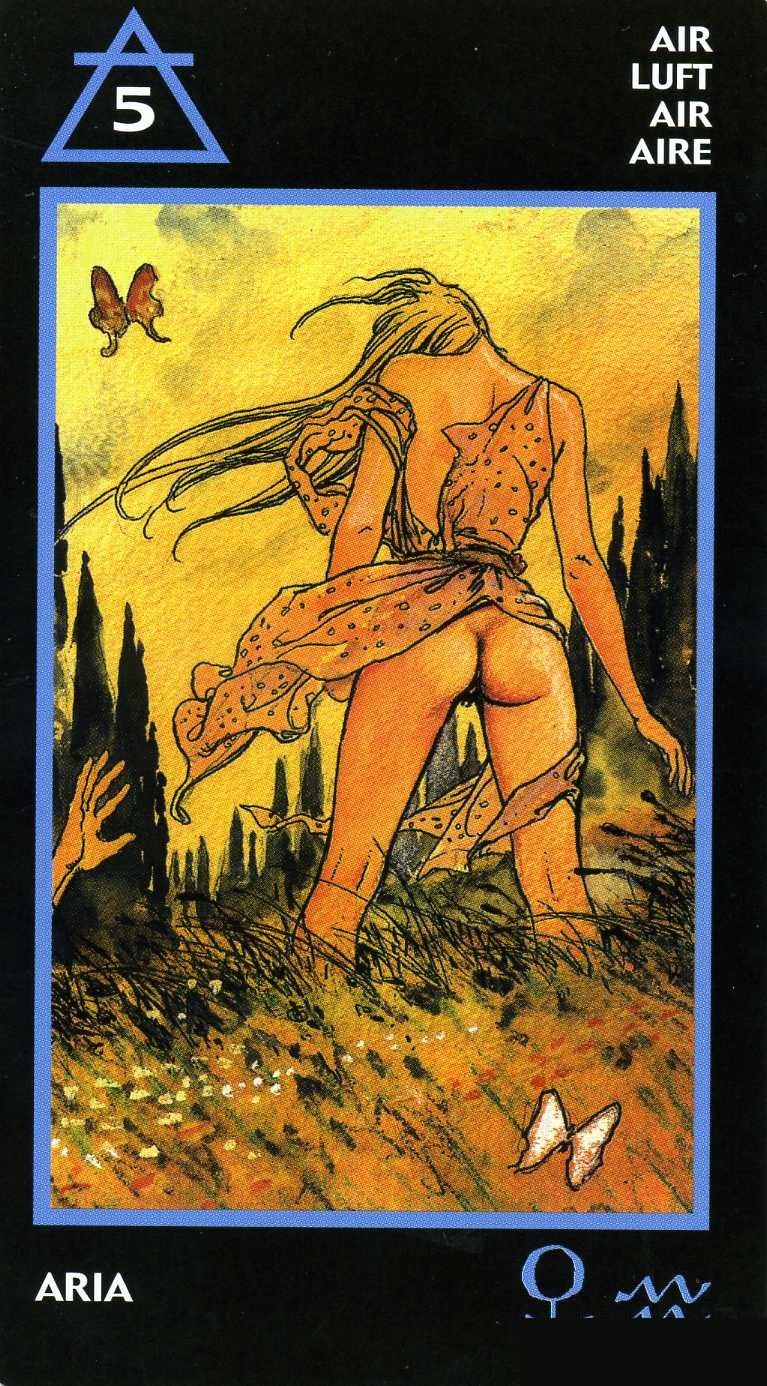
In the Rider-Waite-Smith image, the Five of Swords frames its conflict in broad archetypal strokes: a barren field, three anonymous figures, the cold geometry of swords. The emotional charge is implied rather than felt — we understand the humiliation intellectually through posture and expression. Milo Manara's version brings the scene into the body and the bedroom: the power dynamic is rendered through desire, possession, and the vulnerability of skin. Where Waite's victor smirks at a distance, Manara's figure claims intimacy itself as the battlefield. The Waite card asks 'what have you won and at what cost?' — a moral and strategic question. Manara asks 'who holds power over whom in the space of closeness?' — an erotic and psychological one. Both are honest about domination; they differ in the arena where that domination plays out.
ManaraRider-Waite-Smith
SceneA charged erotic confrontation where one figure asserts power over another through desire and proximityA barren field after battle: one man collects swords while two defeated figures retreat toward the grey water
FocusThe erotics of dominance — seduction as conquest, the body as territory won or surrenderedThe moral hollow of winning by any means — triumph that diminishes the victor along with the defeated
QuestionWho surrenders themselves in desire, and is that surrender freely given or taken?What is the true cost of a victory achieved without honor, and who really loses?
Symbolism & correspondences
Venus in Aquarius governs this card — a placement that illuminates the cold paradox at the Five's heart. Venus seeks beauty, harmony, and connection; Aquarius imposes distance, abstraction, and the ideology of principle over feeling. The result is a love of being right that overrides the love of being close. This astrological tension explains why the card's conflicts are often not heated in the usual sense — they are chilly, strategic, conducted from behind a wall of intellect. The air element of Swords reinforces this: the mind is the weapon and the wound. When you find this card in a reading, notice where cool logic is being used to justify unkindness.
Element
Air
◆
Arcana
Minor
Suit
Swords
Ready to see how this card unfolds in your own reading?