swift actiondecisive forcecouragedirectnessintellectual drive
The Knight of Swords is the mind made kinetic — thought without delay, intention without softening. He is both the hero who arrives just in time and the storm that leaves wreckage in its wake.
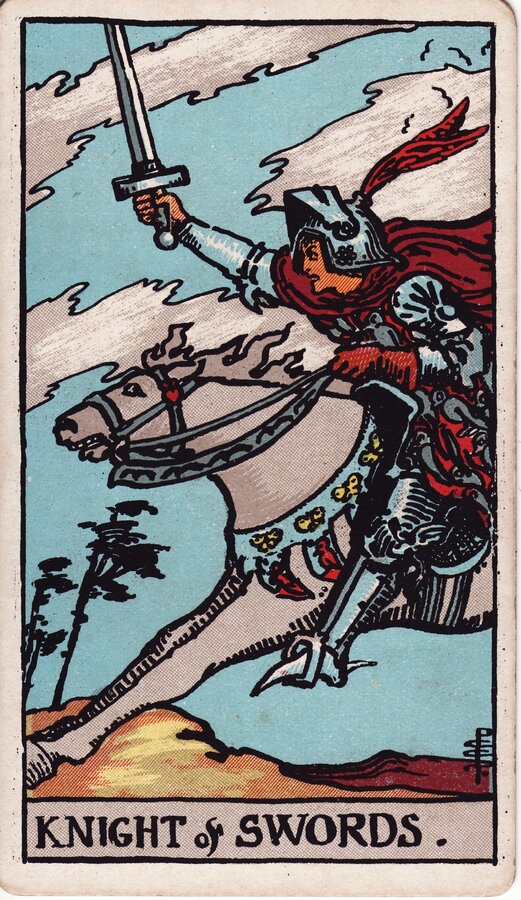
A knight in full silver armor thunders across an open sky on a white horse, his sword raised and angled forward, aimed at what lies ahead. The horse's mane and the knight's red plume stream wildly backward. Storm clouds billow and bend as if the air itself parts for them. Trees at the edge of the image twist under the wind's pressure. Birds scatter. Nothing in the scene is still.
🐴White horse — Pure momentum — speed and devotion to a direction, with the horse's will indistinguishable from the rider's
⚔️Raised sword — The sword tilts forward, not skyward — it points toward a target, not a gesture; this is readiness to strike, not ceremony
🛡️Full armor — Protection, but also enclosure — the knight is unreachable in his charge; no conversation is possible at this speed
🔴Red plume and cloak — Passion running ahead of thought; the heat of urgency that has not been cooled by reflection
🌬️Bending trees and clouds — The Air element at full velocity — the atmosphere itself is reshaped by this force passing through it
🦋Butterflies on the harness — Fleetingness and light touch — the blow lands and the knight moves on; nothing about this energy lingers
Interpretation
The Knight of Swords sits at the intersection of youth and intellect, belonging to the suit that governs thought, conflict, and the double edge of clarity. Unlike the Page who observes and the King who judges, the Knight acts — he is the moment thought becomes deed, the fraction of a second between the decision and the movement. There is something heroic in this, and something dangerous. Every breakthrough that required someone to simply go has this Knight's energy somewhere in its origin.
Within the arc of the Swords suit, this Knight occupies a charged middle position. The Ace of Swords gives the blade; the Page of Swords learns to hold it; the Knight wields it at full gallop. Ahead lies the Queen of Swords, whose clarity is hard-won from experience, and the King of Swords, whose judgment has absorbed all that impulsive speed and made it deliberate. The Knight is not yet there — but this charge, if it does not destroy him, is exactly the path that leads to those courts. He rhymes with The Chariot, which shares his directed motion but adds the hard-learned discipline of the reins.
In a spread, this card almost always signals speed. Events are accelerating. Someone is coming — or needs to come — without delay. It can describe a person in the querent's life: sharp, forceful, sometimes abrasive, someone who moves at a pace that leaves others scrambling. It can also describe an internal state: the moment when the querent has finally stopped deliberating and is ready to act. Context matters enormously — in a supportive spread, this is liberation; surrounded by difficult cards, it is a warning about collateral damage.
When the Knight of Swords appears alongside The Tower, the charge is heading toward a structure that will not survive impact — which may be exactly what is needed, or exactly what must be avoided. Paired with Knight of Cups, the two Knights form a study in contrast: one arrives with a sword raised, the other with a cup extended. The same event — an approach, an arrival — read entirely differently depending on which Knight stands there.
✦ Full InterpretationUnlock the card's full readingFree registration reveals the final paragraphs of the interpretation and gifts you ⭐ for your first spreadyour first spread is on us
Advice & forecast
✦ The card's advice
When the Knight of Swords appears as advice, the message is rarely subtle: you already know what needs to be done, and the cost of delay is growing. This is not the card that asks you to gather more information or weigh competing factors — those steps are behind you. The card is asking whether you have the courage to act on your own knowing. Move decisively, communicate plainly, and resist the pull to soften your position in ways that ultimately serve no one. At the same time, hold one sliver of awareness about direction: speed is only power when aimed. Before you charge, confirm you know what you are riding toward.
🔮 What the forecast holds
In the near future, something arrives quickly — a person, a decision, an event that will not wait for convenient timing. You may not have all the information you would like before this moment lands, and that is precisely the point. The Knight of Swords in a future position promises that the pace of events is about to increase. A confrontation you have been circling may resolve itself through sheer momentum. A door that required patience may suddenly be kicked open. Prepare yourself for speed, and for the clarity that can only come from being in motion.
↓ Knight of Swords reversed
Reversed, the Knight of Swords is a forceful energy that has lost its compass. The charge continues — but it is no longer aimed at anything worth reaching. This can manifest as impulsive arguments that escalate past the point of usefulness, ambitious actions that scatter resources without building toward a result, or a relentless forward motion that exhausts everyone nearby without producing change. There is often a quality of frustration here: the energy is undeniable, but it keeps striking the wrong targets. Sometimes this reversal speaks to someone who has been fighting a battle they cannot win, locked in opposition to a force that will not yield. The wisdom of this position is not to stop — it is to pause long enough to ask: what am I actually trying to accomplish? Once that answer is clear, the Knight's full power is available again.
The card in spreads
The same card reads differently depending on the spread and the question — compare real spreads:
Spread "The Charge"
Clarifying a bold decision or rapid move
«Should I act on this now, and what will the impact be?»
The blade — what you are cutting toward
Ace of Swords
The charge — your current energy and approach
Knight of Swords
The aftermath — what this move will cost or leave behind
Six of Swords
This three-card draw is built for the moment when you are already leaning forward, sword in hand, and need to know whether to trust that impulse. The Ace of Swords in the first position shows the core truth at the center of your decision — the thing you are really cutting toward, whether you have named it yet or not. The Knight of Swords in the center is you: how you are moving, the quality of your charge. Honest reading here means asking whether the Knight's energy in this moment is brave or reactive. The Five of Swords in the outcome position is a pointed reminder that every act of force leaves a field — look at what remains after the charge and ask whether you can live with that landscape. This spread will not tell you to hesitate; it will tell you what you are truly deciding.
Spread "Two Knights"
Navigating a conflict or divergent approach with another person
«Where does our energy clash, and what can we build together?»
The other approach — what the other person or part of you is bringing
Knight of Cups
The friction point — where your directness is meeting resistance
Knight of Swords
The path forward — how to direct this combined force
The Chariot
The Knight of Cups and the Knight of Swords represent two ways of moving through the world — one with feeling extended, one with blade raised. When these energies meet, the friction is real and often productive, though it rarely feels that way in the moment. The Knight of Swords in the center names the specific place where directness is creating friction — the communication style, the pace, the refusal to soften. Neither approach is wrong; they are simply moving at different speeds and in different modes. The Chariot as the path forward asks both parties to learn what disciplined, directed movement looks like when you hold two horses that pull differently. The charge does not need to become a walk — it needs a rein.
✦ PremiumUnlock the Full ReadingSpread "Two Knights": position-by-position reading, card combinations, and guidanceOpen with subscription →first spread is free
Spread "Before the Strike"
Preparation before a high-stakes confrontation or major initiative
«Am I ready, and what do I need to know before I act?»
The judgment — what your most considered self would advise
King of Swords
Your readiness — the energy you are actually bringing
Knight of Swords
The unknown — what you have not accounted for yet
Seven of Swords
This spread exists for the pause between decision and action — that sliver of time when the Knight's horse is already moving but the sword has not yet landed. The King of Swords in the first position asks you to access your own capacity for dispassionate judgment: what do you know, clearly and without defensiveness, about this situation? The Knight of Swords in the center reflects back the quality of your current readiness — brave and aimed, or urgent and scattered? The Seven of Swords in the final position is the card of hidden factors and incomplete information. It asks: what do you not yet know, and does the gap matter? Sometimes the answer is that you know enough and must act anyway. Sometimes it reveals exactly the question you needed to ask before charging in.
✦ PremiumUnlock the Full ReadingSpread "Before the Strike": position-by-position reading, card combinations, and guidanceOpen with subscription →first spread is free
How it differs from Manara
Manara Erotic TarotKnight of Air
vs
Rider-Waite-SmithKnight of Swords
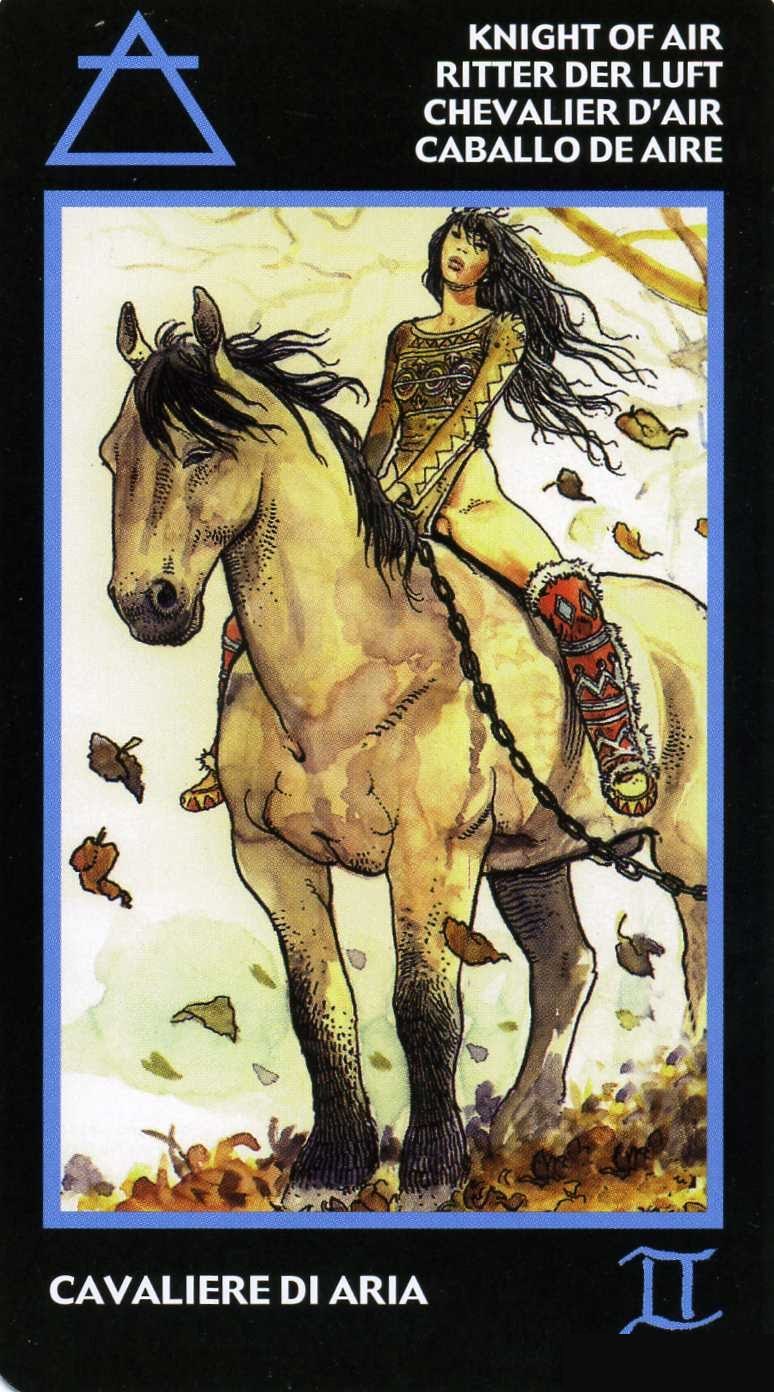
In the Rider-Waite image, the Knight of Swords is all momentum and impersonality — armored, unapproachable, his identity absorbed into the charge. The human body is hidden; what we see is force, metal, and speed. The Manara version brings the body back into focus. Where Waite gives us a figure made abstract by armor, Manara gives us a figure whose desire and drive are visible in the flesh — the charge becomes intimate, the urgency becomes erotic. Waite's question is: where is this force aimed, and who stands in its path? Manara's question is: what does it feel like when someone comes for you with that kind of certainty? Both versions share the essential quality of directed intensity, but Waite frames it as an external event and Manara frames it as a felt experience.
ManaraRider-Waite-Smith
SceneA sensual figure in motion, the body itself the vehicle of force and desire — intimate, immediate, physically presentAn armored knight on horseback mid-charge, all visible humanity sealed inside silver plate and speed
FocusThe experience of being pursued or of pursuing — desire as momentum, the body as the swordDirectional force and decisive action — the mind as weapon, speed as virtue
QuestionWhat does it feel like to want something this completely, to move toward it without hesitation or apology?Is this charge aimed at something worth hitting — and who will be standing in the way when it arrives?
Symbolism & correspondences
The Knight of Swords belongs to the Air element in its most accelerated form — specifically the Venus decan of Capricorn moving into Aquarius, where mental energy is sharpest and least burdened by sentiment. Air suits the sword's nature perfectly: invisible, fast-moving, capable of tremendous force with no visible mass. This is thought at its most kinetic — the kind of mind that processes rapidly, speaks directly, and has little patience for the pace at which feelings move. When this Knight appears, the air in the room has a charge to it.
Element
Air
◆
Arcana
Minor
Suit
Swords
Ready to see how this card unfolds in your own reading?