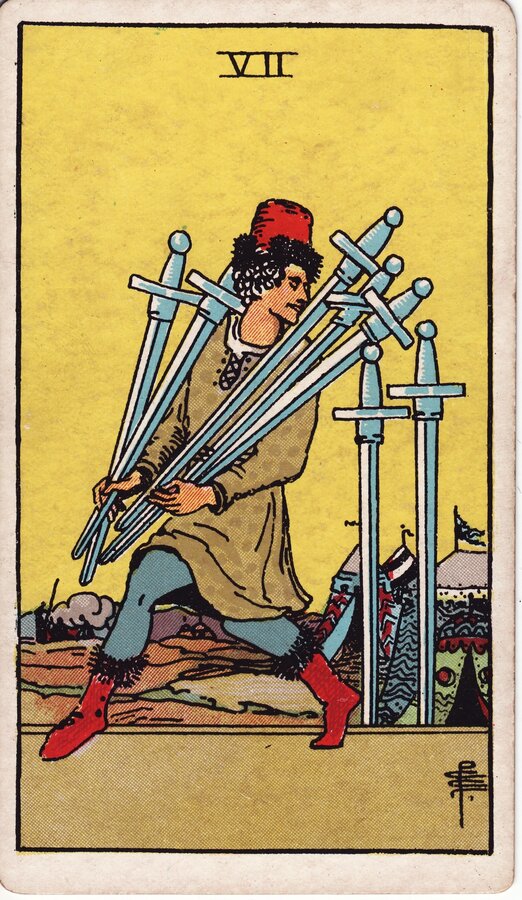
The Seven of Swords is the card of intelligence applied to avoidance — the mind that prefers the oblique angle, the exit through the side door, the victory that leaves no witnesses. It holds both the genuine gift of tactical thinking and the shadow of using that gift to escape accountability.
A man moves on tiptoe across pale, slightly sickly morning ground, his body angled away from a military encampment behind him. He carries five swords clasped in both arms, blades pointing upward, gripping them by the hilts as though collecting ownership rather than weaponry. Over his shoulder he glances back with a half-smile — an expression that sits exactly between triumph and unease. Two swords remain planted in the earth behind him; they are the part he could not take, the evidence he could not erase. In the far background, tiny figures stand beside yellow pavilions, absorbed in their own activity, apparently unaware. The sky above is the pale yellow of an overcast morning — neither welcoming nor dark, a light without warmth or clarity.
🗡️Five swords carried — The portion of power seized — significant but incomplete; ownership of blades implies control over others' capacity to fight
⚔️Two swords left behind — The irreducible remainder — what could not be taken, the limit of the clever plan, the evidence that lingers
👣Tiptoe posture — The body language of the thief, not the warrior; action calibrated for invisibility rather than force
😏Over-the-shoulder glance — Self-satisfaction mixed with anxiety — the half-smile of someone who knows the plan has worked but also knows it is not quite finished
🏕️The encampment — Someone else's territory — the operation occurs within a space the figure does not own, borrowing from what belongs to another
🌅Pale yellow sky — An ambiguous light — not the gold of success nor the dark of failure, but a queasy in-between that refuses to resolve
Interpretation
The Seven of Swords names one of the oldest human moves: the sideswipe, the workaround, the solution that operates below the level of official notice. It appears wherever someone has decided — consciously or not — that the direct path is too expensive, too dangerous, or simply unavailable. This is not always dishonest; sometimes the system genuinely is rigged and cleverness is the only lever left. But the card never lets you forget the two swords still standing in the ground: the incomplete nature of anything built on concealment.
Within the arc of the suit, this card sits between Six of Swords — the quiet departure from troubled waters — and Eight of Swords — the figure bound and blindfolded by her own beliefs. The Six carries the hope that passage to calmer ground is possible; the Seven risks the discovery that the passage was partly theft; the Eight shows what happens when the schemes of the clever mind turn inward and trap the one who ran them. It is a sobering progression, and the Seven stands at its hinge. Related echoes appear in the Magician (The Magician), who also works with tools that are not quite his own, and in the Moon (The Moon), whose waters are ruled by the same Moon-in-Aquarius energy that governs this card — though the Moon's deceptions are interior where the Seven's are outward.
In practice, the Seven of Swords appears when someone in the reading is operating on less than full disclosure — either the querent, or a person around them. It may mark a situation requiring genuine tactical finesse (negotiating quietly before announcing, gathering information before committing), or it may be gently pointing at evasion disguised as strategy. The card rarely accuses; it tends to ask a quiet question. It can also describe someone who has successfully removed themselves from a situation — left without confrontation, extracted without explanation — and must now live with what they took and what they left.
When the Seven of Swords appears alongside The Devil the evasion has likely become a pattern with real costs; alongside The Lovers it often marks a secret in a relationship; and near Justice it suggests the reckoning that indirection eventually invites.
✦ Full InterpretationUnlock the card's full readingFree registration reveals the final paragraphs of the interpretation and gifts you ⭐ for your first spreadyour first spread is on us
Advice & forecast
✦ The card's advice
When this card appears as guidance, it is rarely telling you to be more sneaky — it is more often pointing out that you already are, and asking whether it is still necessary. Tactics that made sense under real constraint can calcify into habit, leaving you moving in shadow long after the threat has passed. Look honestly at what you are withholding and why. Is it protection, or is it avoidance? The two swords in the ground are not just the cost of the plan — they are the part of the situation you have not yet dealt with. At some point it will be worth going back for them.
🔮 What the forecast holds
In a future position, the Seven of Swords suggests a situation that will call for nimbleness over force — a moment where a clever pivot or a quiet move serves you better than direct confrontation. It may also be forecasting the discovery of something that has been handled off the books, either by you or around you. Either way, what is coming requires mental flexibility and a clear-eyed honesty with yourself about your own motives. The partial victory this card promises is real; the question is whether you can live with what it costs.
↓ Seven of Swords reversed
When the Seven of Swords falls reversed, the walls of the plan come down — sometimes all at once, sometimes in slow erosion. A secret surfaces, a scheme is recognized, a carefully maintained ambiguity is finally named. This can feel like catastrophe in the moment, but the card reversed is not purely punitive: exposure of what was hidden is also a form of relief, and often the only route to something more durable. The reversed card also speaks to self-deception — the stories we run internally to justify decisions we know are not entirely clean. Imposter syndrome, the creeping sense of unworthiness, frequently lives here: the conviction that success was not earned but borrowed, and that someone will eventually ask for it back. Reversed, the Seven invites you to stop defending the theft — whether you stole something from another or from yourself — and begin the more interesting work of being honest about what you actually want.
The card in spreads
The same card reads differently depending on the spread and the question — compare real spreads:
Spread "The Audit"
Examining what is hidden and whether it still needs to be
«What am I carrying in secret, and what does it cost me?»
What remains in shadow
The Moon
The strategy in play — what is being carried away
Seven of Swords
What honest reckoning looks like
Justice
This three-card draw is built around the Seven of Swords as the central action — the thing you are doing, the move you are making, the information you are holding close. The Moon in the first position illuminates what is genuinely unresolved beneath the surface: the fear, the confusion, or the private narrative that makes the concealment feel necessary. The Seven of Swords in the centre is the plan itself — look at what specifically is being avoided or circumvented, and notice whether the posture feels like genuine strategy or like habit. Justice in the third position is not a threat; it is a picture of what clarity would actually look like in this situation, the version of the outcome where nothing needs to be carried quietly. Read these three together as a timeline: what is murky, what you are currently doing about it, and what becomes possible if you set down some of what you are carrying.
Spread "The Workaround"
Finding the right indirect path when the direct one is genuinely closed
«How do I move through this obstacle without losing integrity?»
What you are moving away from
Six of Swords
The oblique route available
Seven of Swords
What forward movement actually looks like
The Chariot
Sometimes the Seven of Swords is not about deception at all — it is about finding a way through a terrain where the obvious paths are blocked. Six of Swords in the first position anchors what you are in the process of leaving: the troubled water, the situation that has run its course. The Seven of Swords describes the specific manoeuvre available to you — the indirect angle, the quiet preparation, the move made before anyone knows you are moving. Notice whether the swords you are carrying feel like tools or like stolen goods; this reading only works cleanly if the route you are choosing is tactically creative rather than ethically evasive. The Chariot in the third position holds the vision of what disciplined, directed momentum looks like at the far end of this passage — the moment when you can move openly again, with full ownership of what you carry.
✦ PremiumUnlock the Full ReadingSpread "The Workaround": position-by-position reading, card combinations, and guidanceOpen with subscription →first spread is free
Spread "What Was Left Behind"
Understanding the incomplete victory and what still needs resolution
«What did I not finish, and what would it take to go back for it?»
The partial victory — what was taken
Seven of Swords
What keeps you from addressing what remains
Eight of Swords
The path toward wholeness
Temperance
The two swords left in the ground are the heart of this spread. The Seven of Swords in the first position maps the partial victory: what was accomplished, what was taken, and what the shape of the current situation actually is. Eight of Swords in the second position points to the internal bind — the belief or the fear that makes returning to the incomplete thing feel impossible, the story you are telling yourself about why the two left-behind swords simply cannot be retrieved. Look honestly at this card: is the obstacle as solid as it appears? Temperance closes the spread with an image of what gradual, patient integration looks like — not a dramatic reversal, but a steady process of bringing the hidden and the open parts of a situation into better relationship with each other. This spread works well when you sense that something important is unfinished but do not quite know how to name it.
✦ PremiumUnlock the Full ReadingSpread "What Was Left Behind": position-by-position reading, card combinations, and guidanceOpen with subscription →first spread is free
How it differs from Manara
Manara Erotic TarotSeven of Air
vs
Rider-Waite-SmithSeven of Swords
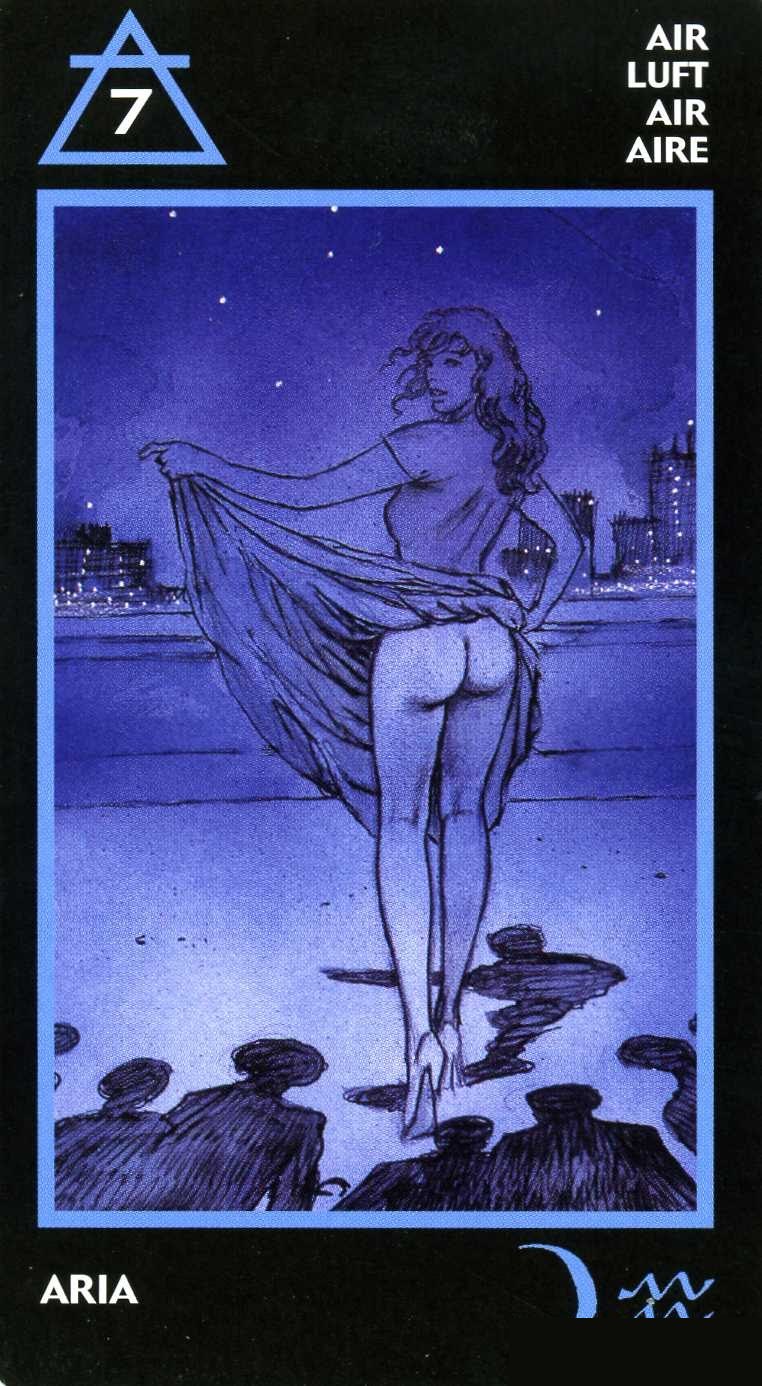
In the Rider-Waite-Smith image the Seven of Swords is staged as a caper: a lone figure steals away from a camp, his cleverness written in posture and expression, the moral weight of the act carried by the two swords he was forced to leave behind. The card is fundamentally about the mind — strategy, omission, the cost of choosing indirection. Milo Manara's erotic tarot reframes the same energy through the body and desire: the figure's intelligence becomes seduction, the stolen swords become stolen attention or stolen intimacy, and the question of what is taken without permission lands in an explicitly sensual register. Where the Waite card asks 'what are you avoiding by being clever?', Manara's version asks 'what are you taking — or withholding — in the language of pleasure and closeness?' Both versions agree that something is happening off the record; they differ in whether that something is a tactical plan or an act of erotic power.
ManaraRider-Waite-Smith
SceneA sensual figure moves with deliberate stealth, desire and cunning fused in a single charged gestureA lone man tiptoes from a military camp carrying five swords, two left planted in the ground behind him
FocusThe erotic charge of secrecy — what is taken or withheld between bodies; stolen pleasure, unspoken desireStrategic intelligence — the mind choosing indirection over confrontation, partial success over clean resolution
QuestionWhat intimacy or pleasure are you taking without full permission — and at what cost to trust?What are you trying to win by moving in shadow rather than speaking plainly?
Symbolism & correspondences
The Seven of Swords is traditionally placed under the Moon in Aquarius — a pairing that blends the Moon's instinct for concealment and indirect approach with Aquarius's detachment from social convention. Aquarius thinks in systems and workarounds; the Moon brings a quality of acting from instinct rather than principle, of doing what feels necessary rather than what is publicly defensible. Together they describe a mind that navigates beautifully in non-standard territory — unconventional, quick, and genuinely clever — but that must watch its own tendency to treat emotional and ethical rules as obstacles to be routed around rather than realities to be engaged.
Element
Air
◆
Arcana
Minor
Suit
Swords
Ready to see how this card unfolds in your own reading?