patient effortharvest assessmentlong-term investmentpause and reflectearned reward
The Seven of Pentacles is the card of the long game — the pause mid-labor when you lift your eyes from the ground and ask whether the work is working. It holds the tension between faith in process and the hard clarity of honest assessment.
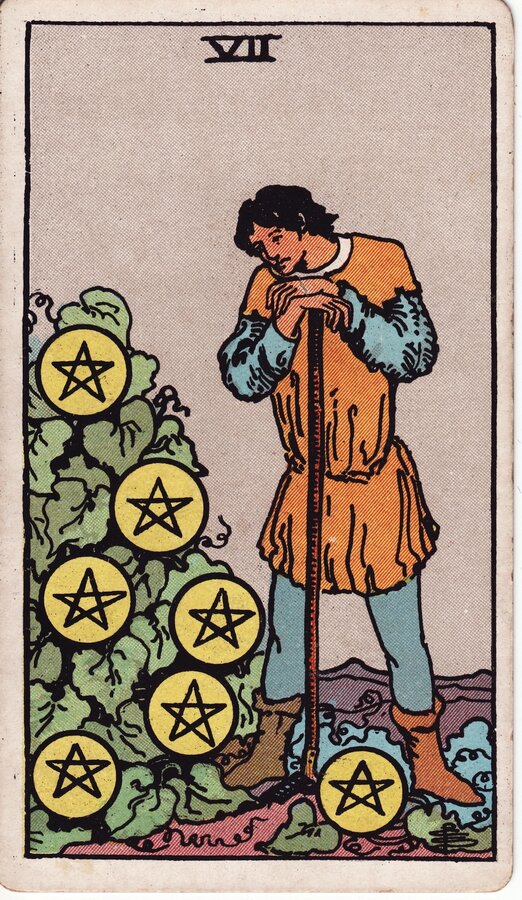
A young man in rough working clothes leans heavily on a long-handled hoe, his weight resting on it as though the tool is the only thing keeping him upright after hours of effort. Before him grows a lush, dark bush bearing six pentacles among its leaves, each coin-like disk hanging heavy and ripe. A seventh pentacle rests apart on the earth at his feet, already separated from the vine. His posture is contemplative — head bowed slightly, gaze fixed on the pentacles rather than on the horizon. The background opens into an uncultivated field beyond the garden, suggesting that what has grown here was not inevitable but chosen, coaxed out of resistant earth over a long season.
🌿The laden bush — The cumulative result of sustained effort — growth that is real and visible, but not yet fully gathered in
🪙Six pentacles on the vine — Work still in process, promise not yet converted into possession; potential that requires a decision to harvest
🪙The seventh pentacle on the ground — The first fruit already separated — a token that has fallen away, whether as a test, a loss, or the beginning of the harvest; what is looked upon with the most uncertainty
⛏️The hoe — Labor set aside, not abandoned — the instrument of past effort now serving as a resting post during the necessary pause
🍂Fallen leaves at his feet — The season is turning; this is autumn's reckoning moment, not the optimism of spring planting but the sober assessment before the first frost
7️⃣The number seven — In the minor arcana, sevens are pivot points — the midpoint tension of the suit's journey where momentum must be consciously renewed or redirected
Interpretation
Of all the cards in the suit of Pentacles, the Seven occupies the most philosophically demanding position: not the exuberance of beginning (Ace of Pentacles), not the satisfaction of completion (Ten of Pentacles), but the difficult middle ground where effort has been expended and the results are visible but not yet conclusive. The figure's posture — neither working nor celebrating, simply looking — captures something universally human: the moment we step back from our own life and ask, honestly, whether we are building what we meant to build.
Within the arc of the Pentacles suit, the Seven arrives after the stability-seeking of Four of Pentacles and the struggle of Five of Pentacles, and it leads toward the focused craft of Eight of Pentacles. If the Eight represents the decision to return to disciplined labor with renewed purpose, the Seven is the moment of deliberation that makes that return possible — or that reveals a need to change course entirely. The Seven's relationship with The Hermit is particularly resonant: both cards depict a solitary figure pausing on a long journey to assess, one in the mountains of the spirit, the other in the garden of the material world.
In practice, this card appears when a querent is at a genuine crossroads within an ongoing investment — a relationship, a business, a creative project, a health regimen. It rarely signals disaster, but it always signals the need for honest assessment rather than wishful thinking or fearful flight. The pentacles on the bush are real; the question is only whether the gardener will harvest them wisely, leave them to ripen further, or walk away from what they have grown.
When the Seven of Pentacles appears alongside Two of Wands, it often speaks to a specific strategic decision point — the Two supplies the expansive vision, the Seven supplies the grounded reckoning with what is actually in hand. Together they form the complete picture of a businessperson or creator at a genuine fork. Paired with The Hanged Man, the pause deepens into something more transformative — not just assessment, but a willingness to surrender the timeline entirely.
✦ Full InterpretationUnlock the card's full readingFree registration reveals the final paragraphs of the interpretation and gifts you ⭐ for your first spreadyour first spread is on us
Advice & forecast
✦ The card's advice
When this card appears as counsel, it is asking you to stay with the discomfort of not-yet-knowing. The harvest is close enough to see, but not close enough to rush. Do the honest accounting: what has actually grown from your efforts, and what have you been hoping would grow that simply hasn't? These are different questions, and the Seven of Pentacles will not let you confuse them. Trust the evidence of what is real — not the story you told yourself at planting time, and not the anxiety that whispers it will all come to nothing. The farmer who panics at the first sign of slowness and uproots the crop destroys the very thing he was cultivating. Tend what is truly growing; release what was never meant for this soil.
🔮 What the forecast holds
In the position of what is coming, the Seven of Pentacles promises a moment of reckoning that will feel both sobering and clarifying. You are approaching a natural review point where the work you have been doing will be visible enough to evaluate honestly — perhaps for the first time. This is not a warning of failure; it is a signal that the fog of effort-without-outcome is about to lift. What you find when it does may confirm that you are exactly where you need to be, or it may reveal that a quiet redirection is long overdue. Either way, the clarity itself is the gift. The season is turning, and with it comes the earned perspective of someone who has genuinely worked.
↓ Seven of Pentacles reversed
When the Seven of Pentacles falls reversed, the pause that should be productive has curdled into anxiety. The gardener is no longer assessing; he is spiraling — tormented by what has not grown fast enough, suspicious of results that are actually solid, or so frightened by the possibility of wasted effort that he cannot see what is genuinely thriving. This reversal often appears around financial worry that feels existential even when it is not, or around a relationship where the inability to tolerate uncertainty is doing more damage than any actual problem. The reversed Seven can also signal the opposite failure mode: the person who will not pause at all, who drives forward through exhaustion because stopping to look feels like defeat. In either case, the card is pointing to a relationship with outcomes — an inability to let things develop at their own pace, or to trust that what was well-planted will, in its own time, be ready to gather. The advice is simple but difficult: name what you are actually afraid of, and then look at the bush again with honest eyes.
The card in spreads
The same card reads differently depending on the spread and the question — compare real spreads:
Spread "The Gardener's Assessment"
Honest review of an ongoing investment
«Is my effort going where it will bear fruit?»
What was planted — the original intention or investment
Ace of Pentacles
What has grown — the honest current state
Seven of Pentacles
What the work requires now — next focused action
Eight of Pentacles
This three-card spread is built for the moment the Seven of Pentacles names: you have been working, and it is time to look clearly. The Ace of Pentacles in the first position recalls the original seed — the vision, the hope, the decision that started everything. Hold it honestly: was it a sound investment? The Seven of Pentacles in the center is your present reality, the bush with its hanging coins and its one fallen pentacle on the earth. What is the shape of what you have built? Is it abundant, sparse, still forming? The Eight of Pentacles in the final position speaks to what focused discipline would look like from here — not frantic energy, but skilled, intentional return to the work. Together, these three cards often reveal whether the querent is in a genuine pause (healthy, temporary) or a stuck pattern (anxiety masking as contemplation). The distance between the Ace's promise and the Eight's prescription tells you whether course correction or simple patience is called for.
Spread "Return on Investment"
Evaluating effort and reward in a specific life area
«Am I investing my energy in the right place?»
The current state of your investment and effort
Seven of Pentacles
The inner wisdom available to guide the decision
The Hermit
The path forward — what strategic vision serves you now
Two of Wands
When the Seven of Pentacles opens this spread, it sets the scene with characteristic honesty: here is what you have built, here is what it has cost, and here is the moment of reckoning. The Hermit in the middle position asks you to consult your own deepest knowing — not the voice of anxiety, not the voice of stubbornness, but the lamp-bearer who has climbed high enough to see the whole terrain. What does that quieter self actually believe about the direction you are heading? The Two of Wands in the final position speaks to the horizon beyond this assessment — the larger vision that either confirms your current course or reveals a fork worth taking. When these three cards fall together, they trace the complete arc of a wise decision: clear sight of what is, honest consultation of what is truly known, and then a deliberate step toward what could be.
✦ PremiumUnlock the Full ReadingSpread "Return on Investment": position-by-position reading, card combinations, and guidanceOpen with subscription →first spread is free
Spread "The Season's Turn"
Understanding timing and readiness in a situation
«Is it time to harvest, wait, or let go?»
What has been nurtured — the sustained care you have given
Queen of Pentacles
The ripeness — what the current moment is actually asking for
Seven of Pentacles
What awaits after the decision — the outcome of choosing wisely
Nine of Pentacles
The Queen of Pentacles anchors this spread in the earth — she is the gardener who tends without ego, who knows the difference between a plant that needs more time and one that is ready. Her presence in the first position honors all that has been given: the patience, the care, the seasons already invested. The Seven of Pentacles at the center is the crux: this is the moment the Queen has been tending toward, and now it demands a decision. Read this card's energy carefully — is there abundance on the vine, or has the growth stalled? Is the fruit heavy and ready, or still green? The Nine of Pentacles in the final position offers a glimpse of what becomes possible when the harvest is timed well and the decision made with clear eyes. She is the figure of elegant sufficiency — not the beginner's hope but the master's satisfaction. Let her presence encourage trust: the work has been real, and the reward for clarity here is genuinely beautiful.
✦ PremiumUnlock the Full ReadingSpread "The Season's Turn": position-by-position reading, card combinations, and guidanceOpen with subscription →first spread is free
How it differs from Manara
Manara Erotic TarotSeven of Earth
vs
Rider-Waite-SmithSeven of Pentacles
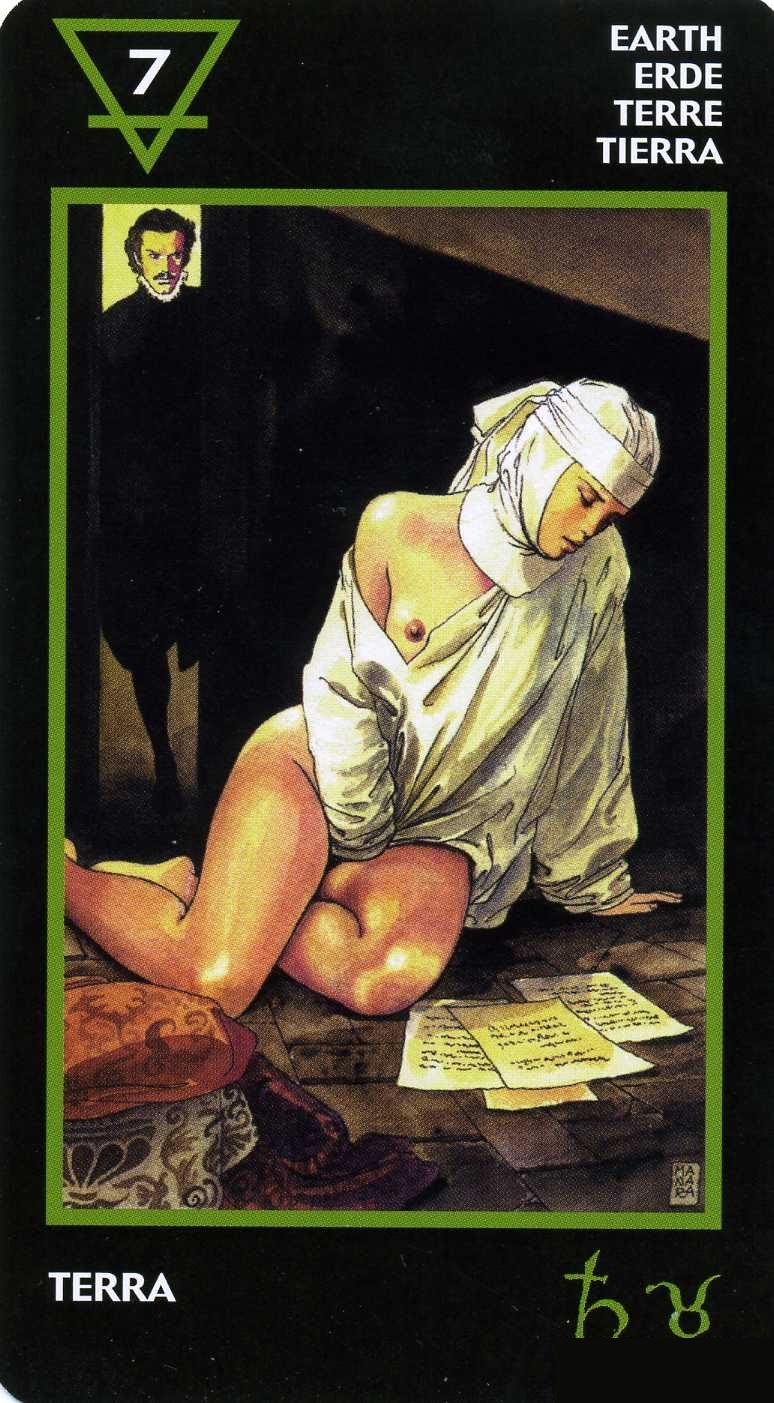
In the Rider-Waite-Smith image, the Seven of Pentacles is fundamentally about productive labor and its honest accounting — the scene is rural, earthy, and almost austere, with the drama entirely internal: a man alone with his thoughts and his crop. The question it poses is intellectual and practical: was this worth it, and what comes next? Milo Manara's erotic interpretation transposes the same core tension — investment, longing, the question of return — onto the body and desire. Where the Waite figure surveys what his hands have built, Manara's version asks what the body has given and whether that giving has been received. The coins of effort become gestures of intimacy; the unharvested bush becomes unfulfilled wanting. Waite grounds this card in material reality and long-term thinking; Manara relocates it to the erotic economy of vulnerability and expectation. Both versions share the essential stillness — a breath held between action and outcome — but the stakes in Manara are immediate and felt, while in Waite they are measured and considered.
ManaraRider-Waite-Smith
SceneA sensual figure pauses in a charged moment of self-reflection, the body itself the site of investment and longingA laborer leans on his hoe amid a garden, contemplating six coins on a vine and one on the ground at his feet
FocusErotic investment and the question of desire returned — what the body has offered and whether it will be metMaterial effort and patient assessment — the accounting of long labor and the decision about what to do with what has grown
QuestionHave I given enough of myself, and will this longing finally be answered?Has my work earned its reward, and am I tending the right field?
Symbolism & correspondences
Saturn in Taurus is one of astrology's most demanding combinations — the planet of limits, discipline, and long cycles operating in the sign most devoted to pleasure, comfort, and the material world. The result is someone who must earn what others seem simply to have, who builds slowly and keeps what they build, and who learns over many seasons that patient cultivation yields more than urgent grasping. This placement rewards endurance and penalizes shortcuts; it is the energy of the craftsman, the farmer, the investor with a decade-long horizon. When this card appears, Saturn's lesson is active: the reward is real, but it will arrive on its own schedule, not yours.
Element
Earth
◆
Arcana
Minor
Suit
Pentacles
Ready to see how this card unfolds in your own reading?