perseverancedefense of positioncompetitioncourageholding the high ground
The Seven of Wands is the card of hard-won position defended against all comers — the principle that achievement does not end at the moment of triumph but must be actively sustained. It asks whether you have the stamina and courage to keep what you have earned.
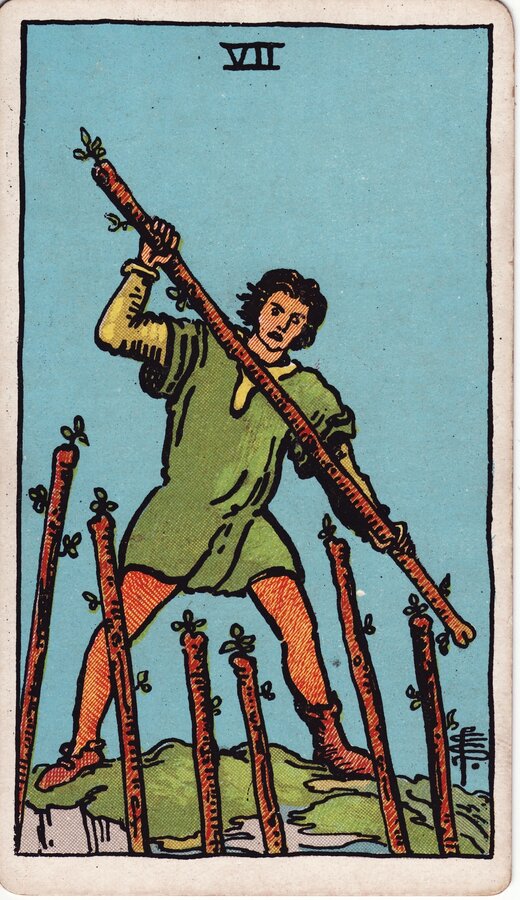
A young man stands on a rocky outcrop, gripping a stout wand raised high above his head in a clear defensive posture. Six other wands thrust upward from below, pressing toward him from an unseen crowd. He is alone at the top, slightly precarious, yet unmistakably elevated above his challengers. One striking detail reveals the sudden urgency of this moment: he wears mismatched shoes, caught mid-preparation when the challenge arrived. The sky behind him is pale and clouded, the tension of the confrontation hanging in the air.
🏔️High ground — Positional advantage earned through past effort — he is literally above his challengers, which tips the odds despite the numbers
👟Mismatched shoes — The attack came without warning; he rose to defend himself before he was fully ready — courage that does not wait for perfect preparation
🌿Green tunic — Living will and vitality — the capacity to keep fighting comes from an inner source of growth, not rigid armour
🪄Six faceless wands — Opposition that has no single human face — competitive pressure, market forces, collective criticism, the weight of circumstance rather than one identifiable enemy
☁️Clouded sky — The moment is charged and unresolved; outcome depends on what the figure chooses to do next
🪨Rocky summit — The position is not entirely stable — maintaining it requires active effort, not passive occupation
Interpretation
The Seven of Wands captures one of the less celebrated but deeply human truths about success: that arriving at a coveted position is only the beginning. The young man on the summit did not get there by accident — behind him lies the chaotic scramble of the Five of Wands and the public recognition of the Six of Wands. Now the crowd that cheered him has become the crowd pressing in, and the question is no longer 'can you rise?' but 'can you remain?'
Within the arc of the Wands suit, this card sits at a crucial inflection point. The suit carries the energy of fire — will, inspiration, ambition, creative drive — and through its sevens it arrives at the moment of testing. The Five of Wands scattered that energy across many competitors; the Six of Wands channeled it into a moment of triumph. The Seven demands that the same fire now burn in a steadier, more deliberate mode: not the rushing flame of conquest but the sustained heat of something worth protecting. The Nine of Wands, further along the path, shows what happens when this sustained defense stretches past its limit — the same figure, wearier, still holding on.
In a practical reading, the Seven of Wands nearly always signals that you are right about something worth standing behind. It appears when a professional position is being challenged, when a creative project faces criticism, when a relationship is under external pressure, or when you have staked out an opinion that invites pushback. The card's core instruction is simple: you have the height, use it. The one qualification worth noting is that the figure's mismatched shoes remind us that 'ready' is rarely a state we achieve before we are called to act.
When this card appears alongside Strength, the inner resource required for defense is being confirmed — the challenge is real, but so is your capacity to meet it quietly and without collapse. Paired with Nine of Wands, the reading warns that defensive vigilance has been going on long enough that rest and reassessment are as necessary as continued effort. Next to Six of Wands, it suggests the transition from triumph to tenacity is happening right now.
✦ Full InterpretationUnlock the card's full readingFree registration reveals the final paragraphs of the interpretation and gifts you ⭐ for your first spreadyour first spread is on us
Advice & forecast
✦ The card's advice
When the Seven of Wands arrives as counsel, the message is to stop rehearsing your retreat and start trusting your elevation. You earned this ground through real effort, real thought, real investment — and that history does not disappear simply because others are now contesting it. Make your case with clarity rather than aggression; the high ground speaks for itself when you articulate it well. What you want to avoid is the slow erosion that comes not from losing a single confrontation but from gradually giving up positions you never consciously chose to surrender. Pick your battles with discernment, but when you have chosen to stand, stand fully.
🔮 What the forecast holds
Ahead lies a period in which maintaining what you have built will require more active engagement than you may have expected. A challenge is coming — or is already forming — from a direction that may feel impersonal, even faceless: competitive pressure, market shifts, collective skepticism, the weight of others' expectations. The good news written into this card is that you are already in the advantageous position; the challenge is not to seize new ground but to hold existing ground, which is a different and, in many ways, more sustainable kind of effort. Those who press in from below are disadvantaged by your elevation. The outcome of the coming weeks or months will depend less on talent and more on nerve.
↓ Seven of Wands reversed
When the Seven of Wands is reversed, the energy of principled defense turns inward and begins to corrode. You may know perfectly well what you believe and what you have built, and yet find yourself hesitating at the moment of commitment — backpedaling in a negotiation, softening a boundary you had every right to hold, or agreeing to terms that reduce your position simply to end the discomfort of standing firm. There is also a subtler trap: the reversed card can indicate that the siege exists primarily in your own imagination. The genuine challengers may have moved on or diminished, but your nervous system has not received the news, and you continue spending energy on a defense that the moment no longer requires. In relationships, this reversal can manifest as excessive guardedness — a kind of emotional fortification that keeps out intimacy along with threat. The path through is honest self-assessment: are you defending something real and present, or are you caught in a habitual posture that has become its own obstacle?
The card in spreads
The same card reads differently depending on the spread and the question — compare real spreads:
Spread "The Summit Spread"
Assessing a position under pressure
«What do I need to know to hold my ground right now?»
What I have already won — the position I am defending
Six of Wands
The nature of the challenge I face — what the pressure is really about
Seven of Wands
How long I can sustain this — what my reserves look like
Nine of Wands
Begin with the first position — Six of Wands — to understand what achievement or status is actually at stake in this moment of contest. The card that falls here tells you what you are truly fighting to protect, which may be different from what the surface conflict appears to be about. The Seven of Wands in the center position speaks to the quality and character of the challenge itself: is it coming from genuine competitors, from circumstance, or from your own internalized fear of losing what you have? The third position, carried by Nine of Wands, answers the endurance question honestly — it will show whether your reserves are solid enough for a long defense or whether a strategic pivot or rest is the wiser move before re-engaging.
Spread "One Against Many"
Navigating a debate, negotiation, or competitive situation
«How do I make my case effectively when I am outnumbered?»
My current position and the pressure I face
Seven of Wands
The inner resource available to me
Strength
What approach will shift the dynamic in my favor
The Hierophant
The Seven of Wands in the first position anchors the reading in the reality of the contest — it confirms that the challenge is real and that the querent is, in some meaningful sense, ahead of the field despite the pressure. Strength in the second position reveals what inner quality is available right now: this card typically points to quiet authority, the capacity to engage without cruelty or panic, and a kind of composure that is more persuasive than force. The final position draws on Hierophant energy — the appeal to shared structures, established credibility, or institutional backing that can shift a debate from a shouting match into a recognized legitimacy. Together the three cards map a path from beleaguered defender to acknowledged authority.
✦ PremiumUnlock the Full ReadingSpread "One Against Many": position-by-position reading, card combinations, and guidanceOpen with subscription →first spread is free
Spread "Worth Defending"
Clarifying which battles deserve continued investment
«Is this fight worth continuing, and what will it cost me either way?»
The truth at the core of this conflict — what is really being contested
Ace of Swords
Where I stand and what it costs me to remain here
Seven of Wands
The balanced path forward — what sustainable engagement looks like
Temperance
The Ace of Swords in the first position cuts through the fog and names the actual truth underneath the conflict — which is rarely what the surface disagreement is about. It asks you to be honest about what principle or resource is truly at stake before you decide how much energy it deserves. The Seven of Wands in the center position then speaks frankly about the cost of your current posture: what it takes from you physically, emotionally, and strategically to remain on this particular piece of high ground. Temperance in the final position offers the most important guidance: it does not urge capitulation or reckless attack, but rather the measured, steady engagement that protects your position without burning through your own resources faster than the opposition.
✦ PremiumUnlock the Full ReadingSpread "Worth Defending": position-by-position reading, card combinations, and guidanceOpen with subscription →first spread is free
How it differs from Manara
Manara Erotic TarotSeven of Fire
vs
Rider-Waite-SmithSeven of Wands
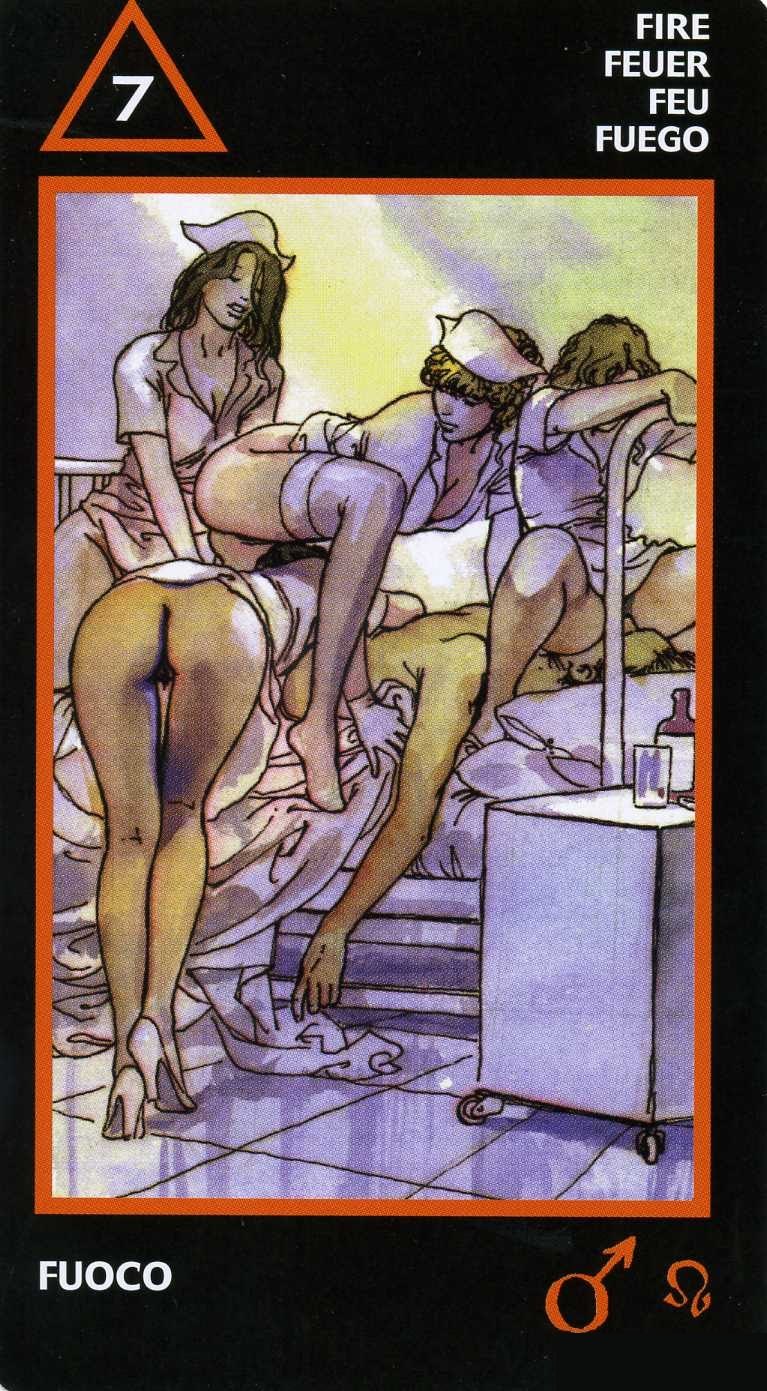
In the Rider-Waite-Smith image the Seven of Wands is an image of public, embodied struggle: a lone figure on a height, staff raised, challengers below, the entire scene framed as a contest of will and position. The symbolic language is martial and universal — about competition, reputation, and the cost of staying on top. In Milo Manara's Erotic Tarot, the same energy of besiegement and defense is refracted through desire: the figure in contest is caught in the force-field of attraction, possession, and the vulnerability that comes with being wanted. Where Waite asks 'Can you hold what you have won?', Manara asks 'Can you hold yourself intact when others press claim to you?' Waite's card is about the world of ambition and ideas; Manara's is about the inner territory of the body and longing. Both versions share the fundamental tension of one against many, but Waite externalises it into argument and competition while Manara internalises it into erotic exposure and the charged politics of desire.
ManaraRider-Waite-Smith
SceneA sensual figure at the center of competing desires, surrounded by the press of longing bodies — intimate, charged, vulnerableA lone young man on a rocky height, wand raised, six anonymous staves thrust toward him from below — martial, exposed, determined
FocusDesire as a field of contest: the body as the high ground that others seek to claim, the tension of being wanted by more than oneAchievement as something that must be actively defended: the mind, reputation, or project under competitive siege
QuestionWhen everyone wants a piece of you, which claim do you honor — and how do you remain whole?You have climbed further than most; can you withstand the pressure of those who want what you have built?
Symbolism & correspondences
The Seven of Wands carries the signature of Mars in Leo — the combination of the planet of assertion and combat with the sign of sovereign pride and creative authority. Mars provides the raw drive to contest and defend; Leo frames that contest as a matter of dignity, recognition, and the desire to be seen as one who does not flinch. Together they produce an energy that is neither coldly strategic nor wildly impulsive, but personally invested in the outcome — which is both the card's strength and its vulnerability. Fire signs understand that flame requires air and fuel to sustain, and this card calls on the same understanding: courage maintained not through aggression but through a steady, bright, deliberate burn.
Element
Fire
◆
Arcana
Minor
Suit
Wands
Ready to see how this card unfolds in your own reading?