The Six of Cups is memory made tangible — the moment when the past hands you a flower and you realize some things do not need to be outgrown, only carried differently. It is the card of innocent exchange, of bonds that ask nothing in return.
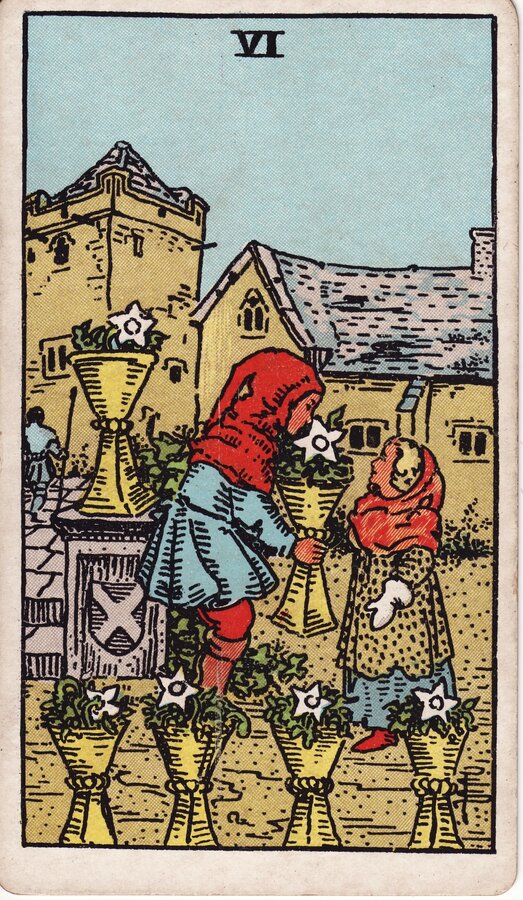
In a walled courtyard of a prosperous medieval household, two children stand at the center of the image. The taller child — a boy in a red cap and tunic — leans forward to present a large stone cup overflowing with white five-petaled blossoms to a smaller child who reaches up to receive it. Four more cups of similar flowers are arranged around them on stone pedestals and the ground. In the background, a figure in armor walks away through an archway, leaving the children to their moment. The light is warm and golden, the stonework overgrown and settled, everything suggesting a place well-known and long-loved.
🌸White five-petaled flowers — Innocence and pure intention — a gift that carries no debt, like a child's notion of generosity
🏛️Stone cups and pedestals — Memory as monument — the past given permanent, solid form; what endures
🧒Two children of different heights — The tender hierarchy of care: an older child giving down to a younger one, love flowing without expectation
⚔️Guard walking away — The adult world receding — for this moment, the children are left alone with their exchange, protected but unsupervised
🌕Warm golden light — The quality of remembered happiness — how good days feel in hindsight, suffused and unhurried
🏡Walled garden courtyard — The enclosed space of childhood: familiar, bounded, safe from the wider world's complications
Interpretation
The Six of Cups is the tarot's great keeper of memory. It arrives when something from your personal history is ready to be revisited — not replayed in sorrow, but received as a gift. The image of one child offering a flower-filled cup to another captures something essential about human bonding: that the purest exchanges are those made without calculation, where the giver does not expect return and the receiver does not feel indebted. This is the energy the card brings into any reading — a reminder that uncomplicated kindness is not naïve, it is foundational.
Within the arc of the Cups suit, the Six follows Five of Cups, whose figure stands grieving over spilled vessels while ignoring the two still standing behind him. The Six is what becomes possible once that grief is acknowledged: the turn from loss toward memory that warms rather than wounds. It anticipates Ten of Cups, where the children playing beneath the rainbow have grown into a family — but here they are still young, still in the courtyard, still learning the first grammar of emotional life. The Page of Cups, with his dreaming sensitivity, carries this same youthful quality as an individual; the Six is the scene that shaped him.
In practical readings, the Six of Cups most often signals a reunion or return: a person from the past re-entering your life, a childhood home revisited, an old project revived. It can also indicate that children are literally present in the situation — a pregnancy, a new beginning with a young family member, or the need to approach an adult situation with a child's directness and trust. In the position of advice, it asks you to set aside sophisticated adult strategy and simply give what you have.
When the Six of Cups appears alongside Wheel of Fortune, both cards speak of return — but the Wheel turns on the scale of destiny while the Six completes a personal cycle of memory. Paired with The Hermit, the combination suggests a deliberate, reflective journey back toward one's origins — not to stay, but to understand. Next to Three of Swords, it can indicate that healing a heartbreak will require revisiting its roots with compassion.
✦ Full InterpretationUnlock the card's full readingFree registration reveals the final paragraphs of the interpretation and gifts you ⭐ for your first spreadyour first spread is on us
Advice & forecast
✦ The card's advice
When the Six of Cups appears as advice, it is asking you to act more simply than you think you need to. You do not need a strategy here — you need a gesture. Reach back toward something or someone from your past without a plan for what happens next. Offer what you have freely, without tallying the cost. If an old relationship or familiar path is calling to you, do not dismiss it as regression: sometimes returning to where you started is the most direct route forward. Let the child in you lead for once — not because adults are wrong, but because some doors only open to innocence.
🔮 What the forecast holds
What is coming has the quality of something retrieved rather than newly won. Expect a reunion, a homecoming, or the return of a feeling or circumstance you had set aside. This may come as news from someone you had lost touch with, an invitation to revisit a place or project from your past, or simply a renewed sense of ease in a relationship that had grown complicated. The approaching period favors simplicity, warmth, and the uncomplicated pleasures of being known. Do not brace for drama — what is on its way arrives with open hands.
↓ Six of Cups reversed
When the Six of Cups reverses, the sweetness of memory curdles into something heavier. You may find yourself returning to the past not for sustenance but for shelter — using nostalgia as a way to avoid the demands of the present, or measuring everything current against an idealized earlier time and finding it lacking. There can be a quality of emotional immaturity here: relating to others through the dynamics of childhood rather than adult reciprocity, expecting to be taken care of in ways that are no longer appropriate, or refusing to acknowledge how much you have changed. In some readings, the reversed Six points to unprocessed childhood wounds that are now shaping behavior in adult life — old scripts running beneath conscious awareness. Occasionally it carries a more constructive signal: you are finally ready to release the past, to step out of a long nostalgia and claim the present. But this liberation requires honesty about what you have been holding onto, and why.
The card in spreads
The same card reads differently depending on the spread and the question — compare real spreads:
Spread "The Returned Gift"
Exploring a reunion or return from the past
«What is this returning person, place, or feeling truly offering me — and what do I need to be ready to receive it?»
What was left behind
Five of Cups
What is returning now
Six of Cups
What this reunion can become
Two of Cups
This spread maps the arc of return. Five of Cups in the first position reveals what grief, loss, or incompletion set the stage for this moment — what you were carrying before the knock at the door. The Six of Cups in the center holds the reunion itself: the quality of this return, what it brings, and the innocence or tenderness available in it. Two of Cups in the third position shows the potential future of this reconnection — whether this is a moment of healing that closes a cycle, or the beginning of something that can genuinely grow. Read these three cards as a continuous story: what was released, what has returned, and what might be built.
Spread "The Childhood Root"
Understanding how early experience shapes the present
«What pattern from my past is still active in my life today, and how can I work with it consciously?»
The early experience or pattern
Six of Cups
How to integrate it
Temperance
What becomes possible after integration
The Sun
When the Six of Cups anchors the first position, it is asking you to look honestly at which childhood dynamics are still shaping your choices and relationships. This is not about blame — it is about recognition. Temperance in the middle shows how to work with this material: not by rejecting it, but by blending it thoughtfully into adult life, finding the balance between honoring where you came from and not being governed by it. The Sun in the final position is a deeply hopeful outcome — the light that becomes available when you make peace with your origins, the clarity and vitality that follow genuine self-understanding. This spread works especially well when old patterns keep recurring in relationships or career.
✦ PremiumUnlock the Full ReadingSpread "The Childhood Root": position-by-position reading, card combinations, and guidanceOpen with subscription →first spread is free
Spread "The Garden Gate"
Discerning whether to step back or move forward
«Should I revisit what I have left behind, or is it time to walk through a new door?»
What you are walking away from
Eight of Cups
What the past is offering
Six of Cups
The path forward if you choose to move on
Six of Swords
This spread is for the crossroads moment — when you feel pulled backward and forward at once. Eight of Cups in the first position names what you are in the process of leaving: what need is no longer being met, what chapter has quietly closed even if you have not yet said goodbye. The Six of Cups at center holds the past's offer: this is not necessarily a trap — sometimes return is genuinely the right move, and the card asks you to feel whether this return carries warmth or avoidance. Six of Swords in the final position shows the journey forward if you choose movement: the calmer waters and the gradual transition that become possible when you travel with only what you truly need. Read all three together — the question is not which path is 'better' but which one your deepest self is actually ready for.
✦ PremiumUnlock the Full ReadingSpread "The Garden Gate": position-by-position reading, card combinations, and guidanceOpen with subscription →first spread is free
How it differs from Manara
Manara Erotic TarotSix of Water
vs
Rider-Waite-SmithSix of Cups
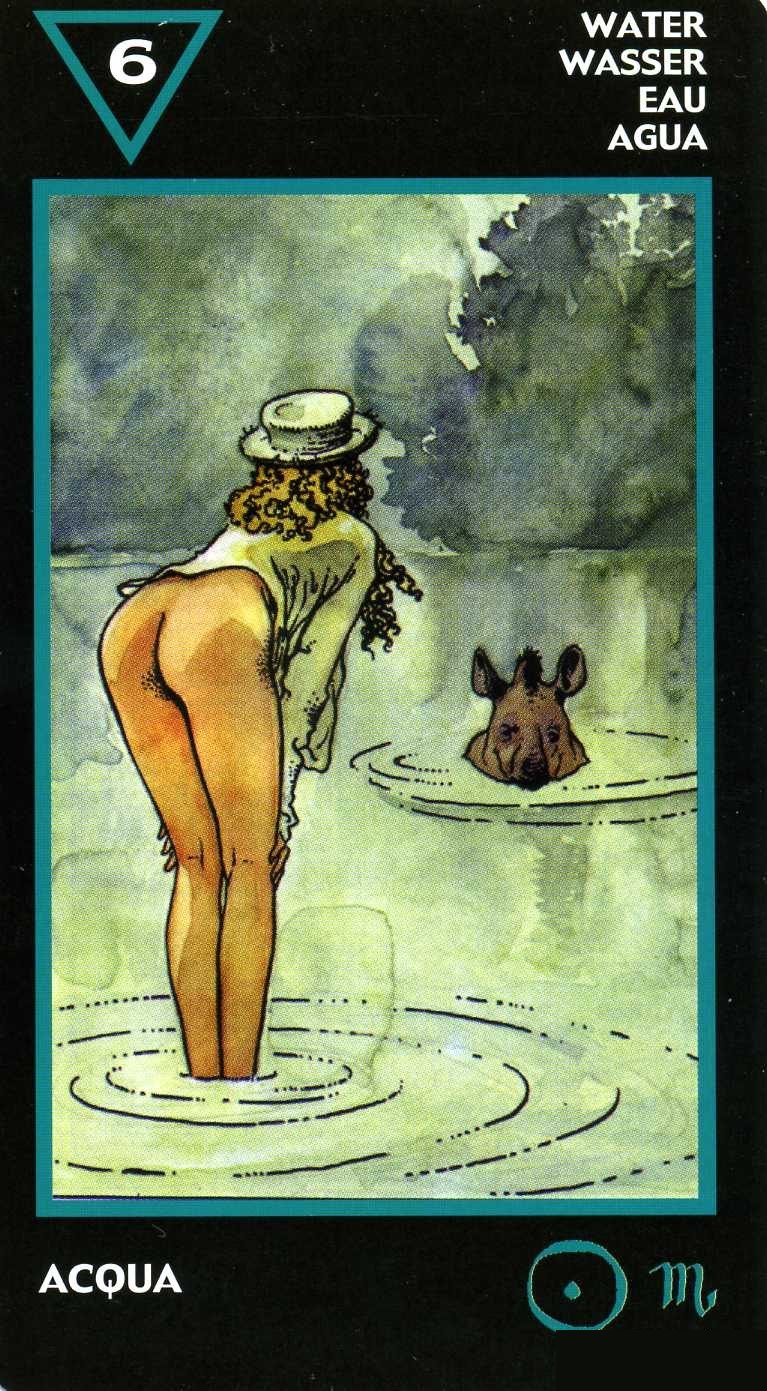
In the Rider-Waite-Smith image, the Six of Cups unfolds as a childhood scene: two small figures in a sheltered courtyard, exchanging cups of flowers in a gesture of uncomplicated tenderness. The symbolism is universal and deliberately pre-sexual — innocence made architectural, memory as stonework and bloom. Milo Manara's erotic reinterpretation transforms this entirely: the nostalgic reunion becomes a charged encounter between adults, the flower-gift replaced by the electricity of remembered desire. Where Waite asks 'what tender thing from your past has returned?', Manara asks 'what longing have you never fully put down?' Both cards carry the theme of return and recognition, but Manara roots it in the body and in passion, while Waite keeps it in the realm of the heart's earliest, cleanest register.
ManaraRider-Waite-Smith
SceneAn intimate reunion between adults, charged with the memory of desire and past closeness — sensual, immediate, embodiedTwo children in a walled garden exchanging cups of flowers — sheltered, pre-sexual, archetypal
FocusLonging, erotic memory, and the pull of a past lover or passion not fully resolvedInnocent generosity, childhood bonds, the warmth of safe memory and unhurried giving
QuestionWhat desire from your past still has a hold on you — and what would it mean to revisit it?What from your past is returning as a gift — and can you receive it with open hands?
Symbolism & correspondences
The Six of Cups is traditionally associated with the Sun in Scorpio — a striking pairing that captures the card's essential tension. Scorpio is the sign of depth, transformation, and what lies beneath the surface; the Sun illuminates whatever it touches with warmth and clarity. Together, they describe the experience of shining a warm light down into deep emotional waters — bringing memories and buried feelings into conscious view, not to stir them into drama but to understand them. This placement also speaks to the regenerative quality of memory: Scorpio transforms, and the Sun in that sign can burn away what no longer serves, leaving only what is genuinely nourishing.
Element
Water
◆
Arcana
Minor
Suit
Cups
Ready to see how this card unfolds in your own reading?