The Six of Swords is the card of the necessary crossing — moving from pain not by resolving it but by carrying it quietly into calmer territory. It asks nothing heroic, only the willingness to leave.
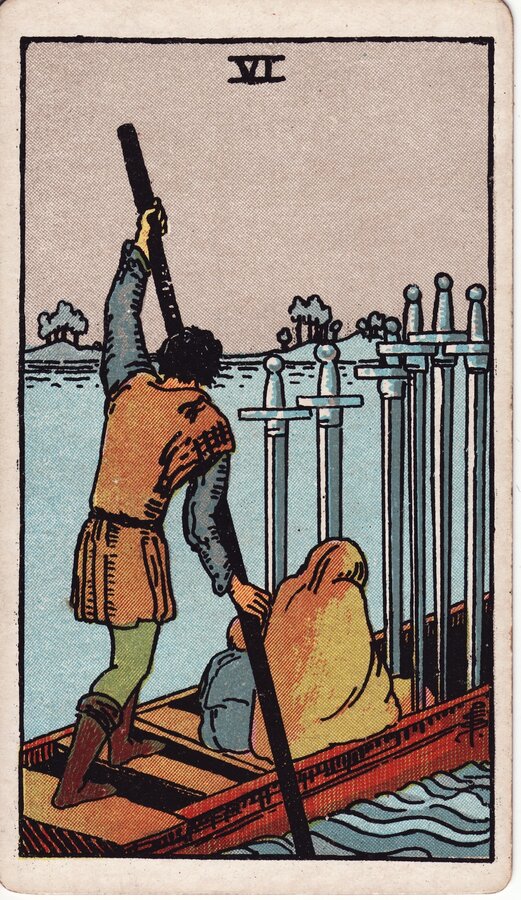
A ferryman stands at the stern, driving a flat-bottomed boat across dark water with a long pole. Two passengers sit huddled in the bow: a woman draped entirely in a grey cloak, and a small child pressed close against her. Six swords stand upright, embedded in the planks of the vessel, forming a kind of barrier or fence between the passengers and the far bank. To the right of the boat, the water churns and ripples; to the left, it lies perfectly still. A distant shore is visible ahead, low and green, closer than it looks.
⚔️Six upright swords — The mind's record of what has been endured — memories, wounds, and hard-won understanding that travel with you but no longer cut
🚣The ferryman — The guide between states — neutral, purposeful, asking no questions about the cargo; sometimes this is another person, sometimes inner resolve
🌊Divided water — The visual proof of transition: choppy on the side being left, calm ahead — the journey itself is the shift from one emotional register to another
🧕Cloaked woman and child — Vulnerability in passage — the part of us that is fragile and needs protecting during a crossing; also the tender beginning of something new carried inside
🏝️The far shore — The not-yet-arrived destination: visible, possible, not yet known — it promises space rather than answers
🛶The boat itself — The means of crossing — reliable, humble, purpose-built for exactly this journey; the vehicle is adequate even if it is not grand
Interpretation
The Six of Swords occupies a specific and precious place in human experience: the moment just after the crisis has passed, when you are no longer fighting but not yet healed. It is the exhale. The Swords suit tracks the life of the mind through conflict, clarity, grief, and isolation — and here, at six, the mind stops arguing and simply moves. There is no fanfare in this card, no victory banner. There is only a boat, a steady hand on the pole, and water growing calmer.
Within the arc of the Swords, the Six arrives after the wreckage of the Five of Swords — the ugly, hollow win, or the humiliating loss — and before the Seven of Swords, where cunning and self-preservation can tip into evasion. The Six is the corridor between those two rooms. It carries the emotional weight of Three of Swords and the enforced stillness of Four of Swords, but now the stillness is in motion — healing through displacement rather than through rest.
In practice, this card appears when a client is in transition that is real but not yet complete. It is not the card of the decision — that was made already, perhaps painfully. It is the card of the crossing itself: the weeks after leaving a job, the first months of a new city, the slow unclenching after a relationship ends. When it falls in a spread it often confirms what someone already knows: the movement they are already making, or need to make, is the right one. The swords in the boat remind the reader that no crossing erases memory — but they are standing still now.
Paired with Death the transition is larger and less chosen — a transformation that sweeps you across regardless of readiness. With Moon, the crossing happens in fog and feeling rather than clarity of purpose, and the far shore remains uncertain. With Six of Wands, the arrival will be triumphant — the difficult passage leads somewhere worth celebrating.
✦ Full InterpretationUnlock the card's full readingFree registration reveals the final paragraphs of the interpretation and gifts you ⭐ for your first spreadyour first spread is on us
Advice & forecast
✦ The card's advice
If this card has appeared for you, the message is gentle and direct: go. Not with drama, not with a final speech, not with a backward glance — just go. The boat is ready and the water ahead is calmer than what is behind you. You are allowed to leave a situation, a mindset, a relationship, or a phase of life without resolving every tension it contained. The swords come with you; you cannot unlearn what you have lived through. But carrying knowledge is different from being pinned by it. Let someone or something help you across if you are too exhausted to pole your own boat. The far shore does not need to be paradise — it simply needs to be somewhere other than here.
🔮 What the forecast holds
Something is shifting in your near future — a change of scene, a change of context, possibly a literal journey but more likely an inner repositioning. The turbulence you have been navigating will not disappear overnight, but you will find yourself moving away from its centre, and the quality of daily life will improve as a result. Expect a gradual settling rather than a sudden breakthrough. The conditions ahead are workable, even if they are not yet known. What matters now is willingness — the capacity to accept the crossing as it comes, unhurried and unheroic, and to trust that movement itself is a form of healing.
↓ Six of Swords reversed
When the Six of Swords is reversed, the boat is beached. Something has prevented the crossing — and it is worth sitting honestly with what that something is. Sometimes it is external: the circumstances genuinely will not release you yet, the timing is not right, there are real obligations that must be met before you can leave. But more often, in reversal, the obstacle is internal: a fear that the other shore might not be better, an attachment to the identity built inside the storm, a grief that hasn't been spoken aloud and so cannot be left behind. There may also be a pressure to surface — things that were kept quiet during the difficult period are demanding to be said. A confession, a declaration, an old anger — something that was submerged in the urgency of survival now insists on being acknowledged. The reversed Six can also indicate a situation where you have arrived somewhere new but are still living as if you were mid-crossing: replaying old conflicts, bracing for turbulence that is no longer there. The invitation is to look up and notice that the water has already changed.
The card in spreads
The same card reads differently depending on the spread and the question — compare real spreads:
Spread "The Crossing Spread"
Navigating a transition that is already in motion
«What do I need to know about this passage I am making?»
What I am leaving — the shore behind
Five of Swords
The crossing itself — what this transition is asking of me
Six of Swords
The shore ahead — what is waiting on the other side
The Star
This spread maps the full arc of a transition when the Six of Swords appears. The first position — often falling on a card like Five of Swords or Three of Swords — names the specific wound or conflict you are genuinely moving away from, so you can see it clearly rather than carry it unconsciously. The Six of Swords in the centre position is the crossing itself: it asks you to honour the in-between rather than rushing past it. The third position reveals the quality of what awaits — not necessarily a final destination, but the emotional register of the new context. When The Star or a gentler card appears here, the spread confirms that the movement is restorative. If a challenging card falls in that third position, it is not a warning to stay — it is a preparation: here is what you will need to meet when you arrive.
Spread "What I Carry Spread"
Understanding what past experiences are travelling with you
«What am I carrying into this new chapter, and what should I set down?»
The passage — what this transition fundamentally is
Six of Swords
What deserves to rest — the weight you can lay down
Four of Swords
What moves with you — the strength to carry forward
Knight of Swords
The Six of Swords as the anchor of this spread frames the entire reading through the lens of conscious passage — what do you bring, and what do you leave? The second position, governed by cards like Four of Swords, often reveals the exhaustion or old defence mechanism that has served its purpose and can now be released; it is not a flaw but a strategy that belongs to the old context, not the new one. The third position, where Knight of Swords energy might appear, identifies the quality — sharpness, momentum, a hard-won directness — that is genuinely yours to keep and carry forward. Reading these two in conversation with the Six creates a practical inventory: not what you must abandon (the card never demands erasure of experience) but what can finally be set down at the threshold.
✦ PremiumUnlock the Full ReadingSpread "What I Carry Spread": position-by-position reading, card combinations, and guidanceOpen with subscription →first spread is free
Spread "The Still Water Spread"
Finding calm and clarity after prolonged stress
«How do I move from turbulence into steadier ground?»
The source of the turbulence — what has been draining you
Nine of Swords
The guiding principle — what steadies the crossing
Temperance
The arrival — the quality of calm that is becoming available to you
Six of Swords
In this spread the Six of Swords sits at the end as the promised destination rather than the active journey — a slightly different and often very reassuring position for this card. The first position frequently reveals the specific anxiety or conflict, often echoed by cards like Nine of Swords, that has made the recent period feel relentless. The second position, naturally suited to Temperance's energy of patient balance, names the quality of attention or approach that will steady you during the crossing itself. When the Six of Swords falls as the outcome, it is a quiet but reliable promise: this is where you are heading. Not a firework, not a revelation — just calmer water, a distant green shore, and the knowledge that the worst is already behind you.
✦ PremiumUnlock the Full ReadingSpread "The Still Water Spread": position-by-position reading, card combinations, and guidanceOpen with subscription →first spread is free
How it differs from Manara
Manara Erotic TarotSix of Air
vs
Rider-Waite-SmithSix of Swords
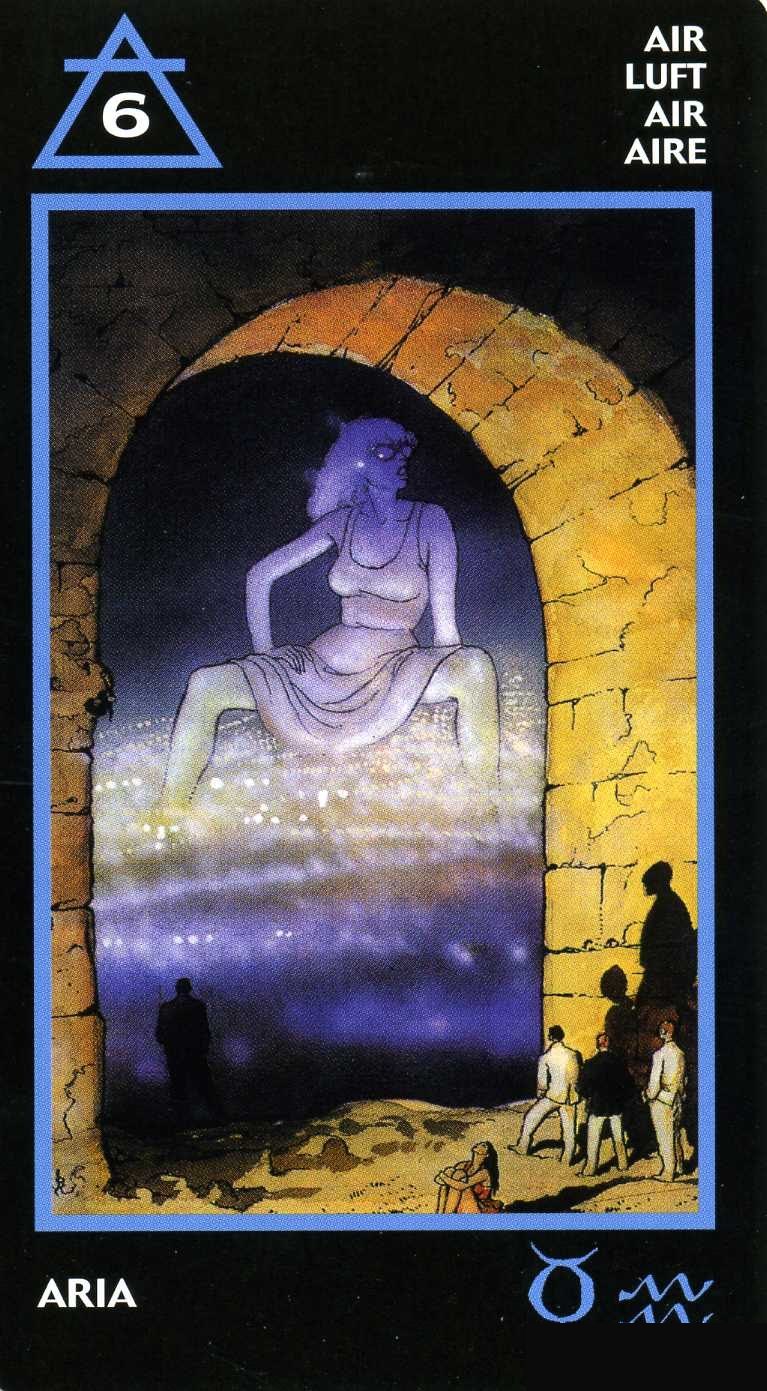
In the Rider-Waite-Smith image, the Six of Swords is almost entirely about containment and quiet movement — cloaked figures, still purpose, the geometry of swords-as-fence. Emotion is present but suppressed beneath heavy fabric and the steady labour of crossing. Milo Manara's Erotic Tarot reimagines this card through the language of the body: where Waite places cloth and shadow, Manara gives skin and feeling, and the 'crossing' becomes intimate rather than geographic. Waite's version asks what you must carry with you when you leave; Manara's asks what you must finally allow yourself to feel once you are free of the storm. Both versions agree that transition is the subject — they disagree on whether it is experienced in the mind or in the flesh. The Waite reading is universal and slightly melancholy; the Manara reading is sensual and release-oriented.
ManaraRider-Waite-Smith
SceneA woman and man in intimate transit — the body as the vessel of transition, touch as the anchor in motionA cloaked woman and child ferried across troubled water by a pole-bearing guide, six swords standing in the bow
FocusEmotional and physical release; the relief of closeness after isolation; the body's intelligence about when it is time to moveMental endurance; the necessary carrying of past experience; the geometry of passage from turbulence to stillness
QuestionWhat do you allow yourself to feel — and share — once the storm is behind you?What do you carry with you, and what are you finally leaving behind?
Symbolism & correspondences
Mercury in Aquarius governs this card — the planet of thought and movement in the sign of detachment and wider perspective. This combination gives the Six of Swords its characteristic quality: the mind stepping back from personal pain far enough to see the larger pattern, then making the rational, humane decision to move toward something better. Aquarius lends a certain coolness to the crossing — it is not an emotional flight but a considered one. Mercury ensures the journey is purposeful: the swords are standing, not flying, because the mind has chosen to carry its experience rather than act from it.
Element
Air
◆
Arcana
Minor
Suit
Swords
Ready to see how this card unfolds in your own reading?