RCANIKAUnlock your Arcana
0

Streak · 0 of 7 days

Come back every day — +1 ⭐ for logging in.

On your 7th day in a row+5 ⭐ and 30% off the subscription

Sign in to start your streak and earn ⭐

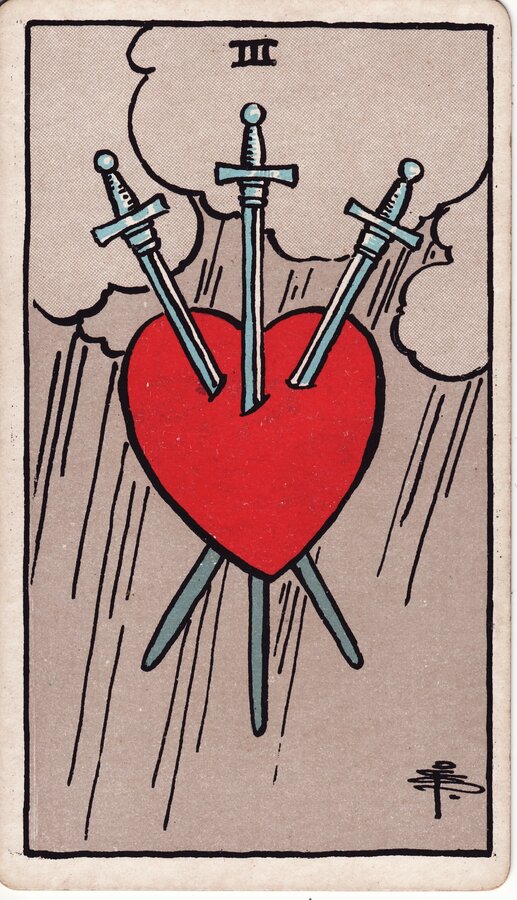
Three of Swords — Tarot card, Rider-Waite-Smith deck
Hover to explore

Three of Swords

Rider-Waite-Smith
heartbreakseparationgriefbetrayalpiercing clarity

The Three of Swords is the tarot's most unguarded image of pain — a heart struck through, rain falling, no symbol of comfort anywhere. It asks us to meet suffering directly rather than explain it away.

The card's image

A stylized red heart floats in a grey, storm-filled sky, transfixed by three steel swords entering from different angles simultaneously. Rain falls in diagonal streaks across the entire image. Heavy dark clouds press down from above. There is no figure, no ground, no horizon — only the heart, the blades, and the weeping sky. The composition is symmetrical and formally exact, giving the anguish a strange, almost heraldic dignity.

Interpretation

No card in the tarot speaks as plainly as this one. Three swords enter a heart simultaneously — not a gradual wearing-down but a moment of rupture, the kind of pain that arrives all at once and reorganizes everything around it. This is the card of the phone call that changes the day, the sentence spoken that cannot be unspoken, the discovery that unmakes a story you had been living inside. The image does not soften it or offer a silver lining. It trusts you to bear what is true.

Within the Swords' narrative arc, the Three follows the Two of Swords, where a figure sits blindfolded and still, holding two crossed blades — frozen between choices, refusing to look. The Three is what happens when that stillness breaks: the thing you were not looking at arrives anyway. It precedes the Four of Swords, the warrior laid to rest in a chapel, sword beneath stone — recovery requires first the wound, then the withdrawal into quiet. The Three sits at the hinge between avoidance and the long work of healing.

✦ Full InterpretationUnlock the card's full readingFree registration reveals the final paragraphs of the interpretation and gifts you ⭐ for your first spreadyour first spread is on us

Advice & forecast

The card's advice

When this card appears as guidance, it is not asking you to feel better. It is asking you to feel. The temptation after a real blow is to move quickly into analysis — to understand why it happened, to assign meaning, to plan the recovery before the grief has even fully landed. The Three of Swords counsels against this particular form of avoidance. Let the rain fall. Let the sorrow be what it is rather than a problem to be solved. There is a difference between pain that passes through and pain that lodges because it was never fully allowed. You do not have to perform strength right now. The wound you are carrying is clean and real — honoring it is not weakness, it is the beginning of genuine passage through.

What the forecast holds

What is coming may arrive with sharpness and without much warning. A parting, a disclosure, a moment of unwelcome truth — the kind of event that leaves a before and an after. This does not mean catastrophe is certain, but it does mean that clarity is coming, and clarity sometimes hurts. The forecast here is not one of prolonged suffering so much as of a clean rupture that makes something undeniable. Prepare not by bracing against it but by building the capacity to remain present when it lands. On the far side of what is coming, there is the possibility in the Four of Swords — rest, stillness, the slow return of breath.

Three of Swords reversed

When the Three of Swords reverses, the pain does not disappear — it changes texture. Where the upright card offers at least the clarity of a named wound, the reversal brings fog: grief that won't quite finish, hurt that circles without completing its arc, a mind that keeps returning to the scene of damage as if replaying it will change the outcome. This can manifest as distraction, poor concentration, an inability to be fully present in daily life because some part of attention is still lodged in what was lost. In more difficult readings, the reversed card describes a sorrow that has calcified into identity — the wound no longer an event but a permanent residence, grief worn as a defining feature rather than as something being passed through. There is also a gentler reading: the swords are in the slow process of being withdrawn, the acute phase is ending, and the confusion is simply the disorientation of healing after intensity. The key distinction is whether the turning inward is temporary or chronic — and whether the querent is willing to gently release what the pain has become.

The card in spreads

The same card reads differently depending on the spread and the question — compare real spreads:

How it differs from Manara

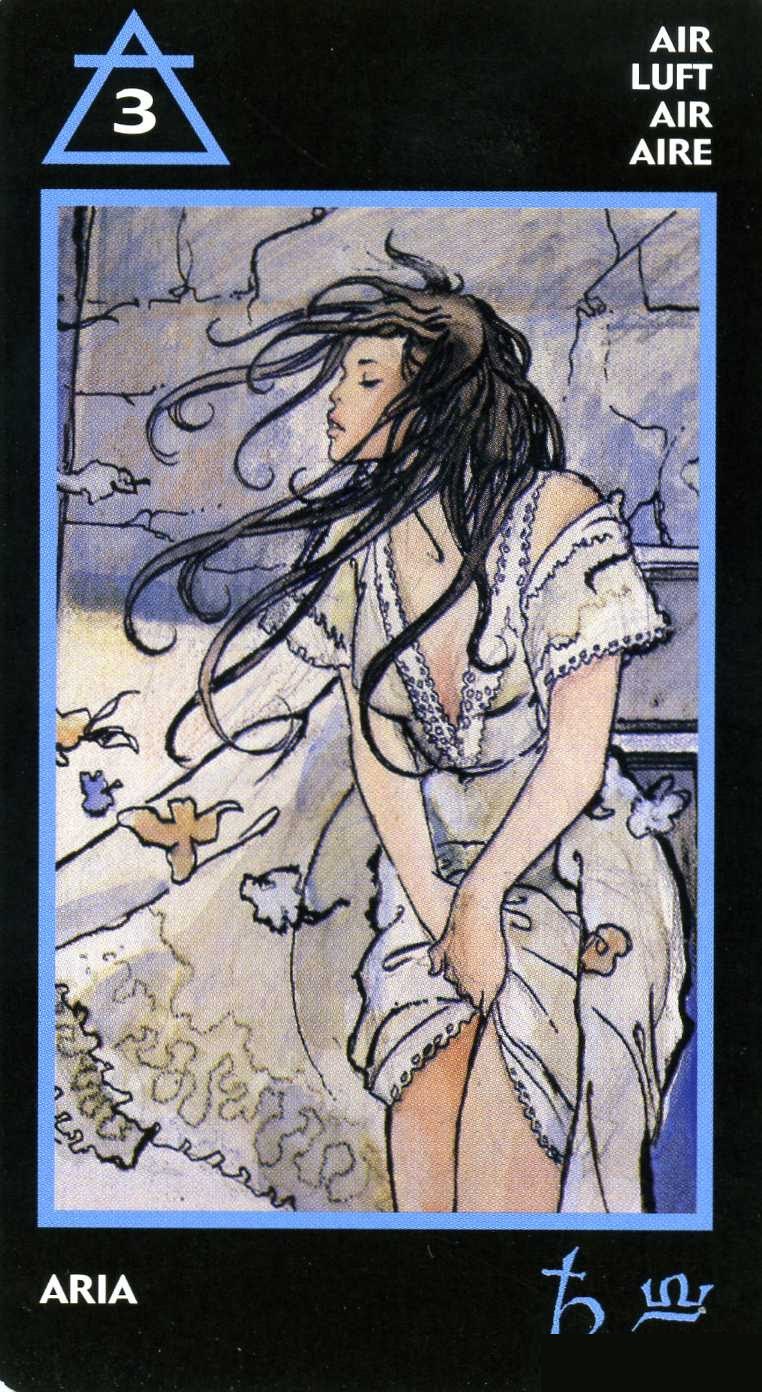
Three of Air — Manara Erotic Tarot deck
Manara Erotic TarotThree of Air
Rider-Waite-SmithThree of Swords

In Milo Manara's Erotic Tarot, the Three of Swords becomes an intensely personal image of abandonment and desire denied — a figure rendered in his fluid, sensual line work, perhaps turning away or reaching toward someone no longer there. The wound is embodied in flesh: longing made visible in posture and skin. The question Manara poses is intimate: who left, and what did their leaving take from the body's joy? The Rider-Waite-Smith image strips away the human figure entirely — only the heart remains, elevated to pure symbol. It becomes universal precisely because it is disembodied. Where Manara grounds grief in a specific erotic loss, the classic image holds space for any sorrow: a friendship, a faith, a vision of the future. Both are honest accounts of pain; one burns with personal particularity, the other opens to the full breadth of what a heart can lose.

ManaraRider-Waite-Smith
SceneA sensual figure in the language of Italian erotic art — the body itself carries the wound, desire and abandonment fused in one imageA floating heraldic heart transfixed by three swords against a rain-soaked grey sky — no figure, pure symbol
FocusThe erotic and relational dimension of loss — how heartbreak lives in the desiring bodyUniversal grief beyond any single cause — the archetypal experience of being pierced by sorrow
QuestionWhat did this particular loss take from you — from your longing, your closeness, your sense of being wanted?What does it mean to let yourself be broken open by something true?

Symbolism & correspondences

Saturn in Libra governs this card — the planet of limits, consequence, and time operating through the sign of relationship and balance. Saturn does not allow us to pretend: in Libra, it makes visible what the scales actually hold, regardless of what we hoped they would show. This placement gives the Three of Swords its quality of inevitable reckoning — the pain arrives not as random cruelty but as the result of something that was already in motion. The air element of Swords adds the dimension of clarity: this hurt is known, named, articulated. It cuts precisely because the mind can see exactly what has happened.

Element
Air
Arcana
Minor
Suit
Swords

Ready to see how this card unfolds in your own reading?

Make a reading

Your first reading is free · 30 seconds