The Eight of Swords is the card of the prison the mind builds around itself — real in its suffering, voluntary in its walls. The exit has always been there; what is missing is the willingness to believe it.
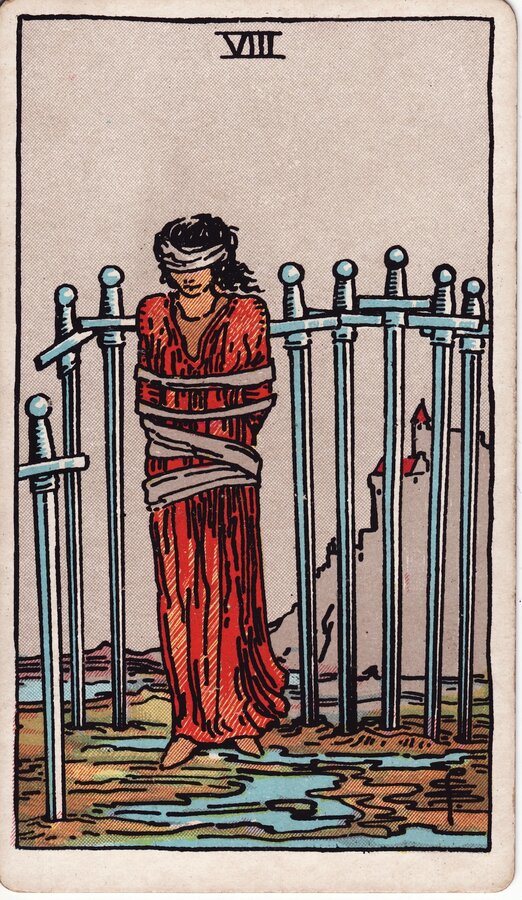
A woman stands on marshy ground, bound and blindfolded. Eight swords are thrust into the earth around her, arranged not as a sealed cage but as a loose, half-open fence — the gap behind her is plainly visible. Her ropes are not tight; they could be shrugged off. In the far distance, a castle rises on a crag against a flat grey sky, unreachable or abandoned. Her bare feet feel the cold, wet earth but she does not move.
🙈Blindfold — Inner blindness — the refusal or inability to perceive the exit that is objectively present
🪢Loose ropes — Constraints that are symbolic rather than physical; they hold only because the figure does not test them
⚔️Eight swords in the earth — The cage of one's own thoughts — numerous, sharp, menacing in appearance, but arranged with a gap and forming no closed circle
🌊Wet, marshy ground — Emotional instability underfoot; the feeling that any move risks sinking deeper
🏰Distant castle — A past life or imagined future that seems permanently out of reach — the place she came from or the place she cannot reach
☁️Grey, featureless sky — Absence of perspective or hope; a flat, closed worldview that makes movement feel pointless
Interpretation
The Eight of Swords stands at the intersection of thought and paralysis — a state that every human mind enters at some point, where the story we tell about our situation becomes more binding than the situation itself. It does not depict an external oppressor; it depicts the architecture of self-entrapment. The figure's suffering is entirely real, and so is the exit she cannot see.
Within the arc of the Swords suit, this card arrives after the conflict of Five of Swords, the difficult departure of Six of Swords, and the cautious strategy of Seven of Swords. The suit has been moving through increasingly interior territory, and here the journey reaches its most psychological moment. The mind has turned entirely inward, no longer scanning for external enemies but circling its own limits. If the figure does not remove the blindfold, the card ahead — the anguished wakefulness of Nine of Swords — becomes almost inevitable.
In a spread, this card tends to appear when a querent has convinced themselves that no options exist. It marks a moment of stuck-ness that feels definitive but is not. The question it poses is diagnostic rather than prescient: not 'what will happen?' but 'what are you not letting yourself look at?' It often speaks to situations where asking for help, changing direction, or even simply acknowledging a feeling would crack the cage — but hasn't happened yet.
When Eight of Swords appears alongside Devil, the self-imposed nature of the trap is especially clear — both cards share the motif of bindings that could be removed. Paired with Hanged Man, voluntary stillness takes on a contemplative quality: the Eight's figure does not know she is choosing to stay; the Hanged One does.
✦ Full InterpretationUnlock the card's full readingFree registration reveals the final paragraphs of the interpretation and gifts you ⭐ for your first spreadyour first spread is on us
Advice & forecast
✦ The card's advice
Something in the situation you are facing holds less power than it appears to. The first move is not to act — it is to look. Remove the blindfold: question the assumption that the door is locked, test the rope you have accepted as unbreakable, say aloud the thing you have been too afraid to name. The constraints may not vanish immediately, but they will stop being invisible. From visibility, action becomes possible. You do not need to be fearless to take the step — you only need to be willing to find out whether the swords actually move when you walk toward them.
🔮 What the forecast holds
A period is approaching in which the walls will feel very close. The temptation will be to go still, to wait for clarity to arrive from outside, to defer any decision until conditions improve. This is understandable — but the card signals that the conditions will not improve on their own. What approaches is not a worsening of circumstances but an intensification of the felt sense of limitation. The good news held inside this forecast: limitations that feel total rarely are. The moment you reach out and touch the rope, something shifts.
↓ Eight of Swords reversed
When the Eight of Swords falls reversed, the stillness is breaking — but breaking is not the same as healing. The loosening may come as insight, a sudden shift in perspective that reveals how much room you actually have. But it may also come as rupture: a loss, a departure, an external event that strips away the illusion of the trap by destroying what was inside it. Either way, the card signals motion where there was none. In love and relationships, old narratives about who you are or what you deserve are losing their grip — and the person you were protecting by staying blind may no longer recognise the one emerging. In practical matters, a period of genuine instability precedes the new freedom; expect some disorientation as the familiar cage disappears. The reversed card's most important message is this: do not rebuild the blindfold. The fear that comes with open eyes is real, and it is far better than the false safety of not seeing.
The card in spreads
The same card reads differently depending on the spread and the question — compare real spreads:
Spread "The Blindfold Spread"
Identifying what is truly holding you back versus what only feels like a wall
«What am I not allowing myself to see, and what becomes possible when I do?»
The blindfold — the core belief or fear creating the restriction
Two of Swords
Current experience — how the trap presents right now
Eight of Swords
The gap in the swords — the exit that is already there
Temperance
When the Eight of Swords occupies the center position here, it confirms that the querent is in the thick of a self-limiting pattern — the energy of the card is live, not past. The first card, in the blindfold position, names the specific belief or fear at the heart of the paralysis. Two of Swords, for example, points to deliberate avoidance of a choice; Devil suggests a deeper attachment to the constraint than the querent has admitted. The third card, in the gap position, does not show a solution so much as a door — Temperance here would suggest the way through requires patience and integration rather than a dramatic break. Read these three as a sentence: 'Because I believe [card 1], I experience [card 2], and the opening I have not yet taken is [card 3].'
Spread "The Loose Rope Spread"
For moments of feeling completely stuck — finding what can actually move
«Where is the rope already loose, and what do I risk by pulling it free?»
Where you are — the nature of the current constriction
Eight of Swords
What you have not yet looked at alone
The Hermit
What opens on the other side of the blindfold
The Sun
The Eight of Swords in the first position grounds the spread in the present reality: this is a genuine stuckness, not just anxiety. It asks the reader to take the feeling seriously before questioning it. The second card — held by Hermit's lantern — names what inner work or solitary honesty has been avoided. Often this is the piece the querent half-knows but has been circling rather than facing. The third card, in the light-beyond-the-blindfold position, gives the texture of freedom rather than a promise: Sun here is a striking, joyful signal, while a more complex card like Judgement suggests that what opens is not ease but a reckoning that turns out to be liberating. The spread works best when the querent reads it not as 'will I get free?' but as 'what does free actually look like for me right now?'
✦ PremiumUnlock the Full ReadingSpread "The Loose Rope Spread": position-by-position reading, card combinations, and guidanceOpen with subscription →first spread is free
Spread "Three-Card Cage Spread"
Understanding a relationship dynamic where one person feels trapped or powerless
«What is the nature of this constriction, who or what placed it here, and what breaks it?»
What nourishes the dynamic — what keeps both people in the pattern
The Empress
The experience of the one who feels bound — what powerlessness looks like here
Eight of Swords
The seed of change — what new energy is available
Ace of Cups
When the Eight of Swords sits in the center of this relationship spread, it identifies one person — often the querent — as experiencing genuine felt powerlessness within the dynamic. The first card names what is feeding the pattern: Empress here might suggest that comfort, nurturing, and not wanting to disrupt warmth are making the cage feel safe. The third card holds the possibility of movement: Ace of Cups as the seed of change is a beautiful signal — new emotional beginning, a willingness to feel again, the very quality the blindfolded figure has been sealed away from. Read the spread as a whole arc: what sustains the pattern, how it is lived in the body and the emotions, and what can crack it open. The Eight of Swords in this position rarely suggests the relationship is irredeemably stuck — it suggests that one person has stopped believing they have a voice in it.
✦ PremiumUnlock the Full ReadingSpread "Three-Card Cage Spread": position-by-position reading, card combinations, and guidanceOpen with subscription →first spread is free
How it differs from Manara
Manara Erotic TarotEight of Air
vs
Rider-Waite-SmithEight of Swords
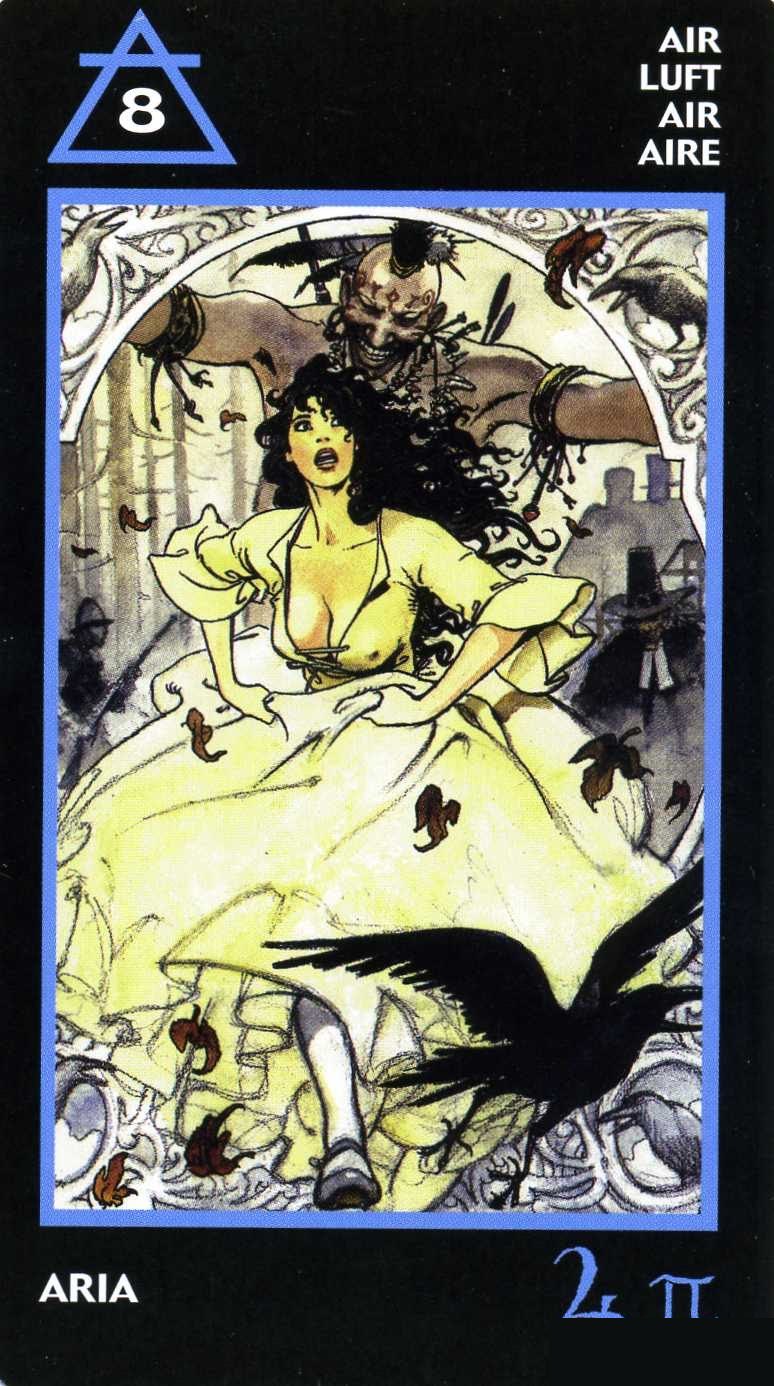
In the Rider-Waite-Smith image, the figure is generic and archetypal — a bound woman on an open plain, her suffering universal and impersonal. The symbolism speaks to everyone who has ever talked themselves into powerlessness. In Milo Manara's Erotic Tarot, the card's energy shifts toward the body as the site of restriction: constraint becomes tactile, intimate, charged with the tension between surrender and captivity, desire and control. Where Waite asks 'what belief is keeping you here?', Manara's version asks 'what part of you wants to stay?' — making the voluntary nature of the trap not philosophical but visceral. Both versions carry the same core truth: the binds are not as tight as they feel.
ManaraRider-Waite-Smith
SceneA body in bondage rendered with sensual precision — constraint as a physical, skin-level experience with erotic undertoneA robed figure, blindfolded and loosely bound, standing in an open landscape surrounded by planted swords
FocusThe body as the seat of limitation and longing; the tension of chosen or unchosen submissionThe mind as the architect of its own prison; thought patterns and belief as the real restraints
QuestionWhat am I afraid to feel, and is that fear keeping me bound?What am I refusing to see, and is that refusal keeping me here?
Symbolism & correspondences
The Eight of Swords carries the energy of Jupiter in Gemini — the expansive, optimistic planet caught in the sign of multiplicity and contradiction. Jupiter wants to see the big picture and move toward it; Gemini fragments the view into a dozen simultaneous angles, none of them conclusive. The result is a mind that generates many thoughts without resolving them into action, a worldview that sees too many possibilities and therefore commits to none. This astrological signature also carries Gemini's essential gift: the mind that is doing the trapping is the same mind capable of the breakthrough. Air cuts through air.
Element
Air
◆
Arcana
Minor
Suit
Swords
Ready to see how this card unfolds in your own reading?