In short Five of Swords upright means hollow victory, conflict, dishonor, domination. Reversed — reconciliation, remorse, aftermath, unresolved grief.
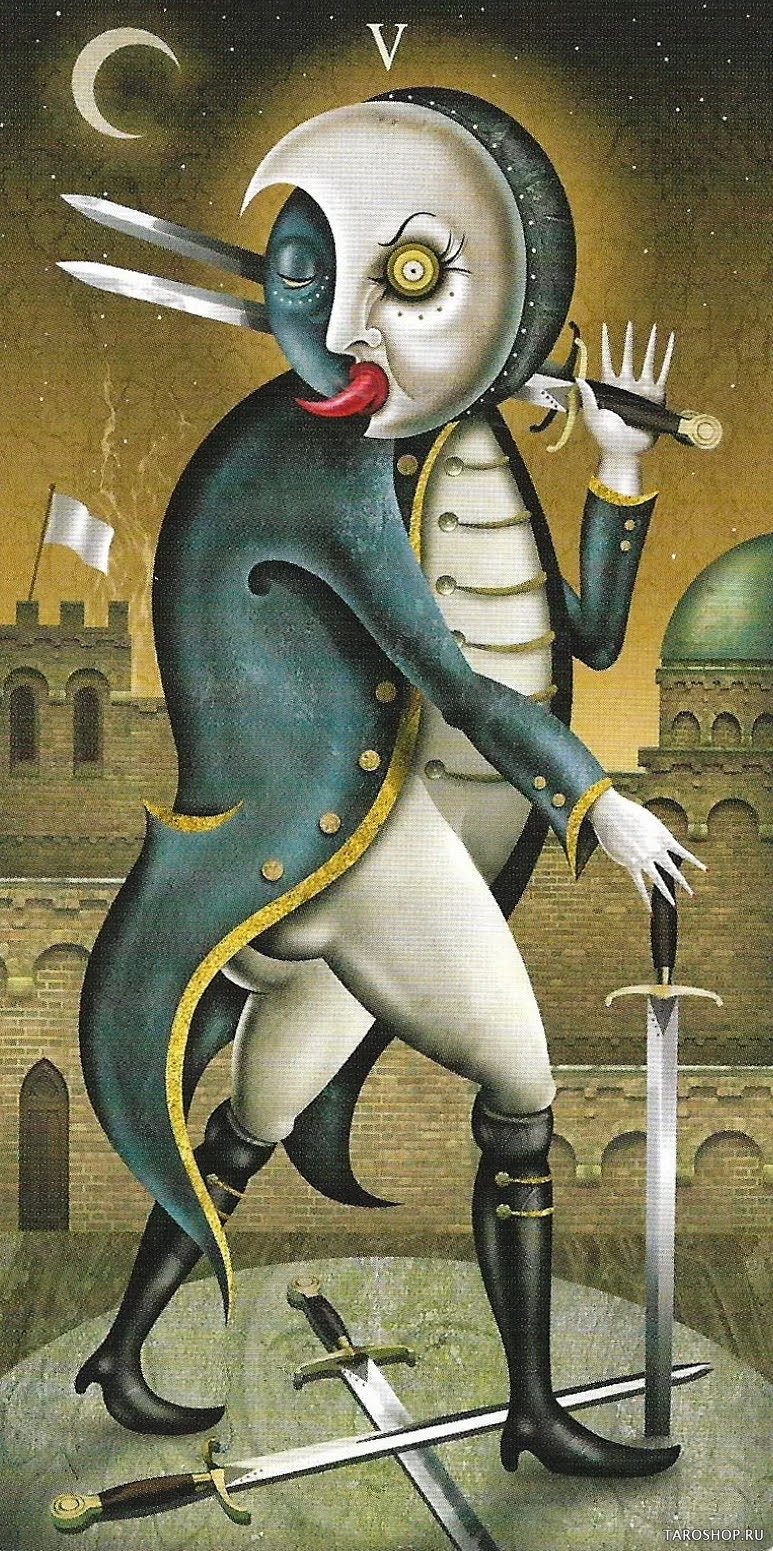
A foreign soldier has entered the city. He gives no honor to the king and dishonors him with his tactics. Such an enemy cannot be beaten — better not to fight for now.
A foreign warrior has slipped into the city. He shows no respect for the king and disgraces him with his methods. Such an opponent cannot be defeated, and so for now it is better not to give battle. Gloating over his victory, the soldier gathers the five swords that have surrendered to him. This is triumph without honor — a win through baseness, before which an honest fighter is forced to withdraw.
😏A gloating soldier — triumph without dignity; the victor revels in another's humiliation
🗡️Five gathered swords — the seizing of another's weapons; strength amassed by taking from those who surrendered
🏴A foreigner without honor — dishonorable tactics, disregard for the rules; an enemy with whom one cannot play fair
🚶Better not to fight — the recognition that there is nothing here to win; the wisdom of withdrawal
Interpretation
The Five of Swords here is the card of dishonorable victory. A foreign soldier has entered the city, gives no honor to the king, fights with base methods, and cannot be beaten by fair means. He gloats as he gathers the surrendered swords. The card's wisdom is that sometimes it is better not to fight at all: against a dishonorable enemy, every battle is a loss.
In Waite's tradition, this is a conflict in which there is no true victor. Victory through the humiliation of another, a quarrel, a grievance, a petty struggle for position. Boasting and gloating. Degradation, destruction — and not only of the defeated, but of the victor himself: to win this way is to lose what was worth winning.
Upright — a deceiver, a dishonorable victory, unfair tactics, a cruel person who delights in another's suffering, a braggart. A feeling of emptiness after a quarrel in which you got your way. A threat to reputation and property. A victory that proves costlier than defeat.
With The Devil The Devil the Five shares the logic of seizing another's strength — victory through taking, like chains placed on another. And with the Seven of Swords Seven of Swords it forms an 'open/covert' pair: here victory through contempt, there through theft. After a sordid conflict often comes the Six Six of Swords — a quiet departure away.
The card's counsel is to leave if the victory costs more than the prize. Do not insist for the sake of insisting. Before a dishonorable opponent, honor is worth more than the win: acknowledge that there is nothing here to gain, and withdraw, keeping the dignity the foreign soldier has already lost.
✦ Full InterpretationUnlock the card's full readingFree registration reveals the final paragraphs of the interpretation and gifts you ⭐ for your first spreadyour first spread is on us
Advice & forecast
✦ The card's advice
Ask yourself what you will win even if you win — and often you will find the prize is less than the cost. Before a dishonorable opponent, do not give battle by his rules: you will lose either the fight or your own dignity. Sometimes the strongest action is to withdraw, acknowledging that there is nothing here to win. Do not insist for the sake of insisting, do not gloat over the fallen, do not turn a dispute into humiliation. And if you are the one fighting — stop and check whether you are losing your honor for the sake of a position. Dignity is worth more than being right in a petty war.
🔮 What the forecast holds
Ahead lies a conflict with no honest outcome: a quarrel in which even victory will leave a bitter aftertaste, or a meeting with someone who fights basely and honors no rules. A threat to reputation is possible, a petty struggle for position, emptiness after a won dispute. The forecast warns: by insisting on your way at any price, you risk losing more than you gain. The best outcome is a wise withdrawal with dignity intact. After this sordid fork in the road comes the time to sail quietly away.
↓ Five of Swords reversed
The reversed Five of Swords here is the unmasking of a false friend, a lessened likelihood of defeat. What in the upright card triumphed dishonorably now comes to light: the base trick is exposed, the mask torn off, and the gloating soldier caught out. This is a favorable turn — the deceit is uncovered, and the chances of losing fall. But the reversed Five has its heavier note too, inherited from Waite: funerals, burial rites, the final closure of what was destroyed. The aftermath of a sordid conflict may show its full force — a lawsuit, the loss of affairs, a final rupture. In a milder reading — reconciliation, the admission of wrong; in a heavier one — shame that catches up later, and mourning for what cannot be brought back.
The card in spreads
The same card reads differently depending on the spread and the question — compare real spreads:
Spread "Is it worth fighting"
Assess whether it makes sense to enter the conflict
«Should I fight for this or withdraw?»
The balance of forces
Five of Swords
Counsel
Queen of Swords
If I leave
Six of Swords
The Five of Swords in the balance of forces — your opponent is dishonorable; you cannot win fairly, and to win unfairly is to lose yourself. The counsel Queen of Swords is the Queen of Swords: judge soberly, see through it, do not let yourself be drawn into a petty war. If I leave Six of Swords — the Six of Swords: a quiet departure toward calmer shores, a movement away from the sordid fight. There is nothing here to win. Withdraw with the dignity the foreign soldier has already lost — and sail to where honor still means something.
Spread "The nature of the rival"
Understand whom you are dealing with
«What sort of person stands against me?»
His essence
Five of Swords
His methods
Seven of Swords
His hold on the situation
The Devil
The Five of Swords at the rival's essence — a dishonorable player who revels in victory through humiliation and knows no rules. His methods Seven of Swords are the Seven of Swords: cunning, a secret move, deceit; he takes not by force but by going around. His hold The Devil is The Devil: he keeps the situation through the seizing of another's strength, like chains on the neck. Do not play by his rules — you would only strengthen his hold. The unmasking (the reversed Five) and stepping out from under The Devil's chains are the path, not a head-on fight.
✦ PremiumUnlock the Full ReadingSpread "The nature of the rival": position-by-position reading, card combinations, and guidanceOpen with subscription →first spread is free
Spread "The Lesser Cross"
Clarify the essence and outcome of the clash
«What will this conflict turn into?»
Essence
Five of Swords
The current balance
Two of Swords
Outcome
Six of Swords
The Five of Swords at the essence — a conflict with no honest victor; someone fights basely, and triumph here is without dignity. The current balance Two of Swords is the Two of Swords: a stalemate, the forces still equal, direct confrontation useless. The outcome Six of Swords is the Six of Swords: a crossing away, a departure from a hard place to a calm one. Do not try to overcome the dishonorable by force — you will get stuck in the stalemate. The best way out is to sail quietly off, leaving the sordid war behind and keeping what the soldier has already lost.
✦ PremiumUnlock the Full ReadingSpread "The Lesser Cross": position-by-position reading, card combinations, and guidanceOpen with subscription →first spread is free
How it differs from Waite
Rider-Waite-SmithFive of Swords
vs
Deviant Moon TarotFive of Swords
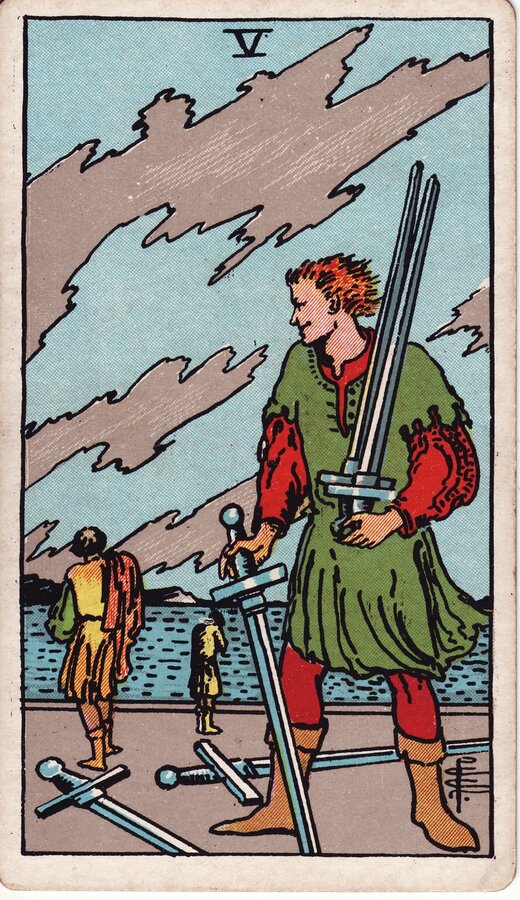
In Waite, the Five of Swords is a victor with a contemptuous half-smile gathering swords while two of the defeated walk away stooped: a Pyrrhic victory in which both the losers and the winner himself are humiliated. This deck specifies the role: a foreign soldier who gives no honor to the king, against whom an honest fighter is forced to withdraw without giving battle. In Waite the accent is on the cost of victory for the victor; here it is on the wisdom of the one who refuses to fight the dishonorable. Both are about the same thing: a conflict with no true victor, a dishonorable struggle. But Waite looks through the eyes of the winner, this deck through the eyes of the one who chose not to war with baseness.
WaiteDeviant Moon Tarot
SceneA victor gathers swords, two of the defeated walk away.A foreign soldier gloats, gathering the surrendered blades.
AboutA Pyrrhic victory, humiliation, the cost of winning at any price.Deceit, a dishonorable victory, unfair tactics, boasting.
Whose gazeThe victor's own, having lost his honor in the win.That of the one who wisely withdraws before a dishonorable foe.
Symbolism & correspondences
Venus in Aquarius: Venus (love, value, union) in Aquarius (detachment, the cold mind) — warmth chilled by reason, value sacrificed to being right. Love under the sign of estrangement, hence the taste of dishonorable victory: a bond destroyed by cold calculation for the sake of triumphing over another.
Element
Air
◆
Arcana
Minor
Suit
Swords
Frequently asked: Five of Swords
What does the Five of Swords card mean?
The Five of Swords marks a conflict where even the winner walks away diminished. Victory has been seized through force or cunning, but at the cost of respect, alliance, or inner integrity.
What does the Five of Swords card mean reversed?
The reversed Five of Swords carries the full weight of what was broken — grief, finality, the funerary quiet after the battle has long ended. In its gentler expression it signals the possibility of reconciliation, a willingness to admit fault and return to the table.
What does Five of Swords mean in love and relationships?
A relationship has become a battleground of point-scoring and wounded pride. One partner may feel triumphant while the other withdraws in hurt silence.
What does Five of Swords mean for work and money?
Competition at work has turned sharp — someone is winning by undercutting, claiming credit, or outmaneuvering rather than excelling. A hollow professional victory may leave you isolated or distrusted by colleagues.
What advice does the Five of Swords card give?
Ask yourself honestly what you are actually fighting for. If winning costs you more than losing would, it is time to put the swords down.
Ready to see how this card unfolds in your own reading?