In short Seven of Swords upright means deception, cunning strategy, stealth, partial victory. Reversed — exposure, confession, imposter syndrome, unwanted advice.
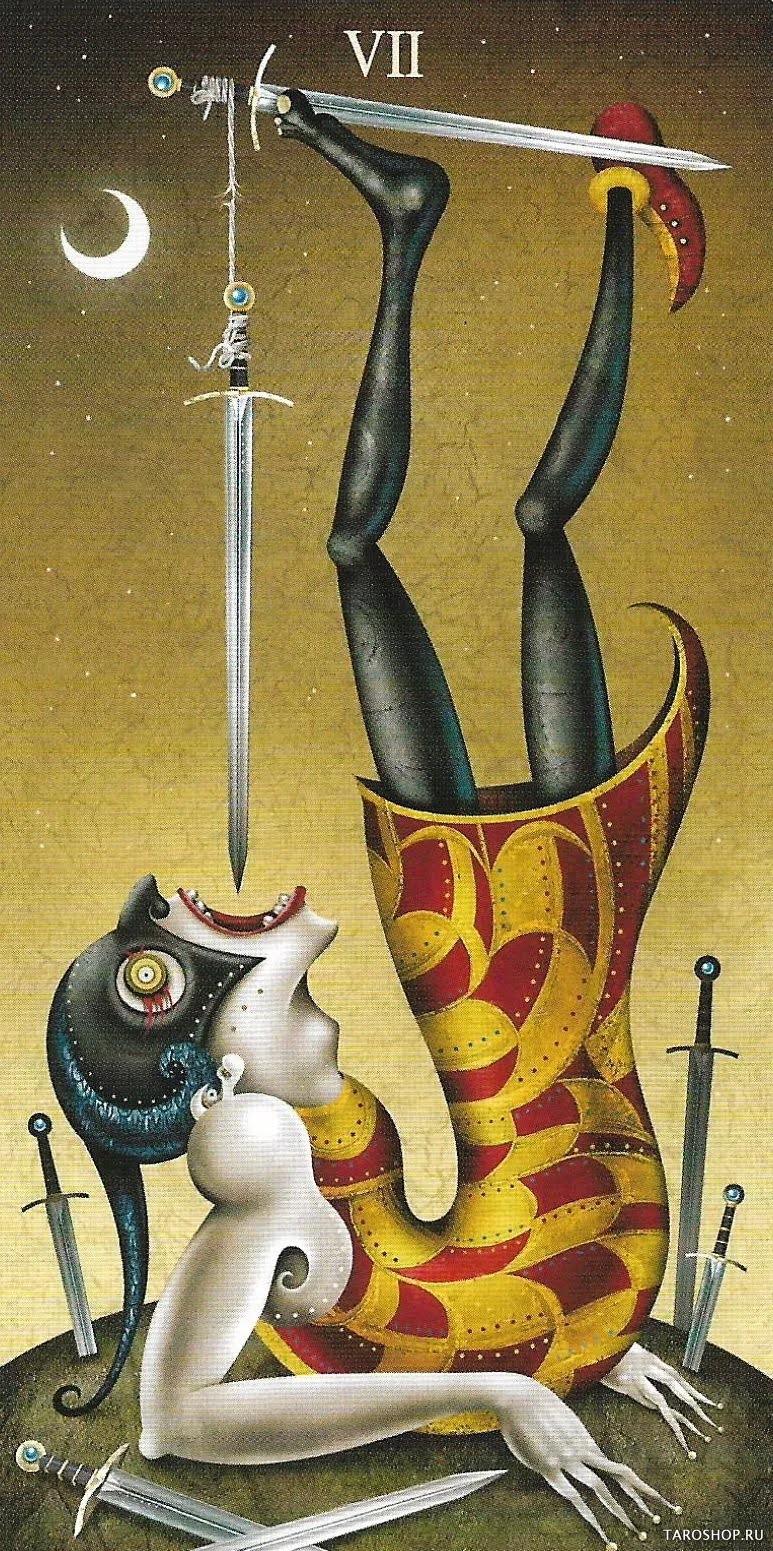
A harlequin tries to swallow his swords, showily flaunting his skill, but his scheme is flawed. The cord that binds the blades has frayed and is about to snap.
A jester-harlequin tries to swallow his swords, staging a flashy feat of dexterity. But his scheme is flawed: the cord binding the blades into a bundle has frayed and is about to break, leaving him in a tragic plight. On the outside — a brilliant trick and a self-assured pose; on the inside — an unreliable construction doomed to fail. A cunning that looks like mastery but hangs on a rotten thread.
🃏A jester-harlequin — a trickster who bets on a flashy deceit rather than honest labor
🗡️Swallowing the swords — a dangerous trick, a risky scheme; a display of skill for show
🪢A frayed cord — a flaw at the foundation of the scheme; a construction doomed to snap
🎭A flashy pose — brilliance outside, failure within; a plan that will not withstand scrutiny
Interpretation
The Seven of Swords here is the card of the flawed plan. The harlequin swallows the swords, making a flashy bet on dexterity, but the cord binding the blades has frayed and is about to snap. On the outside — a brilliant trick; on the inside — a doomed construction. This is a cunning that passes itself off as mastery but hangs on a rotten thread.
In Waite's tradition, this is the card of cunning, of secret action, of victory through going around rather than through direct confrontation. Its meanings are varied and contradictory — natural for a card of deceit: it is itself about ambiguity. A scheme that requires stealth; a plan that cannot be announced. Sometimes — flexibility of mind, the ability to find a way around; but here the accent is harsher: an ill-conceived plan, a road to failure, a feeble attempt.
Upright in this deck — poorly thought-out plans, a road to failure, a mediocre attempt. What looks like a clever move is in fact doomed: the foundation of the scheme is unreliable. This is a warning not to trust flashy but leaky schemes.
With The Magus The Magician the Seven shares the motif of manipulation, but The Magus creates while the Seven appropriates or plays the fool. With The Moon The Moon — the motif of deceit: The Moon is about self-deception, the Seven about deceiving others or a trick that will not work. And with the Eight Eight of Swords it forms a pair: sometimes the trickster falls into the very trap he set.
The card's counsel is to check the cord before swallowing the swords. Do not trust a brilliant plan whose foundation has frayed. Ask yourself whether you are trying to win by dexterity where you ought to act directly or speak honestly. A flashy trick with a flaw is worse than a modest but reliable move.
✦ Full InterpretationUnlock the card's full readingFree registration reveals the final paragraphs of the interpretation and gifts you ⭐ for your first spreadyour first spread is on us
Advice & forecast
✦ The card's advice
Check the foundation of your scheme before setting it in motion: a flashy plan hanging on a rotten thread is doomed to snap at the worst possible moment. Do not trust workarounds and clever tricks where you ought to act directly. Ask yourself honestly: are you trying to win by cunning what would be simpler to settle by conversation or an open step? If there is a flaw in the plan — you already feel it, as the harlequin feels the frayed cord. Give up brilliance on display for the sake of modest reliability. Sometimes the best move is to set the trick aside and take the direct road.
🔮 What the forecast holds
Ahead lies a test of your scheme's soundness: the plan you are betting on may prove flawed. What looks clever and flashy risks failing you at the decisive moment — the cord has frayed, and the trick will collapse. The forecast warns: do not rely on workarounds and brilliance on display, check the foundation of the matter. If you notice the weak point in time and trade cunning for a direct, honest move, you will avoid failure. Otherwise the flashy venture will turn into a tragic plight from which you will have to extricate yourself.
↓ Seven of Swords reversed
The reversed Seven of Swords here is a well-thought-out plan, sound advice. What in the upright card was a doomed trick now becomes a reliable scheme: the cord is strong, the construction will hold. Someone gives you wise counsel, notices the flaw, and keeps you from a mistake — good news for one ready to listen. This is a turn from buffoonery to substance. But the reversed card has its shadow too: good advice that is disregarded; a plan exposed before it could work; the unmasking of the fool. In a milder reading — a refusal of cunning, a return to honesty and a sound scheme; in a heavier one — empty chatter instead of deeds, advice let slip past the ears, exposure at the wrong moment.
The card in spreads
The same card reads differently depending on the spread and the question — compare real spreads:
Spread "Will the plan work"
Test the soundness of the scheme
«Will my venture succeed?»
The scheme
Seven of Swords
The weak point
Eight of Swords
What is more reliable
Ace of Swords
The Seven of Swords at the scheme — the plan looks clever, but the cord has frayed: the foundation is unreliable, and the trick may snap. The weak point Eight of Swords is the Eight of Swords: you have driven yourself into a trap, unable to see the direct way out, and so you seek a roundabout one. This is self-deception. What is more reliable Ace of Swords is the Ace of Swords: one direct, honest stroke, a clear decision instead of buffoonery. Give up brilliance on display. Take off the blindfold of the Eight and cut straight, like the Ace — a sound move is more reliable than a flashy cunning.
Spread "Whom to trust"
Understand whether the person beside you is honest
«Is this person deceiving me?»
What is shown
Seven of Swords
What I notice
Page of Swords
How to act
Queen of Swords
The Seven of Swords in the position of what is shown — before you is a flashy pose, a trick that may conceal a flaw; not everything is as smooth as it looks. What I notice Page of Swords is the Page of Swords: your vigilance is awake, you see the inconsistencies, trust the scout's instinct. How to act Queen of Swords is the Queen of Swords: judge soberly, see through it, do not fall for the brilliance. The frayed cord gives the fool away. Check the foundation of his words before you believe the flashy act.
✦ PremiumUnlock the Full ReadingSpread "Whom to trust": position-by-position reading, card combinations, and guidanceOpen with subscription →first spread is free
Spread "The Lesser Cross"
Clarify the essence and outcome of the venture
«How will this cunning end?»
Essence
Seven of Swords
The hidden motive
Five of Swords
The denouement
The Tower
The Seven of Swords at the essence — a roundabout plan with a flaw, a bet on dexterity instead of directness. The hidden motive Five of Swords is the Five of Swords: the desire to win at any cost, triumph through going around and humiliating another. The denouement The Tower is The Tower: the sudden collapse of a false construction; the frayed cord will snap, and the trick will come crashing down on the fool's head. Cunning built on a rotten foundation will collapse like The Tower. Better to give it up yourself than to wait for it to fall.
✦ PremiumUnlock the Full ReadingSpread "The Lesser Cross": position-by-position reading, card combinations, and guidanceOpen with subscription →first spread is free
How it differs from Waite
Rider-Waite-SmithSeven of Swords
vs
Deviant Moon TarotSeven of Swords
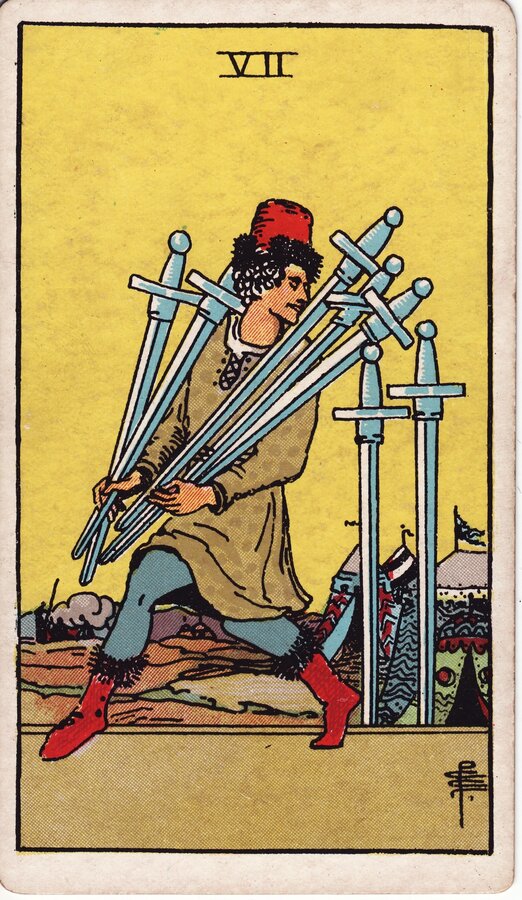
In Waite, the Seven of Swords is a man stealing away from a camp, carrying off five swords and leaving two behind; victory through going around, cunning, partial and ambiguous. This deck sharply shifts the accent: instead of a lucky thief, a harlequin whose flashy trick is doomed because the cord is about to snap. In Waite the cunning partly works (though not fully); here the plan is flawed from the start and leads to failure. Both are about the same thing — a scheme that does not withstand scrutiny, a bet on dexterity instead of directness. But Waite leaves a chance for the workaround to succeed, this deck all but takes it away: the brilliance on display conceals a rotten foundation.
WaiteDeviant Moon Tarot
SceneA thief steals away from a camp, carrying off five swords.A harlequin swallows the swords, the cord about to snap.
AboutCunning, deceit, going around, partial victory through dexterity.An ill-conceived plan, a road to failure, a feeble attempt.
The plan's chanceThe workaround partly succeeds, five of seven carried off.A flawed scheme, doomed; brilliance conceals a rotten foundation.
Symbolism & correspondences
The Moon in Aquarius: the Moon (intuition, the hidden, the nocturnal) in Aquarius (detachment, the lone mind) — cunning hatched in secret, the night-time circumvention of reason. Instinct set in service of evasion and the covert move: the harlequin's trick is born of this lunar-Aquarian slipperiness that gleams but does not hold.
Element
Air
◆
Arcana
Minor
Suit
Swords
Frequently asked: Seven of Swords
What does the Seven of Swords card mean?
The Seven of Swords is the card of the clever sidestep — the move made in shadow rather than in daylight. Something is being done indirectly, with more calculation than confrontation.
What does the Seven of Swords card mean reversed?
Reversed, the Seven of Swords brings hidden things into the open — sometimes painfully, sometimes with relief. A plan that depended on invisibility has been noticed.
What does Seven of Swords mean in love and relationships?
In relationships this card points to something unspoken — a secret kept, a truth withheld, or a strategy running beneath the surface of daily life. It may describe your own guardedness or a partner who is not being fully transparent.
What does Seven of Swords mean for work and money?
At work the Seven of Swords suggests navigating around an obstacle rather than meeting it head-on — pitching an idea quietly, gathering information before anyone knows you are looking, or finding a workaround where the official path is blocked. Lateral thinking is your advantage here, though it helps to stay on the right side of ethical lines.
What advice does the Seven of Swords card give?
Ask yourself honestly whether the route you have chosen can bear the weight of daylight. A partial success built on concealment is still partial — and the two swords left behind will matter eventually.
Ready to see how this card unfolds in your own reading?