overwhelmburden of successovercommitmentresponsibilitynearing the goal
In short Ten of Wands upright means overwhelm, burden of success, overcommitment, responsibility. Reversed — burnout, delegation, hidden agenda, resentment.
An overburdened worker trudges home after a long day's labor; the load is heavy, but there is still enough strength to carry it. Oppression, a burden that must be borne but that is manageable, crushing stress.
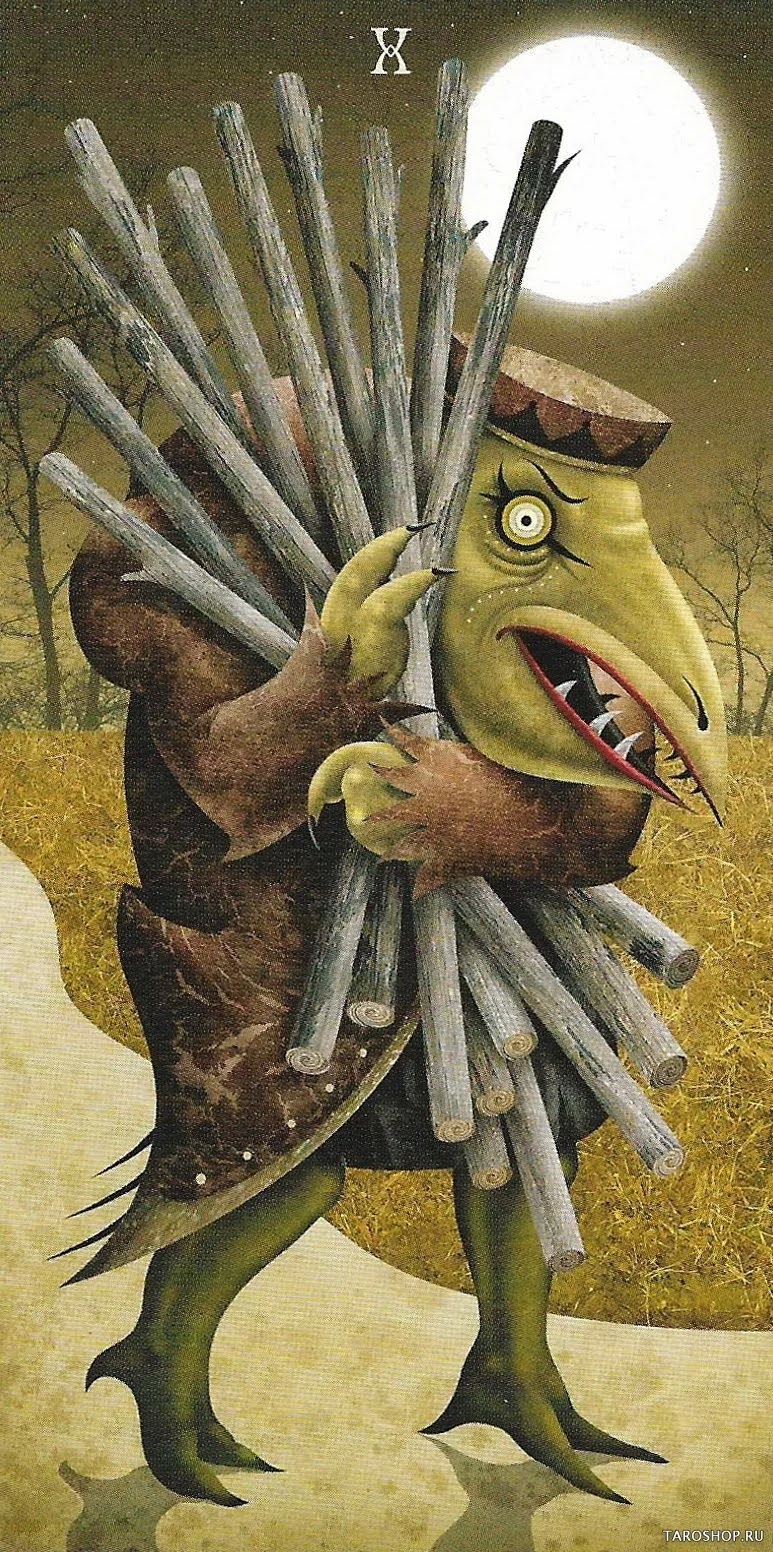
An overburdened worker trudges slowly home after a long day in the fields of the moonlit world. He is bent under an armful of wands and struggles with the weight — but his strength is still enough to carry this heavy load to the end of the road.
🪵An armful of ten wands — the burden of obligations, the weight of one's own accumulated success
🧎Back bent under the weight — oppression, crushing stress, the fatigue of the load
🏚️The long road home — the destination to which the load must be carried, unrelinguished
💪Strength enough to manage — the load is manageable — exhausting, but bearable
🌙Moonlit fields behind — labor that has already been done and continues to press down
Interpretation
The Ten of Wands in this deck's world is the moment when fullness has become a burden: the worker trudges home, bent under an armful of wands, but the strength to carry it is still there. The fire of the suit, having reached its conclusion after the long defense of the Nine Nine of Wands, has become its own weight — successes, achievements, and obligations have settled on the shoulders as a heaviness.
Upright, this is oppression, a burden that must be borne, crushing stress — but with this deck's important caveat: the load is bearable, exhausting but manageable. The Waite archetype sharpens the theme: this is oppression by one's own success — a person has taken on so many obligations that the will has become a burden. Waite also adds a note of pretense, camouflage, risk: success is undone if followed by the Nine of Swords Nine of Swords.
The key idea: the card teaches how to let go, pass on, delegate, or change the load. To reach home and put down the burden rather than trying to carry it still further — that is the task of this worker.
Among the Tens this is the only one where the conclusion presses rather than rejoices: the Ten of Cups Ten of Cups is about the fullness of happiness, the Ten of Swords Ten of Swords about the end of a cycle, the Ten of Pentacles Ten of Pentacles about ancestral wealth, while the Ten of Wands is about the burden of what has been achieved. The Ace of Wands Ace of Wands is the opposite pole of the suit: the lightness of the spark against the heaviness of the conclusion. The Hanged One The Hanged Man is also about suspended movement — but has accepted it, while the Ten still carries.
The counsel is to put down part of the load. Beside the Nine of Wands Nine of Wands one can see how the weary guardian became the porter of his own armament; it is time to acknowledge that not everything needs to be carried alone.
✦ Full InterpretationUnlock the card's full readingFree registration reveals the final paragraphs of the interpretation and gifts you ⭐ for your first spreadyour first spread is on us
Advice & forecast
✦ The card's advice
Put down part of the load — not everything needs to be carried alone. You have taken on so much that your own success presses on your shoulders; the load is still bearable, but that is no reason to carry it forever. Reach home and set the armful down, instead of trying to carry it still further out of a sense of duty or pride. Delegate, relinquish false obligations, redistribute the weight: what has grown from your own achievements can be shared. Check whether the load is blocking your view so thoroughly that you have lost sight of where you are going. A rest is not weakness — it is a way of not breaking down.
🔮 What the forecast holds
Ahead lies a period of peak load: obligations will multiply, responsibility will settle heavily, success will become a burden difficult to carry alone. There will be enough strength to manage, but the fatigue of one's own achievements will accumulate. The forecast calls for unloading: if you put down part of the weight in time and delegate, you will reach home; if you carry everything alone to the point of exhaustion, near heavy cards this risks a breakdown. The conclusion is manageable, but asks for distribution.
↓ Ten of Wands reversed
The reversed Ten of Wands in this deck's world — loss, inability to maintain stability, treacherous acts. The load has become unmanageable: the person drops the armful, loses their footing, and under pressure resorts to intrigue and dishonest maneuvers. Waite specifies the reversal: opposition, complications, scheming — the burden's energy turns into resistance and under-the-table maneuvering, and directed inward becomes blaming everyone else for carrying so much alone. In reimagined form this is nevertheless the moment to shed part of the load: relinquish false obligations, redistribute the weight, acknowledge that pride made you take on excess. Better to honestly lay down the armful than to drop it together with your stability and good name.
The card in spreads
The same card reads differently depending on the spread and the question — compare real spreads:
Spread "What is overloading me"
Find the source of overload
«Why am I breaking down, and what should I put down?»
The burden
Ten of Wands
Where it came from
Nine of Wands
What will lighten it
Temperance
Ten of Wands in the burden position — you are bent under an armful of obligations, and your own success presses on your shoulders. Where it came from Nine of Wands — the Nine of Wands: you held your defense so long that fatigue became a habit, and you took on too much. What will lighten it Temperance — Temperance: measure, delegation, redistribution of the weight. Reach home and put down part of the load: not everything needs to be carried alone; rest is not weakness.
Spread "Should I take on more?"
Decide about a new responsibility
«Should I take on yet another undertaking?»
Now
Ten of Wands
What beckons
Ace of Wands
If overloaded
The Tower
Ten of Wands now — you are already carrying a full armful, strength is enough, but barely. What beckons Ace of Wands — the Ace of Wands: a new spark, an enticing venture, one more torch. If overloaded The Tower — the Tower: the collapse of what was being held by the last of one's strength. Before taking on something new, put down the old: adding a wand to an already unmanageable armful means risking dropping everything at once.
✦ PremiumUnlock the Full ReadingSpread "Should I take on more?": position-by-position reading, card combinations, and guidanceOpen with subscription →first spread is free
Spread "Are we carrying this together?"
Work through overload in the partnership
«Are we carrying our shared load equally?»
My burden
Ten of Wands
Partner
Knight of Wands
For the home's sake
Four of Wands
Ten of Wands as my burden — you are carrying the shared load almost single-handedly, bent under the obligations. Partner Knight of Wands — the Knight of Wands: drive and movement, but without readiness to take an equal share of the weight. For the home's sake Four of Wands — the Four of Wands: the firm hearth worth distributing the load honestly for. Talk about the weight out loud: the home stands on two supports, not one strained back.
✦ PremiumUnlock the Full ReadingSpread "Are we carrying this together?": position-by-position reading, card combinations, and guidanceOpen with subscription →first spread is free
How it differs from Waite
Rider-Waite-SmithTen of Wands
vs
Deviant Moon TarotTen of Wands
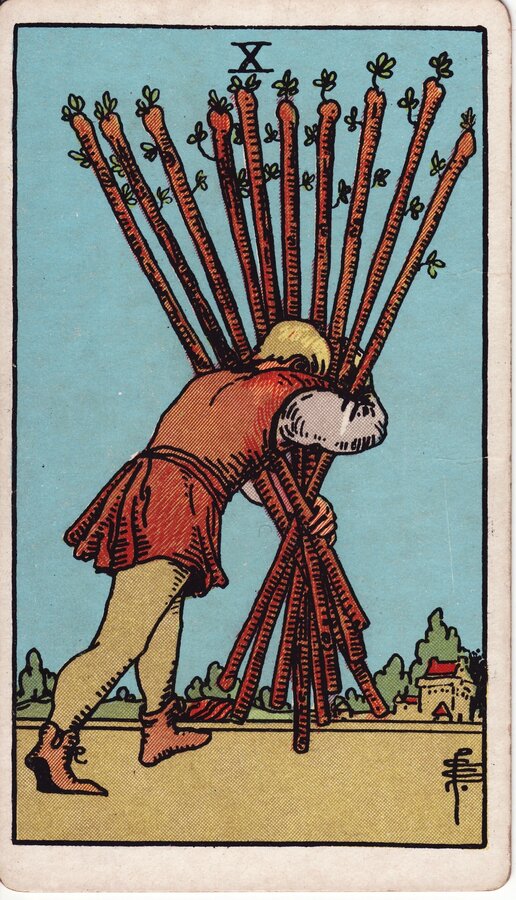
In Waite the Ten is a person bent under an armful of wands that block the view, trudging toward a city: oppression by one's own success, a burden, camouflage, the risk of breaking down. This deck softens the accent: the worker is also bent under the load, but has enough strength to manage. The meaning is one — oppression, burden, crushing stress — but Waite more strongly emphasizes the note of pretense and risk, while this deck underscores that the load, though heavy, is bearable.
WaiteDeviant Moon Tarot
ImageA person bent under an armful of wands, view blocked.A worker trudges home with a load but has enough strength to carry it.
ThemeOppressed by success, a burden, pretense, the risk of breaking down.The same oppression and stress, but with the emphasis: the load is manageable.
ToneMore alarming: success weighs, camouflage, treachery.Heavy but manageable: weariness without catastrophe.
Symbolism & correspondences
Saturn in Sagittarius (third decan of Sagittarius): Saturnian heaviness in the far-reaching Sagittarius — the weight of responsibility, the burden of obligations, a load carried to the point of exhaustion. Saturn presses down on Sagittarius's fire with the weight of taken-on success, turning the flight into a heavy trudge home.
Element
Fire
◆
Arcana
Minor
Suit
Wands
Frequently asked: Ten of Wands
What does the Ten of Wands card mean?
You have carried your ambitions all the way to their fullest expression — and now their weight is nearly too much to bear. The Ten of Wands speaks of success that has grown into a burden, of a life so full of responsibilities that breathing feels difficult.
What does the Ten of Wands card mean reversed?
Reversed, the pressure loosens — but not always cleanly. The weight may be shifting into resistance, manipulation, or a simmering grievance toward others who seem unburdened.
What does Ten of Wands mean in love and relationships?
In a relationship, this card can signal that one partner is shouldering too much — the household, the emotional labor, the planning. The love may be real, but exhaustion is bleeding into resentment.
What does Ten of Wands mean for work and money?
Professional success has multiplied your obligations faster than you expected. Projects stack up, people rely on you, and the work that once felt inspiring now feels like a march with no end.
What advice does the Ten of Wands card give?
Set down at least one bundle before you reach the door. Delegate, postpone, or simply say no — not everything you picked up was yours to carry in the first place.
Ready to see how this card unfolds in your own reading?