In short Five of Wands upright means competition, conflict, struggle, rivalry. Reversed — inner conflict, hidden rivalry, avoidance, resolution.
'The number of passage,' a bridge to another dimension: the appearance of a new ideal that destabilizes the stability of the Four. A new desire breaks the settled rhythm and calls beyond the familiar.
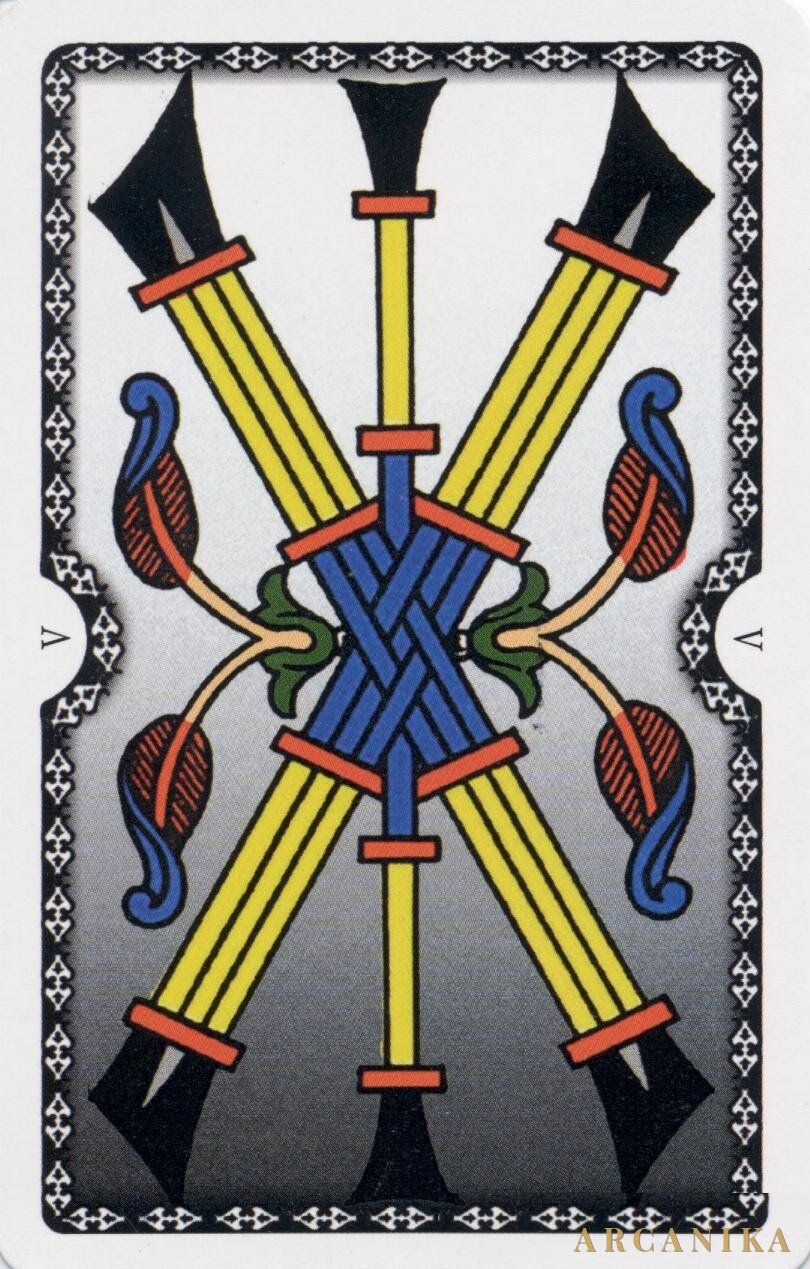
Five wands interwoven so that a 'gap' appears at the center — a rift through which a new view of things emerges. This gap is the ideal of the Five: the stable lattice of the Four has opened, a window beyond it has appeared. The composition is tense, the symmetry broken by the central opening. The crossing of the wands reads both as a collision of forces and as a new opening — the ambiguity of the trial.
🪟A gap-opening at the center of the interlacing — the ideal of the Five; a window beyond the stable, a new view of things
🔓The opened lattice of wands — the stability of the Four is broken, an opening into the new has appeared
⚡Broken symmetry and tension — crisis-transition, a trial by novelty, the destabilization of calm
⚔️The crossing of the wands — a collision of forces; ambiguity — both an opening and a struggle
🌉A bridge to another dimension — a call toward something greater; chance and temptation at once
Interpretation
In our system the Five is the degree of the Five (the Hierophant, guide between worlds; the Devil, temptation) in the element of Fire. This is a crisis-transition, a trial by novelty: the ideal destabilizes the stability of the Four in order to lead beyond it. In Wands this is the appearance of a new desire — a creative or sexual impulse breaking the rhythm.
In the upright position this is the awakening of a new desire, a creative or passionate impulse pulling one off track. An ideal that does not let one stand still; the temptation of change, a call toward something greater. The card breaks the stagnation of the Four and opens a bridge to the new — trial and chance at once.
The time to decide on the transition, but to soberly assess where the desire leads. The danger of the Five is lies, betrayal, fraudulent promises, an ill-fated utterance: the new desire may turn out to be a temptation, a deception, a broken word.
The Five follows the stability of the Four Four of Wands, which the new desire breaks, and leads to the Six of Wands Six of Wands, where the transition is completed and fullness of pleasure arrives. At the level of the Majors the same degree is carried by the Hierophant The Pope and the Devil The Devil — the guide between worlds and temptation.
Among the Fives this is the appearance of the new: the Five of Cups Five of Cups — a love temptation, the Five of Swords Five of Swords — new knowledge, the Five of Pentacles Five of Pentacles — new awareness in matter. In Wands this is the awakening of a new desire.
✦ Full InterpretationUnlock the card's full readingFree registration reveals the final paragraphs of the interpretation and gifts you ⭐ for your first spreadyour first spread is on us
Advice & forecast
✦ The card's advice
Decide to make the transition, but verify that the call is genuine. The new desire is drawing you off track for a reason — it breaks the stagnation in order to open a bridge to something greater; do not brush it aside simply because it disturbs your peace. But the Five is ambiguous: behind the same opening a temptation and an empty promise may be hiding. Before you step, soberly weigh where it is drawing you — toward genuine growth or toward a mirage. Do not destroy the stable for the sake of novelty alone without first making sure the call is real.
🔮 What the forecast holds
Ahead lies a crisis-transition: a new desire or ideal will disrupt the settled rhythm and call beyond the familiar. This is both a trial and a chance — a bridge to another dimension. The forecast promises a way out of stagnation for those who soberly test the call; but there is a risk of yielding to temptation, deception, or an empty promise and destroying the stable in vain. After a true transition, if it is made, fullness of pleasure opens.
↓ Five of Wands reversed
Desire turns into seduction-deception: false promises, betrayal, an ill-fated word, temptation leading astray. Novelty for novelty's sake, destruction of the stable with no replacement. Possible betrayal of self or others, a broken agreement, an alluring but empty goal. The card warns: verify whether the call is genuine or a mirage. Alongside the Devil The Devil the temptation is especially strong — the magma of desire can blind.
The card in spreads
The same card reads differently depending on the spread and the question — compare real spreads:
Spread "Is the call genuine"
Test a new desire for authenticity
«Is this a genuine call or a temptation?»
The call
Five of Wands
What to check
The Pope
If genuine
Six of Wands
The Five of Wands as the call — a new desire is breaking your peace and drawing you beyond the familiar: this is both a chance and a trial. What to check The Pope — the Hierophant of the same degree: align with true meaning, not the glitter of a promise. If genuine Six of Wands — the Six of Wands: the transition will lead to fullness of pleasure. Decide, but weigh soberly — behind the same opening a mirage may be hiding.
Spread "Should I break the familiar"
Understand whether it is worth destroying the stable
«Should I leave the settled life for the sake of the new?»
The temptation
Five of Wands
What breaks
Four of Wands
The shadow
The Devil
The Five of Wands — the temptation of change is pulling you off track: the new desire promises something greater. What breaks Four of Wands — the Four: the stable rhythm, the reliable foundation that is hard to abandon. The shadow The Devil — the Devil: check whether this is a temptation, an empty promise. Do not destroy the stable for the sake of novelty alone — step only once you are sure the call is real, not a mirage.
✦ PremiumUnlock the Full ReadingSpread "Should I break the familiar": position-by-position reading, card combinations, and guidanceOpen with subscription →first spread is free
Spread "A new attraction"
Read a sudden pull toward another
«What does this attraction to someone else mean?»
The nature of the pull
Five of Wands
What is there now
Four of Wands
The choice
The Lovers
The Five of Wands — a new desire has awakened, a call beyond the familiar: it breaks what is settled and draws toward something greater. What is there now Four of Wands — the Four of Wands: a reliable, steady connection, your foundation. The choice The Lovers — the Lovers: the decision requires a free and honest heart. Test the call for authenticity: a genuine ideal leads to growth, a seduction-deception only destroys the stable in vain.
✦ PremiumUnlock the Full ReadingSpread "A new attraction": position-by-position reading, card combinations, and guidanceOpen with subscription →first spread is free
How it differs from Waite
Rider-Waite-SmithFive of Wands
vs
Tarot de Marseille (Conver)Five of Wands
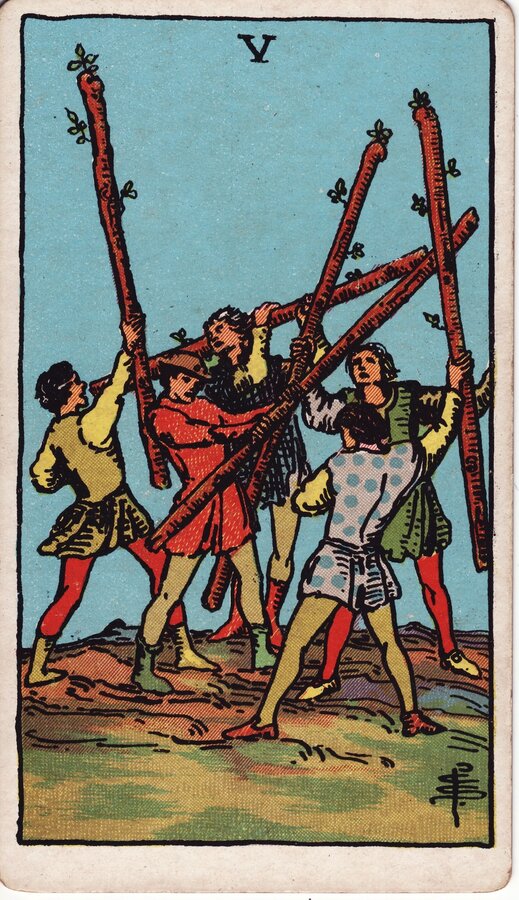
In Waite the Five is a dynamic scene: five youths waving wands in a noisy brawl — a story about competition, argument, rivalry. In Marseille the minor arcana are non-scenic and are read through number × suit: the Five is the degree of passage (the Hierophant — a guide between worlds; the Devil — temptation) in the element of Fire. Meaning is carried by the geometry — a gap-opening at the center of interlaced wands, a window beyond the stable; this is about a bridge to a new desire and the trial it brings, not a brawl.
WaiteTarot de Marseille (Conver)
PresentationNarrative: five youths in a brawl waving wands.Non-scenic pip: five wands with a gap-opening at the center.
ThemeCompetition, argument, collision of interests, struggle.A new desire, a bridge to the new, a crisis-transition, temptation.
VectorExternal conflict between several parties.An inner call beyond the familiar; chance and temptation together.
Symbolism & correspondences
This is not astrology but numerology × element: the degree of the Five (passage, guide between worlds, temptation) in the element of Fire. Crisis-transition and trial by novelty — a bridge beyond the stable, where a genuine call to something greater is at first indistinguishable from seduction-deception.
Element
Fire
◆
Arcana
Minor
Suit
Wands
Frequently asked: Five of Wands
What does the Five of Wands card mean?
Five figures clash with their wands in an open, unresolved struggle — nobody is winning yet, and that is the point. This card marks a moment of lively contest: competing interests, clashing views, the market of wills where each voice wants to be heard.
What does the Five of Wands card mean reversed?
The battle has gone underground. What was once an open clash has become suppressed tension — passive aggression, covert rivalry, or an exhausting stalemate where nobody will name what is wrong.
What does Five of Wands mean in love and relationships?
Sparks fly, but not always the romantic kind — this card can signal arguments, competing needs, or a battle of wills within a relationship. Yet honest friction often clears the air; the couple who can fight fairly tend to build something lasting.
What does Five of Wands mean for work and money?
The workplace buzzes with competition: bids, proposals, or team debates where everyone has a different take. This is healthy contention — your idea is one among many, and you will have to fight for it.
What advice does the Five of Wands card give?
Do not shrink from the contest. Enter the fray with your head up, your argument ready, and your ears open — engagement, not retreat, is the path forward.
Ready to see how this card unfolds in your own reading?