In short Justice upright means fairness, accountability, balance, clarity. Reversed — avoidance, bias, self-deception.
In the Marseille tradition — Justice, and it carries the number VIII (not XI): it and Strength have exchanged places relative to Waite. Eight is the peak of the even numbers, the symbol of perfection.
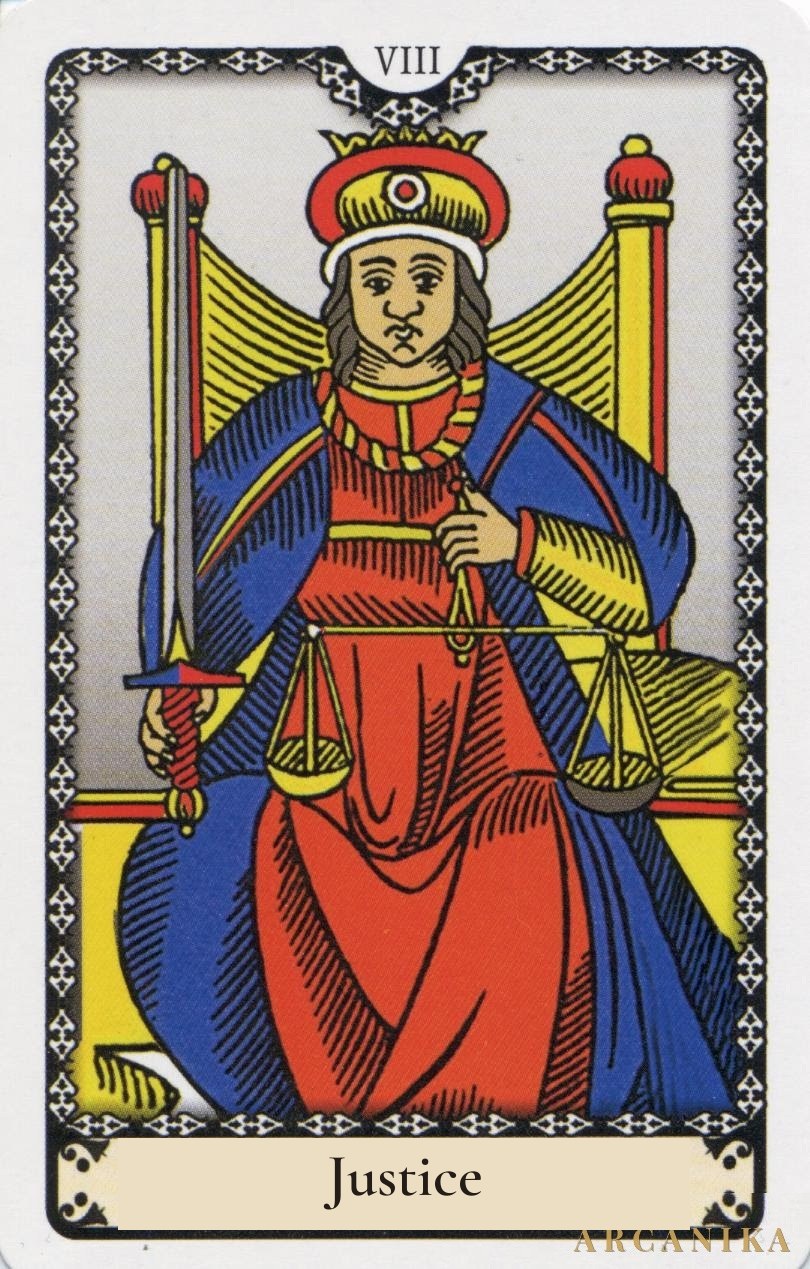
Justice holds a sword and scales and looks directly at us. The card is deliberately asymmetrical: the right pillar of the throne is taller than the left and ends in a dark-yellow ball the left lacks; the necklace runs higher on the left; the pans of the scales are at different levels; the sword is not parallel to the pillar. She holds the scales not straight but influences them with her right elbow and left knee. On the crown a semblance of a third eye; the fingers of the hand holding the scales are arranged in a sacred gesture. On the dress nine ascending triangles, like an ermine mantle.
⚖️Scales at different levels — the instability of Nature itself; a call to avoid the dead perfectionism of symmetry
🗡️Sword not parallel to the pillar — the ability to cut away, to say 'yes' and 'no,' to give each what is deserved
🪑Asymmetrical throne — balance is not equal to symmetry; a living striving rather than frozen superiority
👁️Third eye on the crown — spiritual vision encompassing both the material and spiritual squares
🔺Nine triangles on the dress — an ermine mantle — royal authority, the impeccability of action
Interpretation
Eight is the peak of the development of the even numbers, the symbol of perfection: after the accumulation of two, the creation of four, and the pleasure of six, it reaches the stage where nothing can be added or taken away. The Arabic '8' — two superimposed circles, a doubled square: stability in the material and spiritual worlds.
Upright — balance, stability, perfection, completion. Clarity of judgment, the ability to distinguish the subjective from the objective, to say 'yes' and 'no,' to give each what is deserved. The great feminine archetype — the mother, the pregnant woman, valor, authority. The ability to put oneself in another's place.
But balance and perfection here are not equal to symmetry: the card is deliberately built asymmetrically, and in this lies its lesson — the rejection of dead perfectionism in favor of a living, dynamic striving. Justice is our inner god that makes us assess ourselves without flattery: are we just to ourselves, are we merciful to others?
With the Hermit The Hermit — nine leaves the perfection of eight so as not to die within it. With the Chariot The Chariot the action of seven passes into the perfection of eight; if that perfection is illusory, action will make itself known again. With the Moon The Moon Justice is the most accessible, most human embodiment of the great feminine archetype. With the Magician The Magician the eight balls in his locks reference her as a maternal figure.
Reversed — perfection turned to oppression: an exaggerated perfectionism in which no action is possible; a castrating maternal figure, a remorseless verdict.
✦ Full InterpretationUnlock the card's full readingFree registration reveals the final paragraphs of the interpretation and gifts you ⭐ for your first spreadyour first spread is on us
Advice & forecast
✦ The card's advice
Give each (including yourself) what is deserved, cut away the excess — but do not confuse perfection with symmetry. Assess yourself without flattery: are you just to yourself, are you merciful to others? Speak a clear 'yes' or 'no' where it is needed. But beware of perfectionism: beside the Hermit The Hermit to get stuck in the ideal means to die within it; a living striving is worth more than dead superiority.
🔮 What the forecast holds
A verdict, an assessment, the necessity of a clear 'yes' or 'no' is coming. Ahead lies a decision, a reckoning, the restoration of balance; an encounter with the law or with reality where each will receive what is deserved. This is the moment of truth, when the subjective must be distinguished from the objective. If you accept a living justice, clarity will come; if you fall into perfectionism — you will freeze in inaction.
↓ Justice reversed
The reversed Justice — perfection turned to oppression: an exaggerated perfectionism in which no action is possible ('either perfect or nothing'); a demand for perfection that is inhuman because the ideal does not develop and therefore is dead. A castrating, dictatorial maternal figure; destructive verdicts, accusation and punishment. State institutions whose decisions are remorseless; a false sense of rightness, deception.
The card in spreads
The same card reads differently depending on the spread and the question — compare real spreads:
Spread "What Is Deserved"
Understand the just outcome
«What will the just decision be?»
The scales
Justice
The law
The Emperor
The verdict
Judgement
Justice — each will receive what is deserved, the subjective must be distinguished from the objective. The law The Emperor — the Emperor: firm rules and order on which the decision rests. The verdict Judgement — Judgement promises a clear calling and evaluation. Speak an honest 'yes' or 'no'; a living justice is worth more than a dead symmetry.
Spread "Balance with Oneself"
Assess oneself without flattery
«Am I just to myself?»
The assessment
Justice
The shadow
The Hermit
Healing
Temperance
Justice — your inner voice calls you to assess yourself without flattery. The shadow The Hermit — the Hermit: the risk of getting stuck in perfectionism, clinging to the ideal. Healing Temperance — Temperance teaches mercy toward oneself, the middle path. Be both just and merciful: perfection that does not develop is dead.
✦ PremiumUnlock the Full ReadingSpread "Balance with Oneself": position-by-position reading, card combinations, and guidanceOpen with subscription →first spread is free
Spread "Restoring Balance"
See how to bring equilibrium back
«How do I restore justice in this situation?»
The situation
Justice
The action
The Chariot
Outcome
The World
Justice — the question of balance and what is deserved. The action The Chariot — the Chariot: move toward the goal, but check whether your methods are sound and your victory deserved. Outcome The World — the World promises achieved unity. Cut away the excess, give each its due — and equilibrium will be restored in a living, not a frozen form.
✦ PremiumUnlock the Full ReadingSpread "Restoring Balance": position-by-position reading, card combinations, and guidanceOpen with subscription →first spread is free
How it differs from Waite
Rider-Waite-SmithJustice
vs
Tarot de Marseille (Conver)Justice
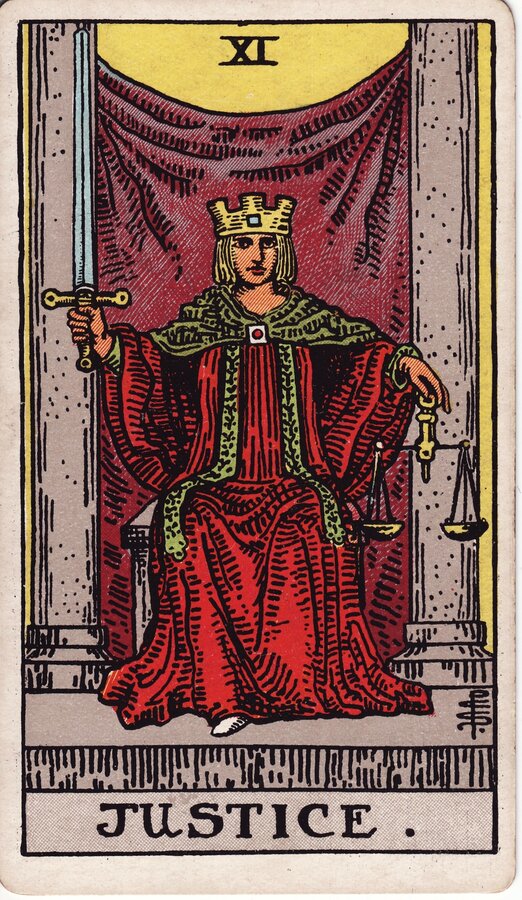
In Waite, Justice carries the number VIII (he shifted it by swapping with Strength), sits between pillars in a strictly symmetrical pose, with level scales and a vertical sword — the image of impeccable, objective law. The Marseille Justice is VIII in the original numbering, and it is deliberately asymmetrical: pillars of different heights, tilted scales. In this lies its lesson — the rejection of dead perfectionism in favor of a living striving. Waite shows the ideal, objective balance; Marseille shows a deeply human justice that upholds the unstable nature of things rather than judging from above.
WaiteTarot de Marseille (Conver)
NumberVIII — after the swap with Strength.VIII — in the original Marseille numbering.
PoseStrict symmetry, level scales and sword.Deliberate asymmetry, tilted scales.
MeaningObjective, impeccable law.Living striving, humanity over perfectionism.
Symbolism & correspondences
The degree of number 8 — eight, the peak of the even numbers and the symbol of perfection: a doubled square, two superimposed circles, stability in matter and spirit. This is balanced, receptive energy of completion and judgment. Numerologically — the point of balance that teaches avoiding dead symmetry in favor of a living striving.
Element
Air
♎
Astrology
Libra — cardinal Air; the sign of the scales, partnership, and deliberate choice
✦
Arcana
Major
Frequently asked: Justice
What does the Justice card mean?
Justice arrives as a still, clear mirror: everything that has come to you has come for a reason rooted in what you have done. This is not punishment or reward in the moral sense — it is simple cause and effect made visible.
What does the Justice card mean reversed?
Reversed, Justice points to a refusal to look. The scales are still there — but a thumb is pressing on one side.
What does Justice mean in love and relationships?
In love, Justice asks for honesty over comfort. A relationship is being weighed — are both people genuinely equal partners, or has an imbalance been quietly tolerated?
What does Justice mean for work and money?
Professionally, Justice favors those whose work has been solid and above-board. A decision, review, or negotiation is coming — and if your record is clean, the outcome should be fair.
What advice does the Justice card give?
Look honestly at your own contribution before assigning blame. The sword only cuts cleanly when the hand holding it is steady.
Ready to see how this card unfolds in your own reading?