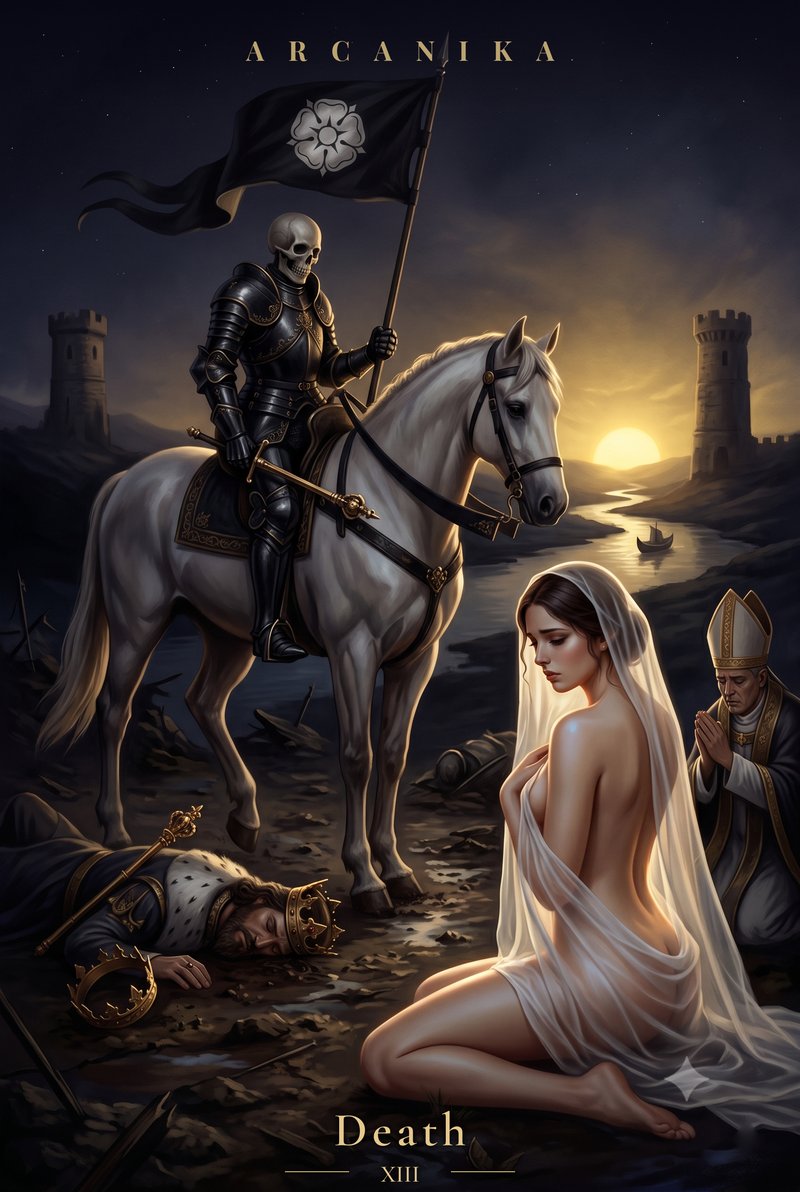
Across a darkening field a rider in black armor moves slowly on a white horse, holding a banner with a white rose — the flower of the end and the new beginning; in the distance, between two towers, a strip of sunset flares up. At the horse's hooves lie the fallen, and among them our maiden: not a frightened victim but a sensual figure with her head bowed and her bare back beneath a slipped veil, meeting the inevitable almost as one meets a lover. Death here is not about horror, nor about a physical end, but about the great transformation: the tearing away of all that has outlived itself, to make room for the living. The old must die — illusions, roles, habits, the former "you" — and that breaking is painful, but it is exactly what opens the door. In the figure of the fallen maiden there is a strange, naked beauty of surrender: she does not cling, she lets go, and in that lies her dignity. The sun rising behind the towers promises: beyond any end there is a dawn. The card speaks plainly: what has ended has ended forever; mourn it honestly, but to hold on to what has gone cold is pointless. Shed the old skin and step naked into the new.
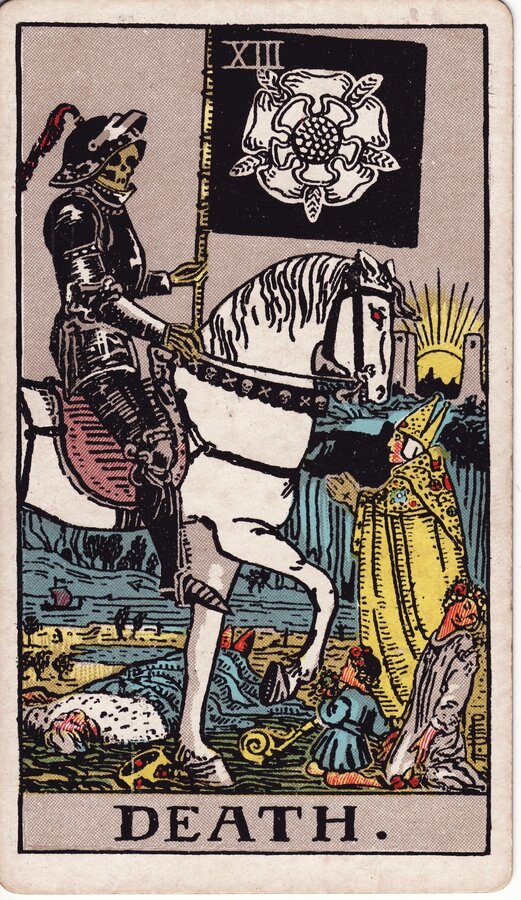
🏇White horse — Purity of passage — the same white horse appears under the Sun and carries the force of life itself. Death rides what life rides. The transition is clean.
🌹White rose on black banner — Life and death in a single emblem. The five petals echo the human form and the mystic rose of regeneration — the banner announces not destruction but transformation.
👑Fallen king — Power, status, and social authority are not exempt. What once commanded the world lies at the rider's feet. No rank negotiates with this passage.
🧒Child facing the rider — Innocence does not yet know to be afraid. The child looks directly at what the adults cannot face — a reminder that the fear of change is learned, not innate.
🌅Sun between the towers — The same towers appear in The Moon — they are gates into the unknown. Between them, the sun is perpetually crossing: every ending carries within it the promise of a next morning.
⛵River and boat — The journey continues on water — the unconscious, the soul's passage. Death is not a wall; it is a crossing. The boat is already moving.
Interpretation
Every major tradition that thinks seriously about change has a version of this card's insight: that the self is not a fixed thing but a series of forms, and that health requires the willingness to let each form complete. The rider does not kill — he passes through, and what falls was already ready to fall. The card's deepest teaching is not about loss but about the relationship between identity and time.
Death sits at position thirteen in the Major Arcana, directly after The Hanged Man and before Temperance. The Hanged Man is the voluntary surrender — the pause, the suspension, the willingness to see from an inverted angle. Death is what becomes possible after that surrender: the old structure actually releases. Temperance is the integration that follows — the slow mixing of what was and what is becoming. Without the Hanged Man's acceptance, Death feels like catastrophe; with it, Death is simply the hinge.
In a reading, this card rarely means what questioners fear it means. It almost never points to literal death — it points to transformation: a relationship reaching its natural end, a phase of life completing, an identity that no longer fits. The card appears at the moments when life demands honesty about what is already finished. The difficulty is not the ending itself but the attachment to the form that housed what we valued.
When Death appears alongside The Tower, the change is likely more sudden and external — the structure is not merely completing, it is breaking. With Judgement nearby, what this card buries will eventually be called back in a new form — the ending is not permanent erasure but a necessary burial before resurrection. Near The Lovers, it speaks of a relationship at a crossroads where one version of the connection must end for any real future to be possible.
✦ Full InterpretationUnlock the card's full readingFree registration reveals the final paragraphs of the interpretation and gifts you ⭐ for your first spreadyour first spread is on us
Advice & forecast
✦ The card's advice
When this card appears, the most useful thing you can do is stop trying to hold the old form together. Not because you do not love what is ending — you may love it very much — but because genuine love for something means honoring when it has completed. Inventory what you are still maintaining out of habit or fear rather than real vitality. Name the things in your life that have already, quietly, ended. Grieve them if you need to — grief is honest. But then turn toward what the clearing makes possible. The energy you have been spending on continuation is the energy available for the next thing.
🔮 What the forecast holds
What is ahead is genuinely new — but to reach it, something that belongs to the past must be allowed to stay there. If this card appears in a future position, expect a significant completion in the period ahead: a chapter of your work, a chapter of a relationship, a chapter of your understanding of yourself. The change is not likely to be subtle. What it asks of you is not courage in the dramatic sense but a simpler, quieter courage — the courage to stop maintaining something that is already over. On the far side of that completion, the card promises not an ending but an opening. The sun between the towers rises as often as it sets.
↓ Death reversed
When Death is reversed, the transformation that should have moved through has stalled. The form is empty but still standing — held in place by fear, by exhaustion, by the sheer weight of familiar habit. This is the card's most difficult expression: not death but the refusal to let something die. The person may feel trapped, depressed, or simply hollow — going through motions that once held meaning. There is often a quality of sleepwalking, of days that feel like replays of other days. The blockage can be internal (fear of who you will be without this identity) or relational (staying in a situation because leaving requires confronting a change you are not ready for). The reversed card does not judge this resistance — it understands it. But it also names it clearly: what you are protecting yourself from is not as dangerous as the stagnation you are living in. The path forward begins with honesty about what has already ended, even if you are not yet ready to act on that honesty.
The card in spreads
The same card reads differently depending on the spread and the question — compare real spreads:
Spread "What Ends, What Continues"
Clarifying what must be released and what carries forward
«What is genuinely over, and what of value survives the transition?»
What prepared this ending
The Hanged Man
What is completing now
Death
What the integration ahead looks like
Temperance
This three-card sequence maps the arc of transformation that surrounds Death. The Hanged Man in the first position shows what inner work — what surrender, what period of suspension — prepared the ground for the transition you are in. It may reveal the pause you have already lived through without fully recognizing its purpose. Death in the center position names what is actually completing: not necessarily what you fear, but what is genuinely finished at the level of form. Look honestly at what this card points to — a relationship, a role, an identity, a way of understanding yourself. Temperance in the final position shows what the patient, unhurried integration of this transition looks like. Temperance is not a fast card — it pours slowly between vessels — and its presence here suggests that what comes after Death will require time and gentle attention to find its new shape. Together, these three cards trace a passage that is not catastrophe but completion.
Spread "The Resistance Reading"
Understanding what is being avoided and why
«What am I holding onto, what is it costing me, and what would I gain by letting go?»
What needs to end
Death
What is being held in place by will or structure
The Emperor
What becomes available after the release
The Sun
This spread is most useful when Death appears reversed, or when you sense that something significant has been postponed. Death in the first position identifies the specific form — the situation, pattern, relationship, or identity — that is genuinely complete and asking to be released. Be as concrete as possible when you read this card here; it will try to show you something precise. The Emperor in the second position reveals the structure or the internal authority figure that is keeping the old form in place. This might be practical (obligations, responsibilities, external pressures) or psychological (a part of you that believes it must maintain control, or that associates this structure with safety). Understanding the Emperor's role here is not about blaming yourself — it is about seeing clearly what force is at work. The Sun in the third position shows what clarity and vitality are waiting on the other side of the release. The Sun does not deal in partial truths — it illuminates. Its presence here is an honest promise that what comes after the completion is genuinely better, not simply different.
✦ PremiumUnlock the Full ReadingSpread "The Resistance Reading": position-by-position reading, card combinations, and guidanceOpen with subscription →first spread is free
Spread "Past Life · Threshold · Next Form"
Mapping a major life transition
«What am I leaving behind, where am I standing now, and what shape does my next chapter take?»
What is being mourned or left behind
Five of Cups
The threshold you are standing on
Death
What guides and sustains you going forward
The Star
This spread reads like a full breath — the exhale, the pause, the inhale. Five of Cups in the first position asks you to look honestly at the grief in this transition. Five of Cups is not shame — it is the honest acknowledgment of real loss. Whatever you are leaving has value; mourning it is not weakness, it is integrity. The card in this position may also show what you are still fixated on rather than what deserves attention. Death in the center is the threshold itself — you are standing on it. This is not a time to rush forward or to pull back. The card here simply names where you are: in the hinge, in the passage, in the moment of genuine transition. It asks only for honesty and presence. The Star in the final position is one of the most quietly beautiful outcomes possible for a Death spread. The Star does not promise drama or sudden transformation — it offers guidance, renewal, and the patient light that allows you to navigate by trust rather than certainty. What comes after this ending will ask you to believe in something you cannot yet see clearly. The Star says: that faith is warranted.
✦ PremiumUnlock the Full ReadingSpread "Past Life · Threshold · Next Form": position-by-position reading, card combinations, and guidanceOpen with subscription →first spread is free
How it differs from Manara
Rider-Waite-SmithDeath
vs
Soblazn — Sensual TarotDeath
In the Rider-Waite-Smith tradition, Death arrives as an armored horseman passing through the social order — impersonal, inevitable, freeing in its impartiality. The card is deliberately de-personalized: no face, no malice, just the rider and the banner. The Milo Manara Erotic Tarot, by contrast, brings Death into the body and into the encounter between two people — transformation here is figured as the dissolution of the self in intimacy, the ego-death of complete surrender to another. Where Waite asks what cycle in your outer life is completing, Manara asks what you must surrender inside yourself to be fully present to love. The imagery shifts from the public landscape of fallen kings and kneeling clergy to the private landscape of skin and breath. Both versions share the core insight that what we call ending is also what makes the next moment possible.
ManaraSoblazn — Sensual Tarot
SceneTwo figures in intimate surrender — the dissolution of self-boundaries in closeness, erotic vulnerability as a figure of ego-deathAn armored skeleton on a white horse passing through a landscape of fallen and kneeling figures beneath a banner bearing a white rose
FocusThe inner transformation that happens in the surrender to love and desire; what the self must release to be fully presentThe impersonal and egalitarian nature of change; the social and psychological structures that cannot survive a genuine transition
QuestionWhat part of yourself are you afraid to let go of in order to be truly close to another person?What in your life has already ended, and what prevents you from acknowledging that it is finished?
Symbolism & correspondences
Death corresponds to Scorpio, the fixed water sign whose domain is depth, transformation, sexuality, and the processes of death and regeneration that sustain life. Scorpio rules what is hidden, what is powerful, what cannot be rushed or circumvented. In Kabbalistic tradition, this card is associated with the path of Nun on the Tree of Life — the path that connects Tiphareth (beauty, the heart) to Netzach (victory, desire), the passage through which the soul must travel to integrate love and will. The planet Pluto, discovered only in the twentieth century, was immediately associated with Scorpio and with this card — both deal in the kind of change that is total and irreversible, the change that does not leave the previous state intact.
Element
Water
♏
Astrology
Scorpio — the fixed water sign governing depth, death, and regeneration
✦
Arcana
Major
Frequently asked: Death
What does the Death card mean?
Something that was meant to end is ending — and that ending is not punishment but precision. The old form has outlived itself, and the rider passes through so that something new can take its place.
What does the Death card mean reversed?
The change that should have happened has not, and its absence has become its own kind of weight. The shell remains but what animated it has already left.
What does Death mean in love and relationships?
A relationship or the way you have been relating may be coming to a close. That closure might feel like loss, but it is more likely a threshold — what you release here is what was keeping you from something real.
What does Death mean for work and money?
A role, project, or professional identity is ending. The work you have outgrown will not hold you; something that felt like failure may be the most honest career move you have made.
What advice does the Death card give?
Let it finish. Stop trying to resuscitate what has already completed its purpose — your energy belongs to what comes next.
Ready to see how this card unfolds in your own reading?