Does your child tire quickly during activities?
They start out curious, but half an hour in they get fussy — and after a break they’re ready to try again.
Come back every day — +1 ⭐ for logging in.
On your 7th day in a row — +5 ⭐ and 30% off the subscription
Sign in to start your streak and earn ⭐
Gentle themes to observe
One tires within half an hour, another drops things halfway, a third goes quiet. The square hints at what to watch for and which conversation to start with.What to watch for — and where to start the conversation
I 30 · II 3 · III 24 · IV 6
Choose the one that feels closest: we’ll show where to look in the square and what to quietly watch for. It’s a sample route, not your child’s result.
They start out curious, but half an hour in they get fussy — and after a break they’re ready to try again.
For a week, note how many minutes in tiredness shows up and which kind of break helps them return.
The “Pace” situation leads into the chapter "Pace and observing wellbeing" of the reading for the parent. Calculate the square — and the route opens on your child’s numbers.
Six themes of the child’s reading and a question for each — different for each age. Choose a theme and the grid highlights its cells — first on the example, then on the child’s square once you enter the date.
school, friends, first clubs
Instead of “how was school”: a question about interest opens a conversation more easily than one about grades.
Choosing the order gives the child something to lean on, and you a calm look at their pace.
When a child explains their solution, you see how they think — with no feeling of a test.
Talking about trying things, not results, is a gentle way into interests and activities.
The Oracle speaks with you and describes the child in the third person. Each theme has a simple week-long experiment and a question to open a conversation.
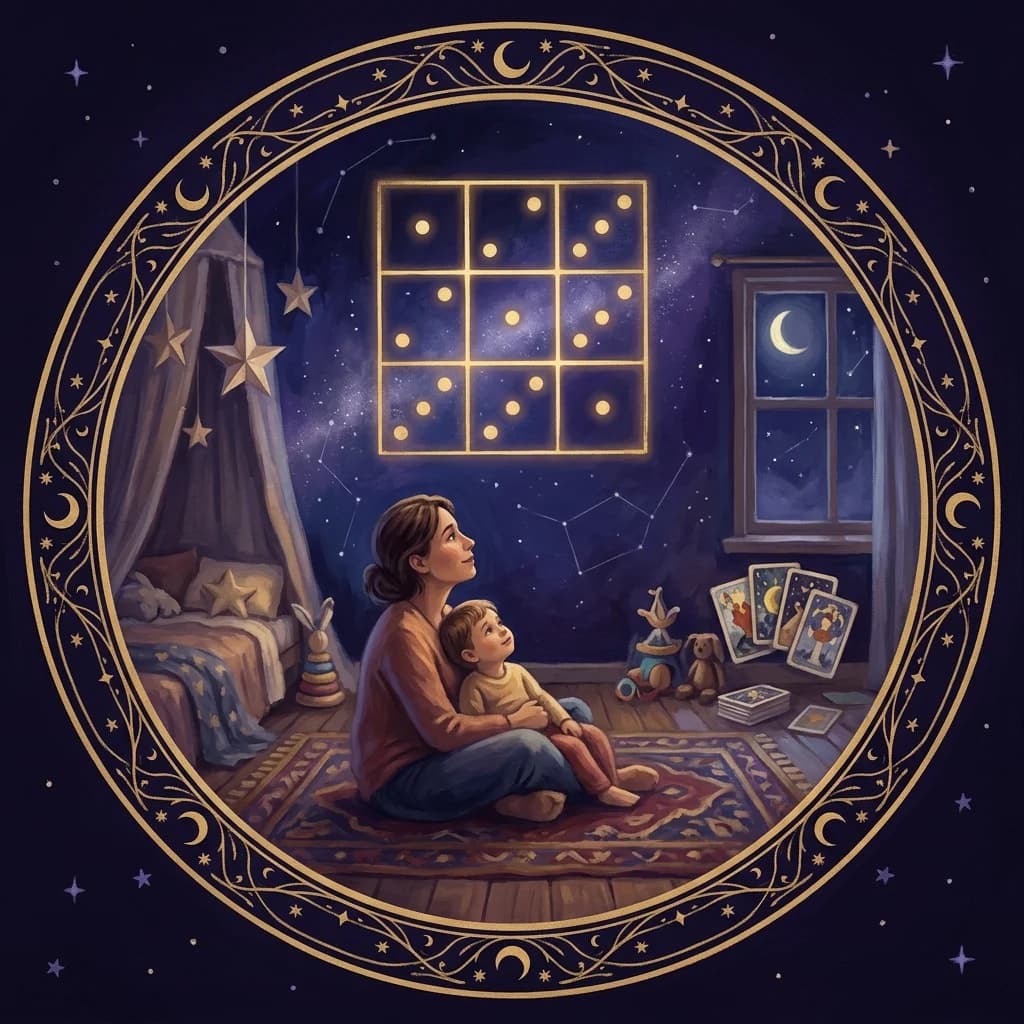
In the second cell of the sample square there are two 2s — the middle of the author’s scale. The model suggests looking not at a “reserve of energy,” but at rhythm: how the child enters an activity and at what point they want to stop.
Look at their numbers — and decide whether to go deeper.
When you want to go deeper
5.6 of 9 cells are filled on average for dates after 2010 — against 6.9 for dates in the 1960s–1980s.
The years of the new century carry zeros that don’t enter the grid, and the nine from “19…” no longer arrives. So empty cells in a child’s square are a norm of the calendar, not a sign that they “missed out” on something. The averages are counted over all dates of those years, not over people.
2025 · on average 5.9 filled cells; two and five are in every date, there’s never a negative difference.
2026 · on average 5.9 filled cells; two and six are in every date, there’s never a negative difference.
A birth date says nothing about a child’s health or development. If something worries you, that’s a question for a qualified specialist.
The reading doesn’t call a child a “leader,” “lazy” or “gifted.” It describes themes you can observe, ones that change with age.
The numbers don’t know which subjects will come easily or who the child will become. That grows from interest, practice and the support of adults.
The reading gives the parent questions; the answers are with the child. The best test of any guess is observation and a calm talk.
Enter the child's date in the form above: the four additional numbers and the grid appear at once, and the square is saved to the child, not to your profile. The formula is the same as for adults.
Repeats in a child's cells are read the same way as for adults, but the reading turns them into themes to observe: pace and recovery, ways of trying, activities and finishing.
For school kids and teens of the 2000s the third number sometimes comes from a negative difference; for toddlers of 2024–2026, never.
Tires, quits, goes quiet?
Enter your child’s birth date — and in a minute you’ll see what to watch for first.