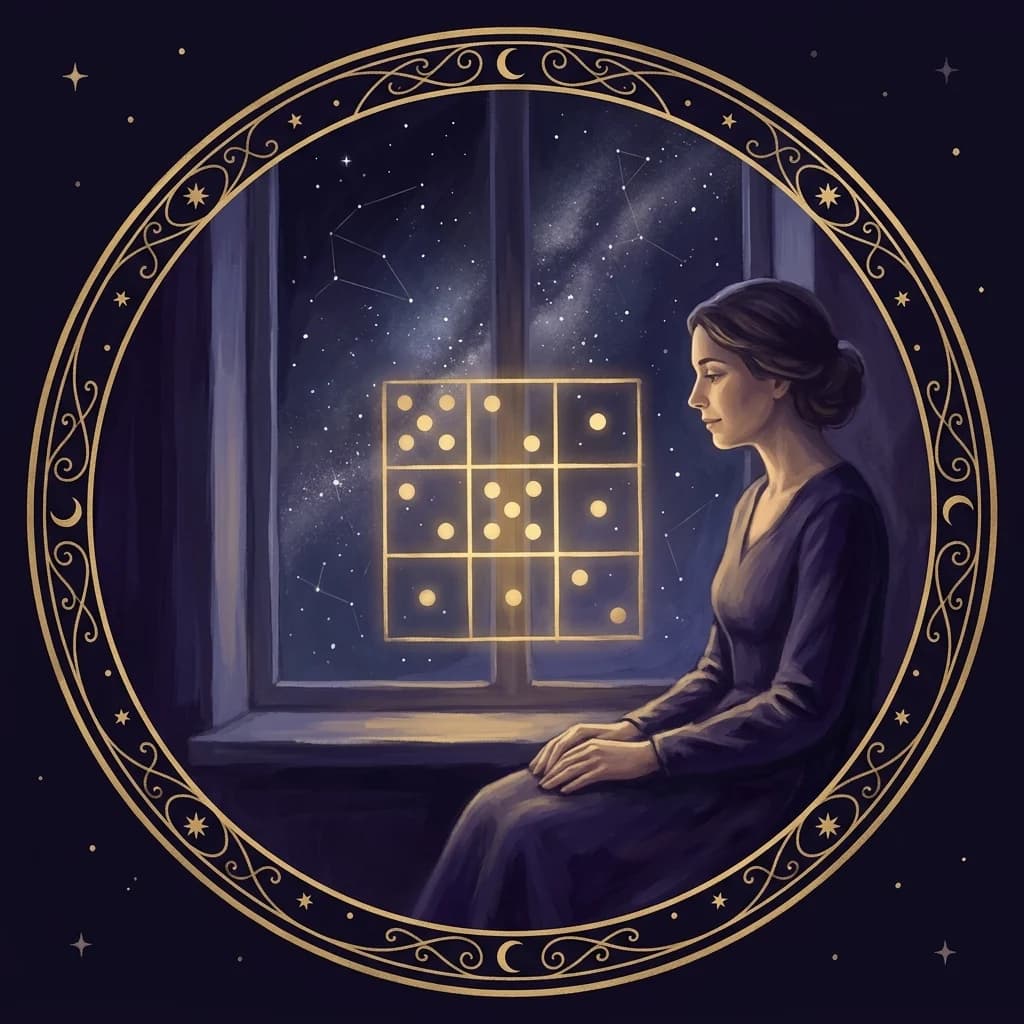
Do you start things and drop them halfway?
An idea catches fire fast, but the spark fades before the finish. Help from others can feel like interference.
Come back every day — +1 ⭐ for logging in.
On your 7th day in a row — +5 ⭐ and 30% off the subscription
Sign in to start your streak and earn ⭐
See your character in the numbers of your birth date
Some things flow on their own, others take real effort. The square shows where you’re full, where you’re empty and what to test this week.Where you’re full, where you’re empty — and what to test
I 30 · II 3 · III 24 · IV 6
Tap the one that feels closest: we’ll show where to look in the square and what to test in real life. It’s a sample route, not your result.
An idea catches fire fast, but the spark fades before the finish. Help from others can feel like interference.
Take one task for a week and note when you want to quit — before someone comments, or after.
The “Drive” situation leads into chapters "Boundaries and initiative" and "Responses to success and help" of the reading. Calculate your square — and the route opens on your own numbers.
From a birth date — four additional numbers and all the digits the grid is built from. You can check it on paper too. Enter your date — the steps recalculate.
Zeros don’t count. Tap a digit and I’ll show its cell.
Pick a digit in the row on the left
Tap a cell to see where its digits come from and how often that happens. Or build a line from three cells. For now — an example.
I’ll show what theme it is, where its digits came from in the date and how often that happens.
Look at your own numbers — and decide whether to go deeper.
When you want to go deeper
The Pythagorean Square, or psychomatrix, is a numerology table built from your birth date.
It shows the map of a date:
Not “who I really am,” but “what in my square is worth testing in real life.”
Each has its own theme. Look not at “good or bad,” but at where you’re full and where you’re empty.
A counter, not a grade: “1111” only means the digit 1 appeared four times.
A row, a column or a diagonal. The sum shows a whole theme, not a single cell.
The model reads the second number as a symbolic theme of choosing directions; the rest are part of the pool of digits.
Six themes gather cells and lines into questions you can check against experience.
«I entered my date — and it was like reading things I’d felt for ages but couldn’t put into words.»
«A skeptic, but the numbers matched who I am. The part about work and luck was spot on.»
«I ran it for my son — now I see his strengths and how to support him. Written so kindly.»
«I thought it’d be another templated filler. But it’s a living reading and you can ask more. Hooked.»
The same date always gives the same numbers. Every step of the calculation is shown on the page.
It’s Arcanika’s own system for self-observation, not a psychological test or a diagnosis.
The reading offers questions and observations. What of it is true about you — that’s yours to decide.
Each cell has its own theme — from “boundaries and initiative” to “learning and remembering”. What “111”, “2222” or an empty cell mean and how often that happens — on the page with the rarity map.
From “Response to feedback” to “Meaning and values”: each line has its own theme and sum, and which sums come up more often — on the lines page.
The formula doesn't change. For some dates at the start of decades the third number comes from a negative difference, and the calculator takes the absolute value.
One thing flows, another stalls?
Enter your birth date — and in a minute you’ll see where you’re full, where you’re empty and where to begin.