In short Three of Swords upright means heartbreak, separation, grief, betrayal. Reversed — lingering pain, confusion, chronic sorrow, slow healing.
Deep sorrow that comes from understanding, not from grievance. The Magus's sword cleaves the blue rose of peace: grief in which the mind grasps the dividedness of the world. Not personal pain, but cosmic — weltschmerz.
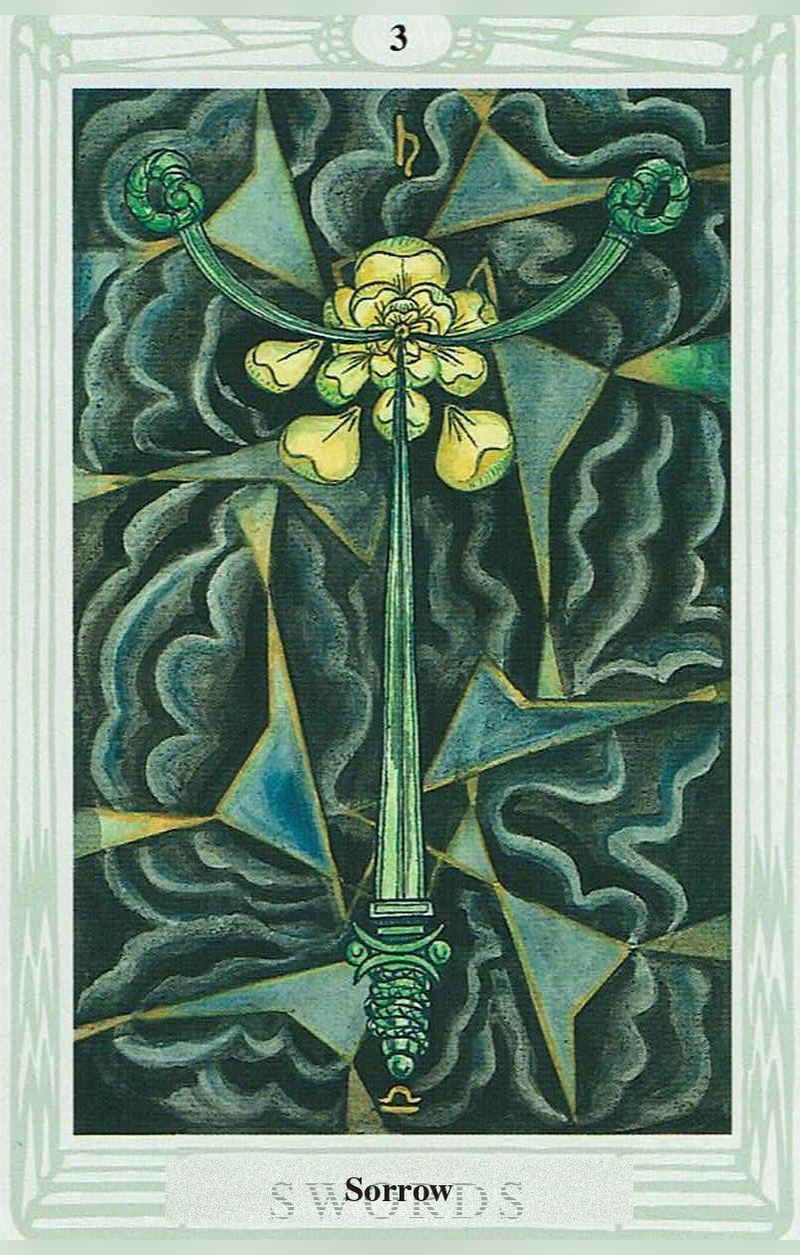
The great Sword of the Magus, point upward, cleaves the union of two shorter curved swords, and that blow destroys the rose — the very blue rose of peace from the Two. In the background, against an impenetrable night, a storm is forming. The card is dark and heavy, like the womb of Chaos: in it a vast, pent-up desire to create, yet its children are monsters. This is the sorrow of Isis, the darkness of the Great Sea.
🗡️Sword cleaving the rose — reason wounding feeling; bitter but honest recognition of truth
🥀Destroyed blue rose — the fragile peace of the Two is shattered by the understanding of dividedness
⛈️Storm in impenetrable night — nascent grief, the darkness of Chaos, the ache of existence itself
🌑Binah — darkness of the Sea — the Great Mother not as bright womb but as the sorrow of Isis
🪐Decan of Saturn in Libra — heaviness, limitation, and time; the painful recognition of shattered equilibrium
Interpretation
The Three of Swords corresponds to Binah in the element of Air and is called 'Sorrow.' Binah — the Great Mother, Understanding — governs Air here not as a benevolent Mother but as the darkness of the Great Sea, the grief of Isis. The idea of division and changeability reaches the quality of melancholy. But this is not a commonplace sorrow at someone's disappointment — it is weltschmerz, cosmic grief, the ache of existence itself.
In the logic of the number, the stability of the three in the suit of Swords marks the triumph of mind over emotion, and in the worst case — the tyranny of intellect. Hence painful decisions and the recognition of unpleasant truth. Waite foregrounds the pain of disappointment, disillusionment, a reasoned but bitter choice; this tradition carries the same message but with even greater emphasis on anxiety and sorrow.
In the upright position this is deep grief that comes from understanding, not from grievance: the mind grasps the dividedness and imperfection of the world; melancholy cleaves the illusion of peace. The moment when one must pass through pain and endure a crisis — a difficult decision, a conflict of mind and heart, news that wounds but is necessary.
Binah gives suffering the form of understanding: this is pain through which maturity is born. Sometimes — the necessity of passing through darkness in order to create something anew. Saturn adds heaviness, limitation, and time; Libra — the painful recognition of shattered equilibrium.
The sword of the Three destroys the blue rose of peace from the Two Two of Swords: fragile equilibrium gives way to sorrow. This is one of Binah's fruits — but where the Three of Cups Three of Cups brings love, the Swords bring the grief of division. The same line of the mind's deterioration leads to the 'Cruelty' of the Nine Nine of Swords — from cosmic grief to the agony of blades.
✦ Full InterpretationUnlock the card's full readingFree registration reveals the final paragraphs of the interpretation and gifts you ⭐ for your first spreadyour first spread is on us
Advice & forecast
✦ The card's advice
Do not flee from sorrow, and do not make theater of it: receive it as cosmic, not personal. Through Binah's darkness, maturity is born — the pain here is not punishment but a form of understanding in which the mind grasps what it had been hiding from itself. Allow the news or the loss to be given meaning, not merely felt. If a bitter but honest choice lies ahead — make it, without substituting self-pity for clarity. This is Saturnine time: let sorrow complete its work, let it ripen, and do not rush the way out.
🔮 What the forecast holds
A rupture, a loss, or a disappointment is coming — one that will need to be understood, not merely endured. The illusion of agreement will be cleaved by understanding: an unpleasant truth will be exposed, a conflict of mind and heart, a painful but necessary decision. This is a heavy card, but not hopeless — Binah gives suffering the form of maturity, and sometimes through darkness a new conception is born. The sorrow here runs as deep as existence itself, but it leads toward understanding, not into a dead end.
↓ Three of Swords reversed
Reversals are conditional in this tradition. The reversed Three is sorrow that has stagnated and turned: melancholy that does not purify but poisons; grief turned into self-pity or dark creativity whose 'children are monsters.' This is 'not the time' to let reason brutally overpower feeling, to make thoughtless sacrifices, or to resign oneself to bitter news before it has been digested. Refusal to accept a loss; the mind circling around its own wound. Or, at the highest reading, a painful but necessary breakthrough of sorrow toward new understanding. The reversal's counsel: do not make pain an idol and do not let it poison you; pass through it, rather than getting stuck.
The card in spreads
The same card reads differently depending on the spread and the question — compare real spreads:
Spread "How to endure a rupture"
Find meaning in a painful loss
«How can I pass through this pain?»
Heart of the pain
Three of Swords
What is dying away
Death
What lies ahead
The Star
The Three of Swords at the heart — this is the sorrow of understanding, not of grievance: the illusion of agreement has been cleaved by truth. What is dying away — Death: Death confirms that the former shape of the bond is finished, and clinging to it is pointless. What lies ahead — the Star: the Star promises quiet healing and hope after the darkness. Receive the grief as cosmic, let it ripen — through it, maturity is born.
Spread "Bitter truth"
Resolve to face honest recognition
«Is it worth learning what will wound me?»
What will be revealed
Three of Swords
What will be destroyed
Two of Swords
What will remain
Six of Swords
The Three of Swords — what will be revealed is a truth that wounds but is necessary; the sword of clarity will cleave a comfortable illusion. What will be destroyed — Two of Swords: the fragile peace of the Two, held together by things left unsaid. What will remain — Six of Swords — 'Science,' a sober and mature mind that has passed through pain to understanding. It is worth finding out: bitter recognition is harder than ignorance only at first, and then it sets you free.
✦ PremiumUnlock the Full ReadingSpread "Bitter truth": position-by-position reading, card combinations, and guidanceOpen with subscription →first spread is free
Spread "Sorrow without cause"
Understand the source of deep grief
«Why does my soul feel so heavy?»
Root of the grief
Three of Swords
What will guide you
The Hermit
Healing
Art
The Three of Swords at the root — your heaviness does not come from a personal slight but from understanding the dividedness of the world; it is Saturnine weltschmerz. What will guide you — the Hermit: the Hermit calls you to be alone with this darkness, not to drown it out. Healing Art — Art will reunite what was cleft, and transform sorrow into maturity. Do not make grief into theater: give it the form of understanding, and it will stop pressing down.
✦ PremiumUnlock the Full ReadingSpread "Sorrow without cause": position-by-position reading, card combinations, and guidanceOpen with subscription →first spread is free
How it differs from Waite
Rider-Waite-SmithThree of Swords
vs
Thoth TarotThree of Swords
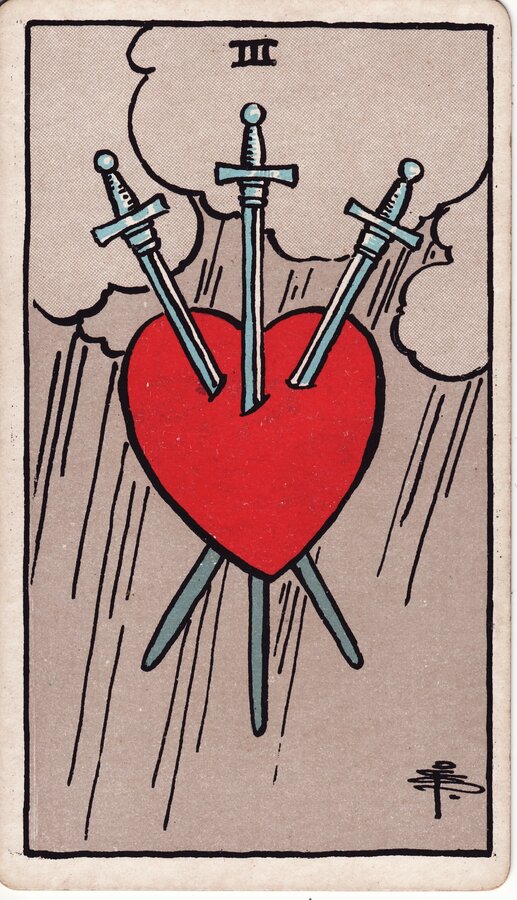
Here the two decks are unusually close. Waite's famous heart pierced by three swords, and this deck's rose cleft by a blade, are essentially about the same thing: reason wounding feeling, a bitter but honest recognition of truth. The difference is only in the weight of grief: Thoth places somewhat greater emphasis on anxiety and sorrow, on the Saturnine weltschmerz — grief that is not personal but cosmic. If Waite says 'I am in pain from disappointment,' this reading adds 'and this pain is part of the very structure of existence itself.'
WaiteThoth Tarot
ImageHeart pierced by three swords in the rain.Sword cleaving the blue rose of peace; storm in the night.
Nature of painPain of personal disappointment and disillusionment.The same pain plus cosmic sorrow, the weltschmerz of existence.
AgreementA bitter, rational, but necessary choice.The same meaning in all positions — only weightier.
Symbolism & correspondences
Saturn in Libra (second decan of Libra): Binah in the element of Air. Saturn gives heaviness, limitation, and time — Saturnine weltschmerz; Libra — the painful recognition of shattered equilibrium. Air darkened by grief.
Element
Air
◆
Arcana
Minor
Suit
Swords
Frequently asked: Three of Swords
What does the Three of Swords card mean?
The Three of Swords announces a wound that cannot be softened. Something has pierced through — a separation, a betrayal, a truth that reshapes everything after it.
What does the Three of Swords card mean reversed?
The wound from the upright card does not close cleanly — instead it becomes foggy, tangled, harder to name. The mind circles the hurt obsessively, preventing the very healing it seeks.
What does Three of Swords mean in love and relationships?
A relationship may be ending, or a truth about it has surfaced that cannot be unfelt. Someone chose differently, or distance — emotional or physical — has opened between hearts.
What does Three of Swords mean for work and money?
A dismissal, a demotion, or a professional betrayal lands with unexpected force. Plans you invested in may be cut short, or a colleague's actions bring disappointment.
What advice does the Three of Swords card give?
Let the heart be struck rather than armored. Clean pain passes; suppressed pain becomes chronic.
Ready to see how this card unfolds in your own reading?