In short Five of Swords upright means hollow victory, conflict, dishonor, domination. Reversed — reconciliation, remorse, aftermath, unresolved grief.
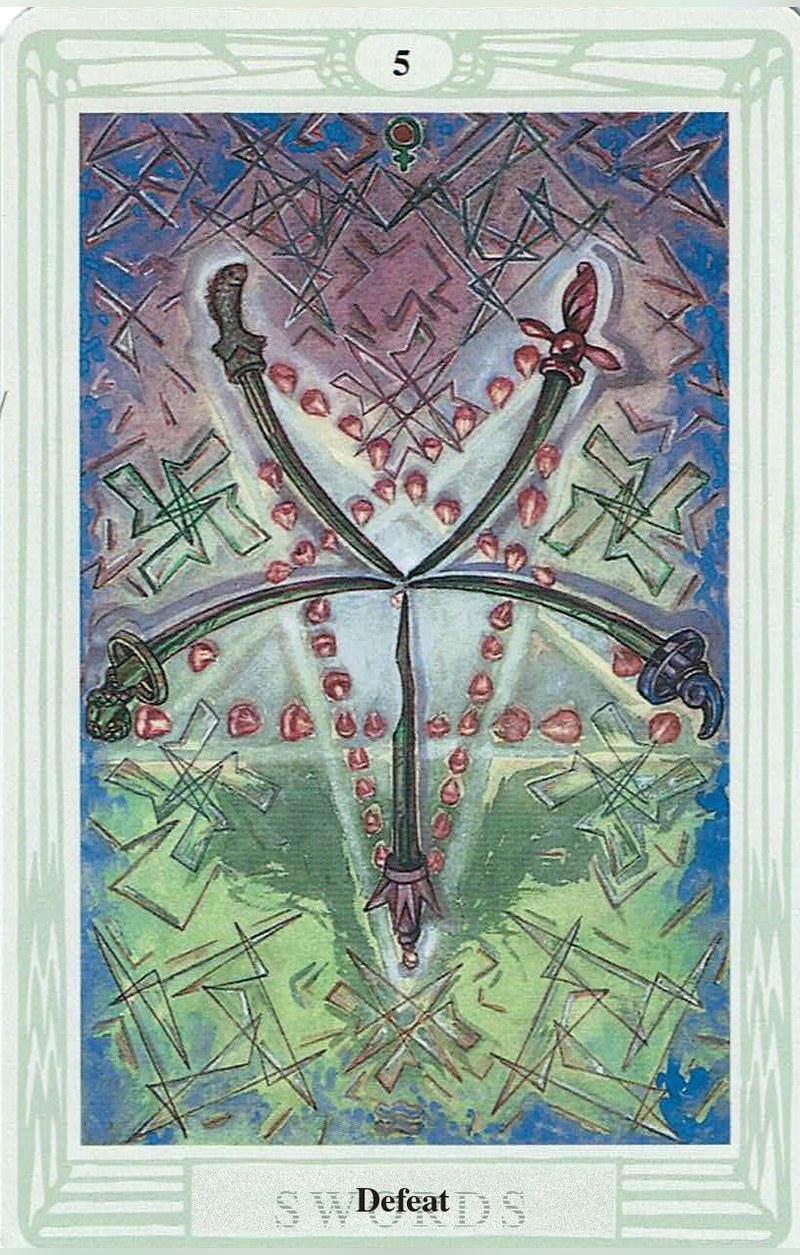
Defeat, loss, humiliation. The hilts of the swords form an inverted pentagram, the blades bent and notched, the rose gone. Collapse not from the strength of an opponent, but from inner weakness.
The hilts of five swords form an inverted pentagram — a symbol of sinister tendencies. Every hilt is different, every blade bent or notched: an impression of decay and dissolution. Only the lowest sword points upward, and it is the least reliable of the weapons. The rose that united and harmonized the blades in the previous cards has entirely disappeared — no harmony remains.
⛧Inverted pentagram of hilts — symbol of sinister tendencies, the rupture of Geburah in the world of mind
🗡️Bent and notched blades — decay, dissolution, heterogeneous and unreliable weaponry
🥀Vanished rose — no harmony or reconciliation remains at all
♀️Decan of Venus in Aquarius — a softening weakness in an air sign — defeat through pacifism
🜁Geburah in Air — rupture through weakness, not through excess of force; possibly betrayal
Interpretation
The Five of Swords corresponds to Geburah in the element of Air and is called 'Defeat.' Fives introduce the idea of motion that disturbs every stable system: storms and tensions arise. Geburah produces rupture, but here the cause of catastrophe is not an excess of force but weakness: Venus governs Aquarius in this decan. This is intellect weakened by sentimentality, defeat through pacifism; betrayal may also be implied.
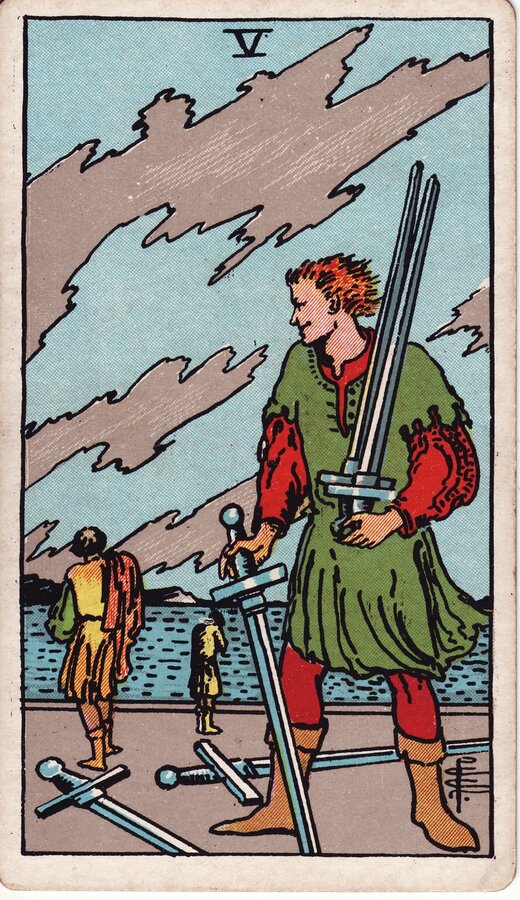
The Five of Swords is among the most unpleasant cards in the entire deck: the challenge and crisis of the number manifest in Swords as treachery, humiliation, pettiness, defeat, or betrayal. From the card alone one cannot tell whether you have been the victim or have yourself caused harm. In Waite the victor cannot enjoy the victory: it was gained dishonestly and at too high a cost.
This tradition adds an important turn: war and humiliation here are the natural consequence of an exaggerated drive for peace and the desire to avoid conflict at any cost. The armed peace of the Four did not hold, and its collapse means precisely defeat. This is a loss through inner weakness, not through the strength of an opponent; indecision, a will softened by feeling.
In the upright position this is a trap, the feeling of betrayal, an encounter with heartlessness and treachery, fear of shameful defeat. Dishonor, loss of position, the ruins of plans. A bitter counsel sounds here: conflict has become unavoidable, one can no longer evade the struggle — otherwise the cost of evasion will be even higher. Compliance born of weakness rather than generosity leads to rout.
The Four's armed peace Four of Swords could not be sustained — the Five is its collapse into quarrel. After defeat the mind, having passed through rupture, will restore its equilibrium in Tiphareth — in the 'Science' of the Six Six of Swords. The severe rupture of Geburah relates the card to the Tower the Tower.
✦ Full InterpretationUnlock the card's full readingFree registration reveals the final paragraphs of the interpretation and gifts you ⭐ for your first spreadyour first spread is on us
Advice & forecast
✦ The card's advice
Name the cause of the loss honestly: it lies in weakness, not in circumstances. Do not confuse generosity with capitulation — peace bought by abandoning the struggle turns into humiliation. If conflict has become unavoidable, stop evading it: the cost of further evasion is higher than the cost of confrontation. Gather the will where you previously gave way to feeling, and do not surrender your weapons out of false peaceableness. If defeat has already occurred — accept it soberly, without clinging to broken blades, and draw the lesson so that the weakness does not repeat itself.
🔮 What the forecast holds
Defeat, humiliation, or betrayal is coming if you do not gather your will. There may be a trap, an encounter with treachery and heartlessness, a loss of position — defeat not from the strength of an opponent but from your own indecision and feeling-softened will. The card warns: 'peace at any price' turns into war here. To turn the line, you will need to stop avoiding the inevitable and bring the dispute to a conclusion with firmness, not concessions. Otherwise the cost of evasion will only grow.
↓ Five of Swords reversed
Reversals are conditional in this tradition. The reversed Five may mean emerging from a string of defeats, recognition of one's own weakness as the first step toward correcting it — or a deepening of dissolution: prolonged decline, corrosion of spirit, the vengeful spite of the loser. This is 'not the time' to act from the shadows, to plot revenge, or to fall into blind destructive fury; sometimes — a defeat that has already occurred and which remains only to accept, so as not to cling to broken weaponry. The reversal's counsel: acknowledge the weakness honestly — that is the very first step away from defeat, whereas revenge only prolongs the dissolution.
The card in spreads
The same card reads differently depending on the spread and the question — compare real spreads:
Spread "Why I keep losing"
Find the true cause of defeat
«Why can I not win?»
Root of the loss
Five of Swords
The false path
Seven of Swords
What is needed
Knight of Swords
The Five of Swords at the root — you are losing not because of the strength of your opponent but because of inner weakness and the desire to avoid struggle at any cost. The false path Seven of Swords — 'Futility': half-measures and cunning instead of honest effort only multiply the defeat. What is needed — the Knight of Swords: the charge and resolve of the Knight of Swords, the readiness to bring the confrontation to its conclusion. Stop evading: conflict has become inevitable, and firmness is cheaper than capitulation.
Spread "Feeling of betrayal"
Sort out a bitter confrontation
«Was I betrayed, or am I myself to blame?»
Heart of the blow
Five of Swords
What is hidden
The Moon
The way out
Six of Swords
The Five of Swords at the heart — the feeling of treachery and dishonor; from the card alone one cannot tell whether you are the victim or the cause. What is hidden — the Moon: the Moon hints at deception, illusion, unclear motives — do not rush to judgment. The way out Six of Swords — 'Science,' a sober analysis without sentiment, will restore equilibrium. Name the weakness honestly and do not respond with revenge: it only deepens the dissolution.
✦ PremiumUnlock the Full ReadingSpread "Feeling of betrayal": position-by-position reading, card combinations, and guidanceOpen with subscription →first spread is free
Spread "After defeat"
Understand how to survive a loss
«What do I do now that I have lost?»
What happened
Five of Swords
The bottom
Ten of Swords
Recovery
The Star
The Five of Swords — defeat has occurred, no harmony remains, the rose is gone from the blades. The bottom Ten of Swords — 'Ruin' warns: if you keep fighting amid the wreckage, everything will end in complete destruction. Recovery the Star — the Star promises healing once you accept the loss rather than clinging to the fragments. Acknowledge the weakness, release the broken weapons — and the way out begins there.
✦ PremiumUnlock the Full ReadingSpread "After defeat": position-by-position reading, card combinations, and guidanceOpen with subscription →first spread is free
How it differs from Waite
Rider-Waite-SmithFive of Swords
vs
Thoth TarotFive of Swords
Both decks share the general tone — this is a card of defeat and dishonor — but they look from different angles. Waite more often places the observer on the side of the victim or witness: the victory in the picture is dishonest and bitter, the triumph empty. This deck gives a diagnosis of cause: defeat here is the price paid for excessive peaceableness, for the desire to avoid conflict at any cost; 'peace at any price' turns into war and humiliation. Hence the different practical emphasis: Waite hints 'do not repeat another's dishonest victory,' this reading — 'stop avoiding the inevitable confrontation.'
WaiteThoth Tarot
Point of viewThe side of the victim or witness of a dishonest victory.Diagnosis of cause: the price of excessive peaceableness.
Root of troubleVictory gained dishonestly and at too high a cost.Weakness and pacifism; collapse of the Four's fragile peace.
Practical emphasis'Do not repeat another's dishonest victory.''Stop avoiding the inevitable confrontation.'
Symbolism & correspondences
Venus in Aquarius (first decan of Aquarius): Geburah in the element of Air. Venus gives a softening weakness, Aquarius — an abstract air-mind; together — the defeat of a mind poisoned by sentiment. Air in decline.
Element
Air
◆
Arcana
Minor
Suit
Swords
Frequently asked: Five of Swords
What does the Five of Swords card mean?
The Five of Swords marks a conflict where even the winner walks away diminished. Victory has been seized through force or cunning, but at the cost of respect, alliance, or inner integrity.
What does the Five of Swords card mean reversed?
The reversed Five of Swords carries the full weight of what was broken — grief, finality, the funerary quiet after the battle has long ended. In its gentler expression it signals the possibility of reconciliation, a willingness to admit fault and return to the table.
What does Five of Swords mean in love and relationships?
A relationship has become a battleground of point-scoring and wounded pride. One partner may feel triumphant while the other withdraws in hurt silence.
What does Five of Swords mean for work and money?
Competition at work has turned sharp — someone is winning by undercutting, claiming credit, or outmaneuvering rather than excelling. A hollow professional victory may leave you isolated or distrusted by colleagues.
What advice does the Five of Swords card give?
Ask yourself honestly what you are actually fighting for. If winning costs you more than losing would, it is time to put the swords down.
Ready to see how this card unfolds in your own reading?